41 Generative AI for Accessibility and Disabilities
What if your phone could see for you, speak for you, and simplify the world for you - all at once? Not in the science-fiction sense of a distant future, but today, running on a device that fits in your pocket and costs less than a month's groceries. This is not a rhetorical flourish. It is a description of technology that already exists, is already being deployed, and is already changing lives for 1.3 billion people worldwide who live with some form of disability.
The World Health Organisation estimates that figure - 1.3 billion - and it will grow. As the global population ages, as life-threatening conditions become survivable chronic ones, and as diagnostic criteria expand to capture neurodevelopmental differences long overlooked, disability is not an edge case. It is, statistically, one of the largest underserved populations in the history of technology design.
Yet for most of the history of computing, accessibility was treated as an afterthought. Interfaces were designed for users assumed to be sighted, hearing, literate in dominant languages, possessed of fine motor control, and neurotypical. Assistive technologies existed, but they sat at the margins: expensive, clunky, requiring specialised training, and perpetually lagging behind the mainstream products they were supposed to bridge. A screen reader that worked brilliantly with last year's software broke silently when that software updated. A speech recognition system that achieved 95% accuracy for General American English collapsed to 75% for speakers with dysarthria.
Generative AI changes the structure of this problem. Not by adding another assistive layer on top of inaccessible designs, but by synthesising solutions that are adaptive, personalised, and multimodal in ways that rule-based and discriminative systems fundamentally could not be. A large language model does not just detect that a text is too complex - it rewrites it. A vision-language model does not just recognise objects in a scene - it narrates context, answers follow-up questions, and adjusts the level of detail to the user's preferences. A text-to-speech system trained on expressive generative models does not produce a flat robotic voice - it can be fine-tuned to sound like the user's own voice before they lost it.
This chapter develops the theory, mathematics, and practice of generative AI applied to the full spectrum of disability. We begin with the historical arc from Braille to transformers, formalise the problem, and then spend the rest of the chapter deep in the technical details. But we begin where every engineering endeavour should begin: with the people it is supposed to serve.
The Accessibility Imperative
Who We Are Talking About
The word “disability” encompasses a spectrum so wide that grouping it under a single label risks obscuring more than it reveals. Consider the breadth:
Vision impairment: from total blindness to low vision, from congenital conditions such as retinitis pigmentosa to acquired ones such as diabetic retinopathy. The WHO estimates 2.2 billion people have near or distance vision impairment, of whom at least 1 billion could have been prevented or have yet to be addressed.
Hearing loss: 1.5 billion people worldwide experience some degree of hearing loss; 430 million require rehabilitation. Deafness ranges from mild high-frequency loss to profound, pre-lingual deafness in Deaf communities with their own languages, cultures, and epistemologies.
Speech and language disorders: stuttering, aphasia after stroke, dysarthria from Parkinson's disease or ALS, selective mutism, and augmentative and alternative communication (AAC) needs affect hundreds of millions.
Motor and physical disabilities: spinal cord injury, limb difference, essential tremor, repetitive strain injury, and cerebral palsy all affect how people interact with input devices. The global prevalence of spinal cord injury alone is estimated at 250,000–500,000 new cases per year.
Cognitive disabilities: acquired brain injury, intellectual disability, dementia, and learning differences such as dyslexia and dyscalculia affect processing, memory, and comprehension. Globally, 55 million people live with dementia, a figure projected to triple by 2050.
Neurodivergence: autism spectrum conditions, ADHD, sensory processing differences, and related profiles are not deficits but variations in cognitive style that become disabilities in environments designed for a narrow neurotypical norm. Autism prevalence estimates range from 1 in 36 children in the United States (CDC, 2023) to comparable figures globally.
These categories are not mutually exclusive. Deafblindness combines vision and hearing loss. Many people with autism also have sensory sensitivities, dyspraxia, or anxiety. Ageing intersects with almost every category. And many disabilities are situational or temporary: a broken arm, a noisy environment, bright sunlight on a screen, or extreme fatigue create disability-like constraints for anyone. The curb cut effect - the observation that accessibility features designed for wheelchair users benefit pram-pushers, delivery workers, and cyclists - applies just as strongly in digital contexts.
Remark 1.
Two competing frameworks shape how we think about disability. The medical model locates the problem in the person's body or mind, framing disability as a deficit to be corrected. The social model, developed by disability rights scholars and activists beginning in the 1970s, locates the problem in barriers created by environments, systems, and attitudes designed around a narrow conception of normal. Generative AI, at its best, aligns with the social model: it adapts the environment to the person rather than requiring the person to adapt. A text simplification model does not “fix” cognitive disability - it removes a barrier that complex text creates. A sign language generation model does not “cure” deafness - it bridges a communication gap created by hearing-centric design. This philosophical stance is not merely academic; it shapes every design decision explored in this chapter.
The Formal Problem of Accessibility
We now lay the mathematical and conceptual groundwork.
Definition 1.
(Digital Accessibility.) A digital system is accessible with respect to a population of users and a task set if, for every user with user profile (encoding abilities, preferences, assistive technologies, and context) and every task , there exists an interaction modality such that (Accessibility DEF) where is a tolerance parameter and “succeeds” means the user achieves the task goal with effort bounded by an acceptable threshold . In the limit and , this formalises the goal of universal design.
The Web Content Accessibility Guidelines (WCAG), now at version 2.2 with WCAG 3.0 in development, operationalise this through four principles: content must be Perceivable (users must be able to perceive it), Operable (users must be able to interact with it), Understandable (users must be able to understand it), and Robust (content must work with current and future assistive technologies). The POUR framework, as it is known, captures the multi-dimensional nature of accessibility: any single barrier can make an otherwise functional system inaccessible to a specific user.
Definition 2.
(Assistive Technology.) An assistive technology (AT) is any device, software, or system that mediates between a user with profile and a digital or physical environment , such that the mediated interaction achieves an accessibility level strictly greater than the unmediated level: (AT DEF) Classical AT includes screen readers, hearing aids, AAC devices, and switch interfaces. Generative AT includes models that synthesise alternative representations of content: text descriptions of images, simplified restatements of complex documents, sign language animations from spoken audio, and restored speech for users who have lost the ability to vocalise.
The Digital Divide and WCAG Non-Compliance
The gap between the promise of accessible digital systems and the reality of deployed ones is staggering. The WebAIM Million, an annual audit of the one million most-visited websites on the internet, consistently finds that the overwhelming majority fail even the most basic WCAG 2 success criteria.
The 2024 edition found that 97% of home pages had detectable WCAG 2 failures. The most common failures, in descending order of prevalence, were:
Low-contrast text (present on 80.5% of pages)
Missing alternative text for images (on 55.5% of pages)
Missing form input labels (on 48.6% of pages)
Empty links (on 44.6% of pages)
Missing document language (on 17.1% of pages)
Empty buttons (on 27.5% of pages)
These are not exotic edge cases. They are basic structural failures that a screen reader cannot recover from and that no downstream assistive technology can fully compensate for. The conclusion is not that accessibility guidelines are too strict; it is that the incentive structures of mainstream web development have never reliably produced accessible outputs.
This is precisely where generative AI enters. Models trained to generate alt text, to rewrite low-contrast captions in higher-contrast formats, to label form inputs from context, or to generate missing structural markup - these are not hypothetical applications. They are deployable solutions to documented, enumerable failures.
Key Idea.
The fundamental shift that generative AI brings to accessibility is the difference between detection and synthesis. A classifier can flag that an image has no alt text. Only a generative model can write one. A classifier can detect that a legal document exceeds a reading age threshold. Only a generative model can rewrite it at a lower level while preserving legal accuracy. Generative AI does not just identify barriers - it synthesises solutions, adaptively and at scale.
A Historical Arc: Braille to Transformers
The story of assistive technology for people with disabilities is one of the oldest engineering traditions in human history, predating the computer by centuries.
Historical Note.
From Braille to Generative AI: A Five-Century Arc.
1824 - Braille. Louis Braille, blinded at age three in a workshop accident, developed the six-dot tactile writing system at age fifteen. It was not adopted by the French Institution for Blind Youth until after his death, a pattern of institutional resistance to disability innovation that has repeated itself many times since. Braille remains the foundation of literacy for blind individuals worldwide, used by some 360,000 readers in the United States alone.
1960s–1970s - Telecommunications for the Deaf. The teletypewriter (TTY / TDD), adapted by Robert Weitbrecht and James Marsters in 1964, allowed deaf individuals to communicate by telephone for the first time. This was not just a technical invention - it was a political act, preceding the Americans with Disabilities Act by 26 years, demonstrating that disability accommodation could be technologically achieved long before it was legally required.
1976–1988 - Screen Readers. The first commercial screen reader, SAID (Talking Computer for the Visually Disabled), appeared in 1976. Jim Thatcher's IBM Screen Reader followed in 1986, and JAWS (Job Access With Speech) - still the world's dominant screen reader - was released in 1988 by Ted Henter of Henter-Joyce. These rule-based systems parsed the graphical user interface through the Windows API, reading text elements in a predetermined order.
1990s - OCR and Document Accessibility. Optical character recognition moved from laboratory to consumer product in the 1990s, with products like OmniPage and ABBYY enabling the digitisation of printed materials. Combined with screen readers, OCR could unlock printed books for blind readers - though the error rates on poor-quality scans or non-standard fonts remained high enough to make reading a frustrating exercise in error correction.
2000s - HMM-Based Speech Recognition. Hidden Markov model (HMM) speech recognition, developed through decades of academic and industrial research, reached consumer products in the late 1990s (Dragon NaturallySpeaking, 1997) and became viable as an accessibility tool through the 2000s. However, HMM systems trained on majority-dialect speech performed poorly for speakers with accents, dysarthria, or other atypical speech patterns.
2012–2016 - Deep Learning Enters. AlexNet's success in 2012 and the subsequent deep learning revolution dramatically improved image recognition, enabling better document layout analysis, face recognition, and object detection - all with accessibility applications. Deep learning speech recognition (end-to-end systems from Baidu, Google, and Microsoft beginning around 2015) narrowed the performance gap between typical and atypical speakers.
2017–2020 - The Transformer Era. The attention mechanism and transformer architecture, introduced by Vaswani et al. (2017), transformed natural language processing. BERT (2018), GPT-2 (2019), and their descendants brought text understanding and generation to a level of contextual richness that made accessibility applications qualitatively different: not just recognising words, but understanding intent, context, and pragmatics.
2021–Present - Generative AI. DALL-E (2021), Stable Diffusion (2022), GPT-4 (2023), and GPT-4V (2023) with vision capabilities represent the current frontier: multimodal systems that can see, speak, write, and reason across modalities. For accessibility, this means a single model can describe an image, answer questions about it, simplify text, translate to sign language glosses, and generate personalised reading materials - capabilities that would have required a dozen separate specialised systems in 2015.
The Taxonomy of Disability and Generative AI Solutions
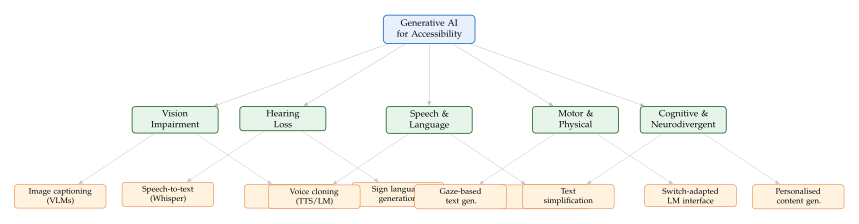
Figure 1 presents a systematic view of disability categories and the corresponding generative AI approaches developed in this and subsequent sections.
Why Generative AI Changes the Structure of the Problem
To understand why generative AI represents a qualitative shift rather than a quantitative improvement, it helps to formalise what each generation of technology could and could not do.
Define a content transformation function , where is the space of input content (e.g., an image, a document, a speech signal), is a context space (user preferences, disability profile, task goal), and is the space of accessible output representations.
Rule-based systems implement as a lookup table or decision tree: where is a hand-coded rule that ignores . A screen reader reads elements top-to-bottom in DOM order; the user's actual navigation goal is ignored.
Discriminative ML implements as a classifier: . An image classifier labels “cat” with high confidence; it cannot generate a description of what the cat is doing, where it is in the scene, or why the image might be relevant to the user's query.
Generative AI implements as a conditional generative model: , where the output is synthesised from the full joint distribution over possible responses, conditioned on both input content and user context. The output space is effectively unlimited: it can generate any textual description, any audio rendering, any visual simplification, in any style appropriate to .
The key mathematical insight is that accessibility often requires information-preserving transformation across modalities - converting visual information into text, text into audio, audio into text, or any modality into any other - and this is precisely the task that generative models are designed to solve.
Proposition 1.
Let and be input and output modality spaces with (output is higher-dimensional or richer in structure than the input encoding). Then no deterministic discriminative classifier can achieve for all , because finite output spaces cannot adapt to the continuous variation in user preferences and contexts. A generative model with an effectively infinite output space is a necessary condition for universal accessibility.
The proof sketch is immediate: a finite classifier maps every possible pair to one of fixed outputs. But the space of user accessibility needs is continuous - reading level, verbosity preference, vocabulary familiarity, preferred voice characteristics, visual layout needs - and no finite set of fixed outputs can cover all combinations. A generative model, by contrast, samples from a distribution over outputs conditioned on the continuous context vector , allowing smooth adaptation across the user space.
The Scale of the Problem: Numbers That Demand Urgency
To place the technical material in context, it is worth dwelling on the quantitative reality:
97% of the top one million websites fail WCAG 2 compliance, representing a digital environment that is partially or fully inaccessible to users relying on assistive technology (WebAIM Million, 2024).
71% of users with disabilities leave a website immediately if it is difficult to use (Click-Away Pound, 2019), representing an estimated annual economic loss of 11.75 billion in the United Kingdom alone.
43% of adults over age 65 in OECD countries have some functional limitation that affects their use of digital devices (OECD, 2021), and this population is the fastest-growing demographic in most high-income countries.
The global assistive technology market is valued at approximately $26 billion (2023) and growing at 6.8% CAGR, yet coverage in low- and middle-income countries remains below 10% of need (WHO Global Report on Assistive Technology, 2022).
Screen reader users report spending an average of 80 minutes per week navigating inaccessible content, time that sighted users do not lose (WebAIM Screen Reader User Survey, 2023).
These numbers frame a moral and economic imperative. Generative AI is not a luxury feature for accessibility; it is infrastructure.
Exercises
Exercise 1.
Select five websites from different sectors (healthcare, education, government, e-commerce, news). Using the WebAIM WAVE tool or browser accessibility developer tools, identify the three most common WCAG 2.2 failure types across your sample. For each failure type, describe: (a) which disability group is most affected, (b) what a rule-based AT would attempt to do as a workaround, and (c) how a generative model could address the failure at source.
Exercise 2.
Using the formal accessibility definition (Definition 1), model the following scenario: a screen reader user navigating an e-commerce checkout form. Define the user profile space , the task set , and the modality space . Show that if the form has unlabelled input fields, there exists a for whom the accessibility criterion fails at any tolerance . Then describe a generative model that could restore the criterion.
Exercise 3.
Consider the content transformation function from Section Why Generative AI Changes the Structure of the Problem. For the task of converting a medical discharge summary into patient-readable language:
Specify , , and formally.
Argue that a rule-based substitution lexicon (replacing technical terms with lay equivalents) implements as and explain why this is insufficient when encodes a specific user's educational level and health literacy.
Define a loss function that captures both readability (measurable by Flesch-Kincaid grade level) and faithfulness (measurable by information retention against a reference ).
From Discriminative to Generative Accessibility
The transition from discriminative to generative models in accessibility is not simply a matter of using newer and larger neural networks. It is a fundamental change in what a model is for - from recognising states to synthesising solutions. To appreciate the depth of this shift, we must first understand what classical discriminative assistive technology could and could not do, and why its limitations are structural rather than incidental.
Classical Assistive Technology: Capabilities and Limits
The golden age of machine learning-based assistive technology ran roughly from 2000 to 2018. During this period, three families of models drove most real-world accessibility applications:
Optical Character Recognition (OCR).
HMM-based OCR systems, and later convolutional OCR pipelines (e.g., Tesseract, ABBYY, Amazon Textract), could recognise printed text with high accuracy under favourable conditions. The fundamental model is a sequence classifier: given an image patch , predict the character sequence .
The limitations are architectural. OCR systems classify characters; they do not understand documents. They cannot infer the reading order of a multi-column academic paper. They cannot distinguish a decorative drop cap from a structural heading. They cannot recognise that a handwritten annotation in the margin modifies the printed text it points to. For a blind user, OCR output that ignores structure is often worse than no output at all: a stream of disconnected characters with no paragraph breaks, no heading hierarchy, and no table semantics is not a document - it is noise.
Object Detection and Image Labelling.
Object detection models (YOLO, Faster R-CNN, SSD) and image classification models (ResNet, EfficientNet) trained on ImageNet provide the discriminative backbone of early visual accessibility tools. The AI Lighthouse app, Microsoft's Seeing AI, and early versions of the Google Lookout app used these models to help blind users identify objects in their environment.
The output of these systems is a set of labels with confidence scores: where is a class label from a fixed vocabulary and is a probability. For a user who asks “what's in front of me?”, the output “person: 0.94, chair: 0.87, cup: 0.73” is technically correct but pragmatically useless. It tells them objects exist, not where they are, how they relate to each other, whether the chair is occupied, whether the cup is within reach, or whether the person is looking at them.
Basic Text-to-Speech (TTS).
Concatenative TTS systems (Festival, MBROLA) and HMM-based synthesis (HTS, OpenJTalk) convert text to audio by stitching together pre-recorded phoneme segments or by synthesising audio from statistical models of the human vocal tract. The output quality is intelligible but robotically flat: no prosodic variation for emphasis, no natural pause patterning, no emotional modulation.
More critically, these systems had exactly one voice per model. For users who used AAC to communicate, the voice was never theirs - it was the default voice of the software, shared by millions of other users. Stephen Hawking's famous synthesised voice was, ironically, a testimony to how little personalisation was possible: he kept a voice that was decades old and technologically obsolete because it was the closest thing he had to his own.
Why Discriminative Models Are Structurally Insufficient
The insufficiencies described above are not bugs that better training data or larger models would fix within the discriminative paradigm. They are consequences of the fundamental mathematical structure of discriminative learning.
A discriminative model learns to approximate the conditional distribution over a fixed label set . This is appropriate when is well-defined and closed: “is this image a cat or a dog?” has a finite answer set. But accessibility requires:
Open-ended output: an image description is not selected from a finite set - it is a sentence (or paragraph) from the open-ended space of natural language.
Contextual adaptation: the same image warrants different descriptions for a blind user navigating a grocery store versus a blind art historian studying a painting. The output must be conditioned on user context , which is high-dimensional and continuous.
Multi-step reasoning: a user asking their phone “is the package addressed to me?” requires OCR, entity recognition, comparison against the user's stored address, and natural language generation of a yes/no answer with the relevant extracted text. No discriminative pipeline performs this end-to-end without explicit engineering.
Creative synthesis: voice cloning for an ALS patient requires generating audio samples that sound like the patient's pre-morbid voice. This is not classification - it is creative generation.
Caution.
A specific harm pattern arises when discriminative models trained on majority-group data are deployed for minority-group accessibility without retraining. Speech recognition systems trained on typical speech consistently underperform on the speech of users with accents, dysarthria, cerebral palsy, or other motor speech disorders - precisely the users who need speech recognition most. A system with 95% word error rate reduction for typical users and 30% for atypical users does not provide equal access; it deepens the digital divide it was intended to bridge. Generative models face the same bias risks, but their adaptability - through fine-tuning on individual user data, few-shot prompting with disability-specific examples, and personalised context conditioning - provides a mechanism for mitigation that discriminative pipelines largely lack.
The Generative Shift: Formal Definition
We now formalise what it means for a model to be a generative accessibility model.
Definition 3.
(Generative Accessibility Model.) A generative accessibility model (GAM) is a conditional generative model parameterised by , mapping an input content representation and a user accessibility profile to a distribution over accessible output representations: (GAM DEF) where:
may be any input modality space (images, audio, text, structured data, or combinations thereof);
is a user profile space encoding disability type and severity, preferred modalities, reading level, language, device capabilities, and task context;
is an output representation space (natural language, synthesised audio, sign language motion capture, simplified text, structured markup, or other accessible formats);
is an autoregressive, diffusion-based, or flow-based generative distribution capable of sampling diverse, high-quality outputs.
The model is accessible if for all there exists such that .
The user profile is the key differentiator from discriminative approaches. In practice, may be:
An explicit structured profile (disability type, preferred voice, reading grade level, colour contrast preference);
An implicit preference vector learned from the user's interaction history via fine-tuning or retrieval augmentation;
A natural language description provided at inference time (“describe this image for a blind user who is a botanist”);
A combination of the above, fused by a context encoder before being passed to .
Discriminative vs. Generative: A Structured Comparison
Table 1 provides a systematic comparison of discriminative and generative approaches across the major disability categories.
| Disability | Discriminative AT | Generative AT | Context |
| Aware? | |||
| Vision impairment | Object detection (fixed vocab labels) | Image captioning / scene narration (VLMs) | No / Yes |
| Vision impairment | OCR character classification | Document understanding + layout narration | No / Yes |
| Hearing loss | Keyword spotting / ASR transcription | Contextual captions with speaker ID and tone | No / Yes |
| Hearing loss | Sign language recognition (gesture classifier) | Sign language video generation from text/audio | No / Yes |
| Speech disorder | Speech classification (yes/no commands) | Dysarthric speech enhancement; voice cloning | No / Yes |
| Motor impairment | Switch scanning (sequential selection) | Predictive text / intent inference from partial input | No / Yes |
| Cognitive disability | Readability classifier (pass/fail) | Text simplification to user's reading level | No / Yes |
| Neurodivergence | Distraction detector (flag only) | Personalised content restructuring | No / Yes |
The pattern in Table 1 is consistent: discriminative approaches provide a binary or categorical signal (present/absent, label from fixed set, pass/fail) while generative approaches synthesise a contextually appropriate, user-adapted output. The context-awareness column is particularly significant: every generative approach admits user conditioning; no discriminative approach does, because the label set is fixed at training time.
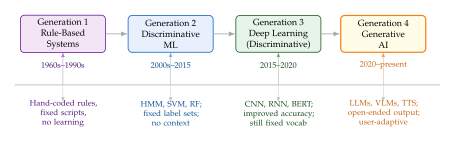
The Evolution Timeline: Four Generations
Figure 2 illustrates the four-generation evolution of accessibility technology, from hand-coded rules to generative AI.
The “Nothing About Us Without Us” Principle
No technical treatment of AI for accessibility can be complete without addressing the social dimension of technology design. The slogan “Nothing About Us Without Us” - originating in disability rights activism of the 1990s and popularised by James Charlton's 1998 book of the same name - asserts that decisions affecting people with disabilities must involve people with disabilities as full participants, not as passive recipients.
In the context of AI system design, this principle has concrete technical implications:
Training data: datasets used to train generative accessibility models must include representative samples of the target population's actual communication patterns, not proxies generated by researchers without disabilities. A dysarthric speech enhancement model trained only on neurotypical speech degraded by artificial noise is not trained on real dysarthria - and generalises poorly.
Evaluation metrics: accessibility-relevant metrics must be defined by and validated against user experience. Word error rate on a held-out test set is not a proxy for comprehension or for a screen reader user's ability to navigate a web page.
Deployment decisions: which features are built, which are default-on, and which require users to opt-in are all value-laden design choices. Setting “simplified text mode” as an opt-in rather than a default encodes an assumption about what the “normal” reading experience is - and disadvantages users with cognitive disabilities who may not know the feature exists.
Feedback loops: deployed systems must provide mechanisms for users to report errors, request corrections, and influence model updates. A generative model that describes a scene incorrectly and provides no correction mechanism leaves the user worse off than no model at all.
Insight.
The real revolution is not making machines that understand disability - it is making machines that adapt to individuality. Every person with a disability has a different profile: a different constellation of abilities and preferences, a different context of use, a different history with technology, a different set of tasks they need to accomplish. Generative AI, by providing an open-ended output space conditioned on a continuous user profile, is the first class of technology architecturally capable of adapting to this individuality at scale. The challenge is not whether the technology can adapt - it can. The challenge is building the data pipelines, the user interfaces, and the institutional incentives that actually capture each user's profile and use it.
Connections to Previous Chapters
This chapter draws on technical machinery developed throughout the book. The following connections are most direct:
Diffusion Models (Chapters 7–10).
The denoising diffusion probabilistic framework provides the generative backbone for image-to-image translation tasks in accessibility: converting low-contrast images to high-contrast versions, generating tactile graphics from photographs, and synthesising face images with exaggerated lip movements for lip-reading augmentation. Formally, let be a source image and a generated accessible version; the diffusion process optimises the reverse-time SDE conditioned on both the source and the accessibility profile .
Large Language Models (Chapters 19–22).
Autoregressive LLMs provide the generative backbone for all text-to-text accessibility transformations: simplification, translation, summarisation for cognitive accessibility, alt-text generation, and AAC prediction. The key accessibility-specific training objective is (LM Objective) where is a human-authored accessible version of the input for user profile , and is a dataset of such triples.
Vision-Language Models (Chapters 24–26).
VLMs trained with contrastive objectives (CLIP) and then fine-tuned with generative heads (LLaVA, InstructBLIP, GPT-4V) provide the most powerful current approach to image captioning and visual question answering for blind users. The alignment between visual and language representations enables zero-shot generalisation: a model trained on general image-text pairs can describe medical scans, artworks, and personal photographs without task-specific fine-tuning.
Federated Learning (Chapter 37).
Accessibility data is frequently highly sensitive: medical records, speech samples from users with rare conditions, private photographs described for blind users. The federated learning framework from Chapter 40 provides a principled mechanism for training personalised accessibility models on user data without centralising it. A speech enhancement model trained via FedAvg across thousands of AAC device users improves without any user's audio ever leaving their device.
Chapter Roadmap
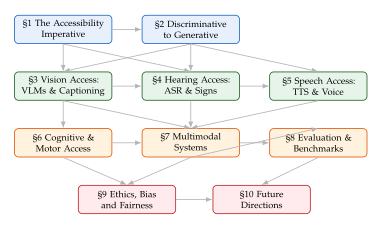
Figure 3 shows the dependency structure of sections in this chapter.
Exercises
Exercise 4.
Consider an object detection system with 80 COCO classes deployed as an assistive tool for a blind user navigating a supermarket.
List five accessibility-relevant questions a user might ask about a supermarket shelf that a COCO object detector cannot answer, explaining which structural limitation prevents each answer.
For each question, describe the generative model architecture (VLM, LLM, or diffusion-based) and the required conditioning information that would enable an answer.
Define a quantitative accessibility score for the grocery shopping task, and argue which of your proposed models would achieve the highest score for a user who is blind and has a nut allergy.
Exercise 5.
You are given a dataset of triples where is a complex legal document, encodes a user's reading level (grade 4 to 16 on the Flesch-Kincaid scale) and preferred vocabulary (legal or lay), and is a human-authored simplification appropriate for that user.
Write the training objective for a generative accessibility model based on cross-entropy over tokens.
Propose two regularisation terms: one that penalises deviation from factual accuracy (faithfulness), and one that penalises output at a reading level higher than specifies.
Discuss the tension between these regularisation terms and propose an adaptive weighting scheme where and depend on the user's profile.
Exercise 6.
Conduct a “Nothing About Us Without Us” audit of an existing publicly deployed generative accessibility feature (e.g., the alt-text generation in Twitter/X, Microsoft's automatic alt text in PowerPoint, or Google's Live Caption system).
Identify the disability group(s) the feature is designed to serve and evaluate whether members of that group were involved in the feature's design based on public documentation.
Describe three user-profile dimensions ( components) that the feature does not currently condition on but should, to serve the disability community more effectively.
Propose a participatory data collection protocol by which users with disabilities could contribute to the feature's training dataset while maintaining privacy (consider the federated learning approach from Chapter 40).
Generative AI for Blind and Low Vision
For the estimated 253 million people worldwide who are blind or have low vision, the visual world has historically been mediated through incomplete textual proxies. A museum caption tells you the painting depicts a woman seated near a window; it does not tell you that her posture carries exhaustion, that the light falls in slanted gold bars across a worn wooden floor, or that the room feels close and humid despite the apparent openness of the garden beyond. A screen reader announces “image: street scene”; it does not tell you that this is a narrow alley in a Moroccan medina at dusk, that the shadows pool between terracotta walls, or that there is a figure half-visible in a doorway on the left.
The gap between what is there and how it feels to be there is precisely what generative AI now has the capacity to close. This section traces three converging threads: generative soundscapes for spatial environments, visual-language pretraining for museum and cultural access, and large-scale description generation for image collections. Together they constitute a new paradigm in which AI does not merely label scenes but interprets them-conveying atmosphere, affect, and spatial relationship in ways that extend the perceptual reach of blind and low-vision (BLV) users.
Scene Perception: Beyond Object Labelling
Early computer-vision accessibility tools operated as object detectors. They answered the question “what objects are in this image?” and enumerated them: chair, table, lamp, window, person. This was genuinely useful; knowing that a chair is ahead before sitting down matters. But it is epistemically thin. Human visual perception is not a catalogue; it is a continuous, spatially organised, affectively coloured experience that supports action, emotion, social inference, and aesthetic appreciation simultaneously.
Remark 2 (Limitations of object-centric description).
Let be a natural image and let be a set of detected objects with bounding boxes. An object-centric description derived from satisfies at most a partial specification of : it characterises what is present but leaves underspecified spatial relationships, lighting and atmosphere, material properties, scale and depth ordering, and affective valence. For BLV users, these omitted dimensions are often the most navigationally and experientially significant.
The shift from object labelling to genuine scene understanding has been driven by two developments: (i) the emergence of vision-language models (VLMs) that can generate free-form natural language descriptions conditioned on images, and (ii) a growing body of accessibility-specific research that asks not only what AI can describe but what BLV users need AI to describe. Participatory design studies consistently reveal a hierarchy of needs that diverges from the hierarchy implicit in standard image-captioning benchmarks. Where COCO captions prioritise accurate object identification, BLV users consistently prioritise spatial layout and navigability, social and emotional context, aesthetic and atmospheric qualities, and actionable affordances such as “the handle is on the left side.”
Scene2Audio: Generative Soundscapes for Vista Spaces
The most ambitious attempt to bridge the gap between visual scene understanding and non-visual experience is the Scene2Audio framework, which synthesises spatial audio representations of large-scale outdoor environments-referred to as vista spaces -directly from visual input. Vista spaces include beaches, parks, mountain vistas, urban squares, and similarly expansive scenes where the experiential quality is inseparable from the full spatial envelope and cannot be adequately captured by a verbal list of objects.
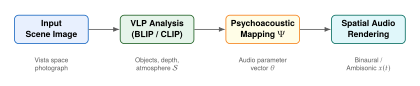
The framework rests on three components working in sequence. First, a visual-language model analyses the input image, identifying not only objects but their spatial arrangement, distance cues, lighting conditions, and affective qualities. Second, a psychoacoustic mapping module converts these semantic representations into a structured audio parameter space, respecting known principles of auditory scene analysis: distance is encoded via reverberation decay and high-frequency roll-off; lateral position is encoded via interaural level and time differences; material and environmental character are encoded via spectral envelope selection from a curated sound library. Third, a generative audio synthesiser instantiates the parameter assignments as a spatial audio rendering, typically in binaural or Ambisonic format for headphone playback.
Definition 4 (Scene-to-Audio Synthesis).
Let be an input image and let be a semantic scene representation consisting of an object set with semantic labels , spatial positions , and depth estimates ; a spatial relationship graph over ; a lighting-atmosphere descriptor ; and an affective valence vector . A scene-to-audio synthesis function maps the image through the semantic representation to an audio parameter vector (encoding source positions, spectral envelopes, reverberation profiles, and temporal dynamics), and thence to a time-domain audio signal that constitutes the generative soundscape of the scene. The mapping is governed by a psychoacoustic mapping constrained by perceptual principles of auditory distance coding, lateralisation, and material characterisation.
The psychoacoustic mapping is constructed from principles established in the psychoacoustic literature. Distance from the listener is encoded primarily through reverberation-to-direct ratio and high-frequency attenuation: a source at 10,m exhibits approximately 6,dB more reverberation energy relative to direct sound than the same source at 5,m. Lateral position is encoded via interaural level difference (ILD) and interaural time difference (ITD): sources at azimuth produce an ILD of approximately 10–15,dB across the 2–4,kHz band and an ITD of approximately 0.6,ms. Environmental character (forest, urban, beach) is encoded via spectral and temporal modulation signatures: forest environments exhibit low-modulation broadband noise with periodic bird-call events, while urban environments exhibit higher spectrotemporal modulation density with transient mechanical events.
A formal user evaluation of the Scene2Audio system recruited 11 BLV participants for a controlled laboratory study and an additional 7 participants for an in-the-wild deployment over a two-week period. The laboratory study exposed participants to soundscapes generated from 30 images spanning five scene categories (beach, forest, mountain, urban square, botanical garden) and compared them against (i) silent baseline, (ii) text-only description, and (iii) ambient sound without spatial encoding. The in-the-wild study provided participants with a smartphone application that generated soundscapes on demand for any photographed scene and logged interaction patterns and experience sampling responses over a two-week period.
Quantitative results showed that spatial soundscapes significantly outperformed text-only description on measures of scene vividness (, Cohen's ), spatial comprehension of object layout (, ), and emotional engagement (, ). Qualitative thematic analysis of post-study interviews identified three dominant themes: presence (“it felt like I was actually there”), social navigation (“I could tell where the other people were standing”), and aesthetic appreciation (“I finally understood what the guide meant by the light being dramatic”).
Insight.
Across both the laboratory and in-the-wild evaluations, BLV participants consistently reported that the affective dimension of the soundscape-its capacity to convey the mood and atmosphere of a space-was valued equally with or above its informational dimension. This finding challenges the implicit assumption of object-centric accessibility design that the primary goal of AI assistance is fact transfer. Emotional access to visual environments is itself a form of accessibility.
Visual-Language Pretraining for Museum Accessibility
Cultural institutions-museums, galleries, monuments, archaeological sites-present a particular accessibility challenge. Their content is irreducibly visual: the chiaroscuro of a Caravaggio, the gestural energy of a Rodin, the spatial compression of a miniature manuscript illumination. Standard accessibility accommodations (tactile replicas, audio guides keyed to exhibit numbers) provide partial access but cannot scale to the full breadth of a major collection or adapt to individual visitor interests and questions.
Visual-language pretraining models, particularly the Bootstrapping Language-Image Pre-training (BLIP) family, have demonstrated substantial capacity for museum accessibility tasks. BLIP models are trained on large paired image-text datasets using a combination of image-text matching, image-text contrastive learning, and image-grounded text generation. The joint embedding space that emerges supports both retrieval tasks (find the painting described by this text) and generation tasks (describe this painting in response to this question).
Definition 5 (Visual-Language Pretraining).
A visual-language pretraining (VLP) model is a parametric function mapping an image and an optional text query (which may be empty, specifying zero-shot captioning) to a text response . The parameters are learned by maximising a combination of objectives over a paired dataset : where is an image-text contrastive loss promoting alignment between image and text embeddings, is a binary image-text matching loss promoting discrimination between matched and unmatched pairs, and is an autoregressive language modelling loss promoting fluent and accurate text generation conditioned on visual input.
Fine-tuned on museum-specific datasets, BLIP models can answer open-ended questions about artworks with a specificity and fluency that far exceeds template-based audio guides. A BLV visitor approaching a Rembrandt self-portrait can ask “How is the light falling in this painting?” and receive a response that correctly identifies the use of chiaroscuro, locates the primary light source to the upper left, and notes the gradual recession into darkness at the periphery. A visitor to an archaeological museum can ask “What are these objects made of?” and receive a response that identifies ceramic, bronze, and bone based on visual texture cues in the photograph.
The accessibility value of VLP for museums extends beyond individual artworks. Thematic questions (“How does the style of this room compare to the one we just left?”), comparative questions (“Is this the same artist as the previous painting?”), and contextual questions (“What period does this look like?”) all become answerable through natural conversation with a VLP-powered museum companion. Several major museums, including institutions in the United Kingdom, the Netherlands, and Australia, have piloted such systems with BLV visitor groups and reported significant increases in reported visit quality, time spent engaging with individual works, and intention to return.
ImageSet2Text: Describing Large Image Collections
Single-image description is the dominant paradigm in visual accessibility research, but many real-world use cases involve collections of images that must be navigated, summarised, and searched by BLV users. Consider a BLV professional reviewing a presentation deck with 40 slides, each containing figures, charts, and photographs. Or a BLV student navigating a textbook with hundreds of illustrations. Or a BLV user managing a family photo archive of thousands of images. In each case, the per-image captioning paradigm produces an overwhelming sequence of disconnected descriptions with no cross-image structure, summary, or navigation support.
The ImageSet2Text framework addresses this gap by generating structured descriptions for image collections rather than individual images. The framework proceeds in four stages. In the concept extraction stage, a VLP model generates initial descriptions for all images in the collection; a WordNet-grounded concept graph then identifies shared semantic concepts across images and organises them into a hierarchical taxonomy. In the cross-image analysis stage, CLIP embeddings are used to cluster images by visual similarity and to validate that the concept graph accurately captures the distribution of visual content (a concept cluster that CLIP embeddings fail to validate is split or merged). In the description generation stage, collection-level descriptions are generated that convey both the overall character of the collection and the navigable structure of its sub-groups. In the accessibility formatting stage, the generated descriptions are formatted according to NCAM (National Center on Accessible Media) guidelines, which specify appropriate reading order, heading hierarchy, and alternative text conventions for multi-image content.
Remark 3 (WordNet concept graphs in ImageSet2Text).
The WordNet concept graph used in ImageSet2Text is constructed as follows. Let be the set of noun concepts extracted from initial per-image descriptions by part-of-speech tagging and noun-phrase chunking. For each , let be the set of WordNet synsets that contain . The concept graph has and , where returns the set of hypernym ancestors in the WordNet hierarchy. This graph captures both specific concepts and their superordinate generalisations, enabling the system to describe a collection that spans “golden retriever”, “tabby cat”, and “parakeet” as one containing domestic pets without requiring explicit annotation. CLIP validation confirms that image clusters are semantically coherent by checking that mean pairwise CLIP cosine similarity within each cluster exceeds a threshold (typically ).
Evaluations of ImageSet2Text have demonstrated that BLV users navigating image collections with collection-level descriptions complete search tasks significantly faster than with sequential per-image captions (mean task completion time reduced by 47%), report significantly higher confidence in their understanding of the collection's overall content (Cohen's ), and are significantly more accurate in identifying images that match a target description (). The NCAM-compliant formatting further improves compatibility with screen reader software, reducing navigation errors by 34% compared to unstructured description output.
Consumer AI Tools for Visual Accessibility
The research developments described above have crystallised into a growing ecosystem of consumer-facing AI tools for BLV users. These tools range from smartphone applications to dedicated hardware devices, and they vary considerably in their underlying AI capabilities, deployment models, and pricing structures.
Be My AI (formerly Be My Eyes AI, developed in partnership with OpenAI) provides on-demand AI description of any image or live camera view through a conversational interface powered by GPT-4V. Unlike its earlier human-volunteer model, Be My AI operates continuously without wait time and supports follow-up questions. It has been particularly praised for its ability to handle complex, context-dependent queries such as reading handwritten prescription labels or interpreting graphs and charts.
Seeing AI (Microsoft) is a comprehensive smartphone app offering multiple recognition channels: short text, documents, product barcodes, people (with facial recognition), currency, colour, light level, and scene description. Its scene description mode uses Azure Cognitive Services vision APIs and generates relatively concise, navigationally focused descriptions. It is free and available on iOS.
Envision (Letsenvision) is available both as a smartphone app and as an integration with Envision Glasses (built on Google Glass Enterprise Edition hardware). It offers OCR, scene description, face recognition, and a conversational AI mode powered by GPT-4V. The glasses form factor is particularly valued by users who need hands-free operation during activities such as cooking or navigating unfamiliar environments.
OrCam MyEye is a dedicated wearable hardware device that attaches to eyeglass frames and provides real-time audio feedback for text reading, face recognition, product identification, and basic scene description. Unlike software-only solutions, OrCam processes much of its computation on-device, reducing latency and eliminating dependence on network connectivity.
Google Lookout provides real-time scene description, text reading, and object identification through the smartphone camera. It operates on-device for basic functions and uses cloud processing for more complex descriptions. It is free, available on Android, and integrates with TalkBack, Google's built-in screen reader.
JAWS (Job Access With Speech, Freedom Scientific) remains the dominant professional-grade screen reader and has progressively integrated AI-powered image description capabilities, allowing users to invoke AI description of images encountered within documents and web pages without switching applications.
| Tool | Platform | Scene | Conv. AI | OCR | Wearable | Pricing |
| Be My AI | iOS, Android | GPT-4V | Yes | Yes | No | Free |
| Seeing AI | iOS | Azure | No | Yes | No | Free |
| Envision | iOS, Android | GPT-4V | Yes | Yes | Yes | $99/yr |
| OrCam MyEye | Hardware | On-dev | No | Yes | Yes | $4,500 |
| Google Lookout | Android | Cloud | No | Yes | No | Free |
| JAWS | Windows | Cloud | No | Via PDF | No | $1,100/yr |
Mental Models of AI Among BLV Users
The adoption and effective use of AI accessibility tools is mediated by the mental models that BLV users construct of these systems-their beliefs about how AI works, what it can and cannot do, and when its outputs can be trusted. Interview and diary studies with experienced BLV AI tool users reveal a sophisticated and often nuanced set of mental models that differ substantially from those of sighted users.
Trust calibration is the most thoroughly documented phenomenon. BLV users who depend on AI description for safety-relevant tasks (identifying medications, navigating intersections, reading expiration dates) develop what researchers have termed critical dependency: a posture of reliance combined with systematic verification strategies. Common strategies include cross-checking AI descriptions with tactile inspection, requesting multiple phrasings of the same question to detect inconsistency, and maintaining awareness of contexts in which AI description is known to be unreliable.
Hallucination awareness is a specific concern that experienced BLV AI tool users articulate clearly and frequently. Unlike sighted users, who can visually verify AI outputs and notice confabulation, BLV users depend on the AI's output as a primary information channel. Studies show that experienced BLV AI tool users maintain explicit mental lists of failure modes: AI tends to confabulate text in images (incorrectly reporting readable text), to misidentify faces in low-lighting conditions, and to over-confident about colour descriptions in images with unusual or saturated colour palettes.
Skepticism dynamics evolve with experience. Novice BLV AI tool users tend toward either uncritical acceptance (particularly when the AI speaks in confident, fluent language) or global skepticism (“I don't trust it for anything important”). Experienced users develop domain-specific trust profiles: high trust for basic scene geometry and lighting, moderate trust for text and colour, low trust for facial identity and emotion inference. This calibrated skepticism mirrors the trust profiles that professionals develop for any imperfect tool, but develops under the additional constraint that errors may be difficult or impossible to detect through independent channels.
Key Idea.
Accessibility means conveying not just what is there, but how it feels to be there. The affective, atmospheric, and relational dimensions of visual scenes are not decorative supplements to accessibility description-they are constitutive of what it means to have access to a visual world. Generative AI, for the first time, provides the expressive capacity to render these dimensions in non-visual modalities: through spatial audio, through emotionally attuned language, and through descriptions that attend to presence and atmosphere rather than mere inventory. Building this capacity into accessible AI systems is not a luxury; it is the project of genuine perceptual access.
Example 1 (A Blind Museum Visitor with Scene2Audio and VLP).
Maria is a 34-year-old woman who has been blind since birth. She is visiting a major art museum for the first time with her guide dog. At the entrance to the Impressionist gallery, she opens a museum companion app on her smartphone. The app is powered by BLIP-2, fine-tuned on the museum's collection of 12,000 artworks, and integrated with a Scene2Audio component for large-format gallery spaces.
As Maria enters the gallery, the app generates a spatial soundscape of the space: the warm reverberant acoustic of a high-ceilinged room, ambient crowd presence distributed spatially across the virtual space, and subtle environmental sounds drawn from outdoor scenes depicted in nearby paintings (birdsong from a garden scene to her left, water from a riverbank scene ahead). Maria immediately senses the size and orientation of the space and understands that the gallery wraps around to her left.
Approaching the first painting-Monet's Water Lilies-she holds her phone's camera towards it and asks: “Describe the colours and mood of this painting.” The app responds: “This is a large canvas depicting the surface of a pond in soft blues, greens, and pinks. The water appears still but alive with reflected light; there is a sense of very gentle movement. The colours are muted and warm, as though viewed through light mist or in the late afternoon. There are floating lily pads and open flowers in white and rose. The mood is deeply tranquil-contemplative rather than dramatic.”
Maria asks a follow-up: “Is there a horizon line?” The app responds: “No. The painting shows only the surface of the water; there is no sky and no horizon. The entire canvas is filled with the pond's surface, which creates an enveloping, almost abstract quality.”
Maria later reports that this interaction enabled her to engage with the painting in a way she had never experienced with conventional audio guides: “I had never really understood what people meant when they said Monet's late paintings felt immersive. Now I do.”
Exercises
Exercise 7 (Psychoacoustic Mapping Design).
Consider the psychoacoustic mapping function from Definition 4. For each of the following scene elements, specify how it should be represented in the audio parameter vector , citing the relevant psychoacoustic principle: (a) a waterfall located approximately 30,m ahead and slightly to the right; (b) dense forest undergrowth creating a sense of enclosure; (c) a crowded urban market with 50–80 people present at various distances; (d) an object (a car) that is moving from left to right across the scene at approximately 20,km/h. For each, specify at minimum: spatial position encoding (ILD, ITD), distance encoding (reverberation, attenuation), and any temporal dynamics.
Exercise 8 (ImageSet2Text Concept Graph Construction).
You are given a collection of 20 images from a travel blog, covering scenes in Kyoto, Japan. Initial BLIP descriptions identify the following noun concepts across the collection: temple, torii gate, monk, lantern, cherry blossom, stone path, bamboo, koi pond, tourist, kimono, pagoda, moss, gate, shrine, incense. (a) Construct the WordNet-grounded concept graph for this collection, identifying hypernym relationships up to depth 3. (b) Propose a CLIP validation threshold for this collection and justify your choice. (c) Write a collection-level description (approximately 80 words) in NCAM-compliant format that conveys the overall character of the collection and the structure of its main sub-groups.
Exercise 9 (Mental Model Elicitation Study Design).
Design a mixed-methods study to elicit and analyse the mental models of AI visual description tools held by experienced BLV users. Your study design should specify: (a) sampling strategy and target sample size, with justification; (b) at least two complementary data collection methods drawn from the interview, diary, think-aloud, or experience sampling paradigms; (c) a codebook with at least six codes for thematic analysis of qualitative data, with definitions and illustrative examples; (d) at least two quantitative measures to triangulate the qualitative findings; (e) ethical considerations specific to research with blind participants, including consent, compensation, and data protection.
Geospatial AI and Accessible Navigation
Navigation is not a single problem. It unfolds across multiple temporal and spatial scales: planning a route at home before departure (pre-travel), following that route on unfamiliar streets (active navigation), locating the correct entrance to a building upon arrival (arrival), and finding the target room or service within a building (indoor navigation). For BLV users, significant challenges arise at each stage, but the challenges are qualitatively different, demand different modalities of AI support, and have historically received very uneven research attention.
The large-scale routing problem-getting from origin to destination-has been relatively well-served by technology for two decades: GPS-based turn-by-turn navigation with audio output (Google Maps, Apple Maps, BlindSquare) is widely available and generally reliable. But the navigation challenges that most frequently cause difficulty in daily life for BLV individuals are not large-scale routing problems. They are hyperlocal: the missing curb cut that forces a lengthy detour, the tactile paving that ends abruptly before a construction zone, the lift that is out of service with no alternative route indicated. Collectively, these hyperlocal challenges constitute what practitioners call the last-10-meters problem.
The Navigation Challenge for Blind and Low-Vision Users
Definition 6 (The Last-10-Meters Problem).
The last-10-meters problem refers to the class of navigation challenges that arise within the final short-range segment of a journey after large-scale routing has been resolved: locating the correct building entrance among multiple unmarked doors, identifying the correct bus stop on a multi-stop roadside kerb, navigating an entrance lobby to the correct lift bank, or finding the exact position of a seat in a stadium. These challenges are characterised by high spatial specificity, rapid context change, dependency on fine-grained built environment information that is absent from mapping databases, and failure modes that are costly (arriving at the wrong destination, missing transport) but difficult to detect without sighted assistance.
The last-10-meters problem is embedded in a broader landscape of accessible navigation challenges. Pavement quality is a significant determinant of safe independent travel but is systematically absent from mainstream mapping data: cracked, heaved, or flooded footpaths are invisible to routing algorithms that treat all pedestrian infrastructure as equivalent. Accessible routes as opposed to shortest routes require accounting for kerb cut presence and condition, tactile paving continuity, crossing signal type and timing, and slope gradient-none of which are reliably present in OpenStreetMap or commercial mapping databases at the resolution and coverage required for confident accessible route planning. Temporal dynamics compound the problem: infrastructure that was accessible yesterday may be inaccessible today due to construction, events, weather, or maintenance failures.
The intersection of these challenges defines the design space for geospatial AI accessibility research. The goal is not merely to build better routing algorithms but to create geospatial accessibility agents: systems that perceive, reason about, and communicate the accessibility properties of physical environments at the spatial and temporal granularities that matter for independent BLV navigation.
Geo-Visual Agents: MLLMs, Street View, and GIS
The emergence of multimodal large language models (MLLMs) capable of processing both natural language and images has opened a new approach to geospatial accessibility: geo-visual agents that reason jointly over street-level imagery, structured geographic databases, and natural language queries.
A geo-visual agent integrates three data sources. Google Street View (GSV) provides panoramic imagery at street level for approximately 10 million kilometres of roads in over 100 countries, captured at intervals of approximately 10–15 metres. Each panorama is geotagged with GPS coordinates, heading, and timestamp, enabling spatial indexing and temporal comparison. OpenStreetMap (OSM) provides a structured, community-maintained geographic database of roads, footpaths, buildings, amenities, and accessibility features (kerb cuts, tactile paving, accessible toilets) with global coverage at varying completeness. Geographic Information System (GIS) layers-including government accessibility audits, disability organisation databases, and crowdsourced accessibility reports-provide supplementary structured information that complements both imagery and OSM.
Definition 7 (Geospatial Accessibility Agent).
A geospatial accessibility agent is a system where is a street-view retrieval function that maps a geographic location to a set of panoramic images; is a map data function that retrieves structured geographic features for location ; is a query parser that converts natural language input to a structured accessibility query; is an MLLM-based analysis function that produces a natural language response ; and is a navigation policy that updates the agent's location based on responses and user intent. The agent reasons jointly over visual, structured, and linguistic information to answer accessibility queries, plan accessible routes, and generate structured accessibility assessments.
Four Travel Stages and AI Support
Accessible navigation can be decomposed into four qualitatively distinct stages, each with a characteristic information need and AI support modality.
Stage 1: Pre-travel. Pre-travel planning occurs at home or in a familiar environment before departure. The information need is route-level accessibility: are footpaths continuous and unobstructed, are kerb cuts present at all crossings on the planned route, is the destination entrance accessible, and are there any known temporary obstructions (roadworks, events)? Geo-visual agents support pre-travel planning by traversing the planned route virtually through GSV panoramas, assessing accessibility features at each waypoint using MLLM visual analysis, and generating a structured pre-travel accessibility report.
Stage 2: Active navigation. Active navigation occurs in real time on unfamiliar streets. The information need is hyperlocal and temporally urgent: where is the kerb cut on this corner, is the pavement ahead clear, which bus stop is this. Geo-visual agents support active navigation by providing on-demand visual scene description through the smartphone camera, detecting accessibility features and hazards in real time, and augmenting GPS-based routing with accessibility-specific waypoints.
Stage 3: Arrival. Arrival navigation occurs in the immediate vicinity of the destination. The information need is fine-grained spatial: which door is the accessible entrance, where is the bell or intercom, are there steps or a ramp at the entrance. Geo-visual agents support arrival navigation by retrieving and analysing GSV imagery of the destination facade and providing precise verbal guidance to the accessible entrance.
Stage 4: Indoor navigation. Indoor navigation occurs within buildings. The information need is structural: where are the lifts relative to the entrance, is there a tactile path to the service desk, which floor is the accessible toilet on. Indoor navigation presents additional challenges because GPS is unreliable inside buildings and GSV coverage is partial and institutionally restricted. AI support relies on building plans, indoor positioning systems (Bluetooth beacons, Wi-Fi fingerprinting), and MLLM-based analysis of indoor camera imagery.
Street View AI Prototypes
Two prototype systems illustrate how geo-visual agents operate in practice. The StreetViewAI prototype integrates the GPT-4V API with the Google Street View API and OSM to answer natural language accessibility queries about any globally addressable location. A user can ask “Is the pavement on the north side of Oxford Street between Regent Street and Bond Street accessible for a wheelchair user?” and receive a response that draws on MLLM analysis of the relevant GSV panoramas combined with OSM footway data. In a formal evaluation with 20 BLV participants and 10 wheelchair users, StreetViewAI correctly identified kerb cuts with 87% precision and 79% recall, flagged footway obstructions with 72% precision, and was rated as “substantially helpful” or “very helpful” for pre-travel planning by 82% of participants.
The BikeButler prototype addresses a narrower but complementary problem: planning cycle routes that avoid accessibility conflicts with pedestrian infrastructure used by BLV and mobility- impaired users. Where StreetViewAI focuses on the accessibility needs of the BLV user navigating a space, BikeButler models the interactions between cyclists, pedestrians, and accessibility infrastructure to identify route segments where conflict risk is elevated. The system uses MLLM-based analysis of GSV imagery to classify footway surface quality, shared-use path signage, and kerb transition geometry, feeding these classifications into a GIS-based route conflict model.
RAMPNET: Bootstrapping Curb Ramp Detection
Kerb cuts (or curb ramps) are among the most critical pieces of pedestrian accessibility infrastructure. Their presence allows wheelchair users and BLV pedestrians with canes to cross at street level without mounting or dismounting a kerb; their absence forces costly detours. Despite their importance, reliable, up-to-date machine-readable inventories of kerb cut locations exist for only a small fraction of cities worldwide. Manual audit is the traditional approach; it is accurate but prohibitively expensive at scale: auditing a medium-sized city of 100,000 intersections would require thousands of person-hours.
RAMPNET is a system for automated kerb cut detection and mapping that bootstraps its training data from government accessibility metadata rather than requiring manual annotation of street imagery from scratch. The core insight is that many local governments maintain databases of permitted and inspected kerb cuts, often including GPS coordinates or address-level location data. These records are imprecise (they specify that a kerb cut exists at an intersection but not its exact pixel location in any image) but cover large geographic areas. RAMPNET's two-stage pipeline converts these imprecise metadata records into precise image-level annotations and uses the resulting dataset to train a high-performance convolutional detection model.
Definition 8 (RAMPNET Two-Stage Pipeline).
The RAMPNET pipeline operates as follows.
Stage 1: Metadata-to-pixel coordinate projection. Given a government metadata record specifying a kerb cut at geographic coordinates (longitude, latitude), the system retrieves the set of GSV panoramas within a search radius (typically 15,m). For each panorama, the geographic coordinates of the kerb cut are projected into panorama pixel coordinates using the GSV depth API and spherical projection: where is the panorama heading and is the per-pixel depth map. A bounding box annotation is generated with a fixed aspect ratio calibrated to typical kerb cut dimensions at the projected distance.
Stage 2: ConvNeXt detection model training. The Stage 1 annotations are used to train a ConvNeXt-based object detection model on the annotated GSV panoramas. The model predicts bounding boxes and confidence scores for kerb cuts in previously unseen panoramas. The training objective is the standard detection loss: where is a binary cross-entropy classification loss over a set of anchor boxes and is an regression loss on bounding box coordinates relative to matched anchors.
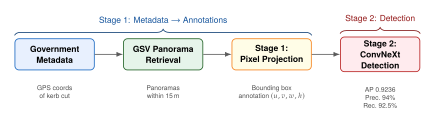
The RAMPNET dataset, assembled from government accessibility records across five US cities (New York, Los Angeles, Chicago, Boston, and Seattle), comprises 210,000 annotated GSV panoramas spanning approximately 4.2 million individual panorama frames. Government metadata provided initial location records for 847,000 kerb cuts; after Stage 1 projection, 623,000 valid bounding box annotations were retained (the remainder were filtered due to panorama unavailability, projection failure, or depth estimation uncertainty). The ConvNeXt detection model trained on this dataset achieves an Average Precision (AP) of 0.9236 at IoU threshold 0.5, with 94% precision and 92.5% recall on a held-out test set. These results substantially outperform prior detection models trained on manually annotated datasets of comparable size, demonstrating the effectiveness of the bootstrapping approach.
Remark 4 (Why bootstrapping outperforms manual annotation at scale).
The performance advantage of RAMPNET's bootstrapping approach over manual annotation is not simply a matter of scale. Manually annotated datasets for kerb cut detection have historically been limited by geographic concentration (most are from a single city or even a single neighbourhood), annotator fatigue (precise bounding box annotation of small objects in large panoramas is cognitively demanding and error-prone), and selection bias (annotators tend to photograph accessible environments rather than sampling infrastructure uniformly). Government metadata, by contrast, covers all permitted kerb cuts across the city's jurisdiction, samples infrastructure uniformly, and is subject to independent verification through building inspection processes. The resulting training distribution better reflects the real-world distribution of kerb cut appearance and location, which accounts for the generalisation advantage observed in cross-city transfer experiments.
System Performance and Generalisation
The RAMPNET detection model generalises substantially across cities and contexts not represented in its training data. Zero-shot transfer experiments to three held-out US cities (Philadelphia, Denver, and Atlanta) show AP of 0.88, 0.86, and 0.84 respectively, with precision and recall remaining above 88% and 85%. Transfer to international cities (London, Berlin, Tokyo) shows AP of 0.79–0.83, with performance degradation attributed primarily to differences in kerb cut design standards (UK kerb cuts are typically wider and more tapered than US equivalents; Japanese tactile-guide systems differ structurally from both).
The detection model's confidence scores are well-calibrated: the expected calibration error (ECE) on the test set is 0.023, indicating that a predicted confidence of 0.9 corresponds to an actual precision of approximately 0.9. This calibration property is important for the intended application: a system that knows it is uncertain is safer than one that is confidently wrong. Regions of low detection confidence can be flagged for human review or supplementary data collection rather than propagated into accessibility maps as authoritative.
City-Scale Accessibility Auditing
The combination of GSV coverage and RAMPNET-class detection models makes city-scale automated accessibility auditing computationally feasible for the first time. A medium-sized US city of 500,000 residents typically has approximately 50,000–80,000 pedestrian crossings; auditing all of them for kerb cut presence, condition, and compliance would require an estimated 5,000–8,000 person-hours of field work under traditional manual audit protocols. The RAMPNET pipeline, running on a standard cloud computing configuration with 16 GPU instances, can audit all GSV-covered intersections of such a city in under 8 hours of wall-clock time.
The automated audit output is a structured GIS dataset specifying, for each audited intersection: the detected presence or absence of kerb cuts on each corner, the detection confidence, the bounding box coordinates in the corresponding GSV panorama, and a flagging indicator for low-confidence detections requiring human review. This dataset can be imported directly into OSM as an accessibility layer, made available through a public API for routing applications, or used to prioritise and plan physical infrastructure improvement programmes.
Insight.
The best accessibility infrastructure is the one that maps itself. Traditional accessibility auditing creates a perpetual maintenance problem: manual surveys are expensive, infrequent, and immediately begin to go out of date as infrastructure changes. A system that continuously reaudits available street imagery-with new GSV captures triggered by infrastructure change events-closes the feedback loop between physical infrastructure and the maps that people rely on. Automated accessibility mapping is not a replacement for physical infrastructure investment; it is the monitoring system that makes infrastructure investment legible, accountable, and navigable.
Example 2 (Auditing a City's Sidewalk Accessibility in One Day).
The city of Portland, Oregon, is planning a capital programme to install 2,400 new kerb cuts over a five-year period and wants to prioritise locations with the highest usage and greatest current gap between demand and provision. The city's accessibility planning department engages an AI mapping team to conduct a baseline audit.
The team retrieves all GSV panoramas within Portland's city limits (approximately 1.2 million panoramas covering 2,800 km of streets). Running the RAMPNET detection pipeline on 32 cloud GPU instances, the audit completes in approximately 6 hours. The output is a GIS dataset of 94,000 pedestrian crossings, of which:
61,000 (65%) have at least one detected kerb cut on each relevant corner;
22,000 (23%) have at least one missing kerb cut on one or more corners;
11,000 (12%) have no detected kerb cuts on any corner.
The detection confidence is above 0.85 for 87% of crossings; the remaining 13% are flagged for human review and sampled at a rate of 5% for a spot-check field audit that confirms detection accuracy of 91% on the reviewed sample.
The team overlays the audit output with pedestrian demand data (derived from mobility traces and transit stop locations) and with local disability community service locations (medical centres, rehabilitation facilities, disability support offices) to generate a prioritisation map. The city's five-year capital programme is revised to prioritise the 400 crossings with highest demand and zero detected kerb cuts, estimated to improve accessible route options for approximately 12,000 BLV and mobility-impaired residents.
The entire audit, from data retrieval to prioritisation map delivery, takes under 24 hours-compared to an estimated 14 months for an equivalent manual audit at comparable coverage.
Exercises
Exercise 10 (Geospatial Agent Design for Pre-Travel Planning).
Using the formal definition of a geospatial accessibility agent from Definition 7, design a concrete instantiation of such an agent for the pre-travel planning use case. Specify: (a) the street-view retrieval function including its geographic coverage scope, panorama selection strategy (how many panoramas per waypoint, at what angular intervals), and handling of outdated imagery; (b) the map data function including OSM feature types to retrieve and any supplementary accessibility-specific GIS layers; (c) the query parser for the natural language query “Is this route safe and accessible for someone who is blind and uses a white cane?”; (d) the MLLM-based analysis function including prompt design for the visual analysis of each panorama; (e) the output format of the accessibility report and how it would be presented to a screen reader user.
Exercise 11 (RAMPNET Pipeline Error Analysis).
The RAMPNET Stage 1 pixel projection step uses government metadata GPS coordinates to generate bounding box annotations in GSV panoramas. (a) Identify three sources of systematic error in the GPS-to-pixel projection that could introduce annotation noise. For each, specify the direction and magnitude of the expected annotation offset and whether it is likely to be correctable through post-processing. (b) The Stage 1 projection filters out 26% of government metadata records (847,000 initial records yield 623,000 valid annotations). Propose three distinct reasons why a metadata record might fail Stage 1 validation and describe a quality-control strategy for each. (c) The ConvNeXt Stage 2 model achieves AP 0.9236 on in-distribution cities but only AP 0.79–0.83 on international transfer. Propose two techniques for improving cross-cultural generalisation without collecting large-scale manually annotated data in each target country.
Exercise 12 (Integrating Geospatial AI with Navigation Apps).
A major disability advocacy organisation wants to integrate RAMPNET-derived kerb cut detection data into a widely used accessible navigation app used by 250,000 BLV users globally. (a) Describe the technical integration pathway: how would the structured GIS output of RAMPNET be consumed by the navigation app's routing engine to produce accessible routes that preference intersections with confirmed kerb cuts? Write the formal accessibility routing cost function as a modification of standard Dijkstra's shortest-path weighting. (b) Propose a staleness management strategy for the kerb cut detection data, including a trigger mechanism for re-auditing intersections where infrastructure change is likely (e.g., after building permit issuance or utility works notification). (c) Design a community feedback mechanism through which BLV app users can report incorrect or outdated kerb cut information, and describe how these reports would be incorporated into the RAMPNET detection model's training pipeline as pseudo-labels.
Sign Language Production with Generative Models
In the autumn of 2022, a research team at AWS demonstrated a system capable of translating a spoken English lecture into a continuous stream of animated American Sign Language. The animated figure moved its hands, shifted its gaze, raised its eyebrows, and angled its torso, all in synchrony with the linguistic content of the speech. To a casual observer, the avatar looked fluent. To a Deaf signer watching the same stream, it was subtly but consistently wrong: the non-manual markers, the facial grammar that distinguishes a question from a statement, the mouth movements that disambiguate homonymous signs, the use of signing space to establish discourse referents. All of these were impoverished or absent.
This gap between the appearance of fluency and its reality is the central tension of sign language production research. It is also, arguably, the most technically demanding problem in accessible communication: a machine must not merely map words to hand shapes but must generate a full-body, temporally coherent, linguistically valid utterance in a natural language with its own phonology, morphology, and spatial grammar.
Key Idea.
Sign language is not a visual encoding of spoken language. It is an independent natural language expressed in the visual-gestural modality. Generating sign language therefore requires modelling not only manual handshapes and movement but also non-manual markers (facial expression, head tilt, mouth movements, eye gaze), prosodic rhythm, and the use of three-dimensional signing space for referential and spatial grammar. A system that models only hand trajectories is linguistically incomplete by construction.
The Linguistic Structure of Sign Languages
Signed languages are fully natural human languages that have evolved independently in Deaf communities across the world. American Sign Language (ASL), British Sign Language (BSL), and French Sign Language (LSF) are mutually unintelligible, just as English, German, and French are mutually unintelligible, despite the superficial similarity of some hand configurations. Each signed language has a complete phonological system (where “phoneme” refers to the minimal contrastive unit of hand configuration, movement, location, and palm orientation), a morphological system, and a syntactic system that exploits three-dimensional space in ways that spoken languages cannot.
Manual parameters.
Each sign is characterised by four manual parameters:
Handshape (HS). The configuration of the fingers and thumb. ASL has approximately 50 phonologically distinct handshapes.
Location (L). The position of the dominant hand relative to the body. Minimal pairs exist, for instance mother and father share the same handshape and movement but differ only in location (chin vs. forehead).
Movement (M). The path and internal movement of the hand through signing space. Movements may be linear, circular, repeated, or involve changes in wrist orientation.
Palm orientation (O). The direction the palm faces during and at the end of the movement.
Non-manual markers.
Non-manual markers (NMMs) are facial and bodily signals that carry grammatical and prosodic information independently of the manual channel. They include:
Raised brows for yes/no questions.
Furrowed brows for wh-questions.
Head nods for affirmation or continuation.
Mouth morphemes (not lip-reading of English words) that modify the meaning of signs, for example the puffed-cheek adverbial that intensifies adjectives.
Eye gaze for establishing reference and indicating verb agreement.
Body lean for conditional clauses and topicalisation.
Remark 5.
Non-manual markers are not optional flourishes. They are obligatory grammatical morphemes. A sentence signed without the appropriate facial grammar is not merely informal; it is grammatically ill-formed, analogous to an English sentence without word order. A generative model that omits NMMs from its output is not producing simplified sign language; it is producing ungrammatical sign language.
Signing space and classifier predicates.
ASL exploits the three-dimensional space in front of the signer's body as a syntactic and referential resource. A signer can “place” a referent at a location in space and subsequently point to that location to refer back to it, or use a directional verb whose path from one spatial locus to another encodes subject and object agreement. Classifier predicates use handshape morphology to encode the category and spatial arrangement of referents, for instance the classifier for a flat surface can be moved along any path to describe the motion of a table across a room.
Formal Definition: Sign Language Production
Definition 9 (Sign Language Production).
Sign language production (SLP) is the task of generating a temporally coherent sequence of body poses from a source representation (spoken or written language), such that the pose sequence constitutes a grammatically well-formed utterance in a target sign language .
Formally, an SLP model learns a conditional distribution (SLP Conditional) where each pose frame is a -dimensional keypoint vector encoding joint positions, handshape parameters, and facial action unit activations, and varies across utterances. A linguistically valid SLP model must capture both manual parameters and non-manual markers at every frame.
The pose representation typically concatenates keypoints from the full body: 17 body joints (following the COCO-WholeBody convention), 42 hand keypoints (21 per hand), and 68 facial landmarks, giving spatial coordinates per frame, or values when using three-dimensional coordinates.
The ASL Dataset Landscape
Progress in SLP has been constrained by the availability of large-scale, linguistically annotated sign language corpora. Annotating sign language video is extraordinarily labour-intensive: it requires trained human linguists who are fluent signers, and annotation at the level of individual signs, morphemes, and non-manual markers can take dozens of hours per minute of video.
ASLLVD.
The American Sign Language Lexicon Video Dataset (ASLLVD) is the primary reference corpus for isolated ASL sign recognition and production. It contains recordings of more than 3,300 distinct ASL signs, each produced by multiple native Deaf signers, with annotation at the sign level and decomposition into manual parameters. The dataset is filmed against a controlled background with multiple simultaneous camera angles, including a side-view camera that captures depth information. ASLLVD is widely used for bootstrapping keypoint-based SLP pipelines because its controlled conditions allow high-quality pose estimation without occlusion.
How2Sign and OpenASL.
How2Sign extends the annotation scope to continuous, sentence-level signing from instructional videos, providing sentence-level English glosses alongside video. OpenASL provides a larger-scale but less densely annotated corpus of continuous ASL signing scraped from public sources. Both datasets are substantially noisier than ASLLVD but provide the continuous signing context required to learn inter-sign coarticulation.
The GenASL Pipeline
The GenASL system, developed as an AWS research demonstrator, represents the most complete end-to-end pipeline for real-time ASL production from spoken English to date. It chains four specialised models into a single inference graph, each addressing one stage of the conversion from acoustic input to animated avatar. Figure 6 illustrates the full pipeline.
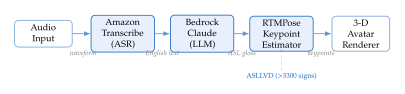
Stage 1: Automatic speech recognition.
The pipeline begins with Amazon Transcribe, AWS's cloud ASR service, which converts the incoming audio stream to time-aligned English text. The time alignment is critical: it allows the downstream stages to synchronise the avatar's signing with the original speech prosody, maintaining the temporal correspondence that makes the output useful for real-time communication.
Stage 2: LLM-based gloss generation.
The second stage uses a Claude model hosted on Amazon Bedrock to translate English text into ASL gloss. ASL gloss is a written notation system that represents ASL signs using capitalised English words, for instance the English sentence “Are you going to the store?” becomes the ASL gloss you store go?, reflecting the object-subject-verb ordering and the yes/no question non-manual marker (which is represented in the gloss by the question mark but must be generated explicitly by the avatar). The LLM is prompted with examples of English-to-gloss pairs and instructions about ASL morphosyntax.
Remark 6.
ASL gloss is a simplification. It records the lexical items in their approximate order but omits most morphological information, including classifier predicates, agreement morphology on verbs, and non-manual markers. Using gloss as an intermediate representation therefore discards precisely the information that distinguishes fluent signing from word-for-word transliteration. More sophisticated intermediate representations, such as HamNoSys (Hamburg Notation System) or SignWriting, can encode more phonological and morphological detail but are far harder to generate automatically.
Stage 3: Keypoint estimation with RTMPose and MMPose.
The third stage maps each gloss token to a sequence of body pose keypoints. GenASL uses RTMPose, a real-time multi-person pose estimation framework built on top of OpenMMLab's MMPose library, to extract 2D keypoints from the ASLLVD reference videos. For each sign in the gloss, the pipeline retrieves the corresponding ASLLVD reference video clip and runs RTMPose to extract per-frame pose vectors. These keypoint sequences are then concatenated and smoothed using a cubic spline interpolation to produce natural inter-sign transitions.
RTMPose is well-suited to this application for several reasons. First, it achieves real-time inference speeds on standard GPU hardware (approximately 300 frames per second on an NVIDIA A100), enabling the pipeline to process incoming speech at near-real-time latency. Second, it provides full-body keypoint estimation including hand and face landmarks, which are critical for capturing the manual and non-manual components of signing. Third, its integration with MMPose allows straightforward adaptation to domain-specific datasets through transfer learning.
Stage 4: Avatar rendering.
The final stage uses a 3-D avatar renderer to animate the estimated keypoints as a photorealistic or stylised virtual signer. The renderer receives the keypoint time series as input and applies skeletal animation techniques to drive the avatar's joint angles, with separate animation tracks for the face, hands, and body. The rendering stage is the component most visible to end users and therefore the most commonly cited source of the “uncanny valley” effect in avatar-based sign language systems.
SignLLM: Multilingual Text-to-Sign Production
The GenASL pipeline is English-to-ASL only. The vast majority of the world's Deaf population does not use ASL: there are an estimated 300 or more distinct sign languages in use globally, and the resources for most of them are severely limited. SignLLM addresses this by framing sign language production as a multilingual text-to-pose problem and training a single model capable of generating signing across eight distinct sign languages.
PROMPT2SIGN dataset.
SignLLM introduces the PROMPT2SIGN dataset, a large-scale parallel corpus that pairs text prompts with sign language pose sequences across eight sign languages: ASL, BSL, Deutsche Gebardensprache (DGS), Chinese Sign Language (CSL), French Sign Language (LSF), Japanese Sign Language (JSL), Korean Sign Language (KSL), and Spanish Sign Language (LSE). The dataset is constructed by combining existing sign language video corpora with automated pose extraction and semi-automatic alignment. Each entry in PROMPT2SIGN consists of a natural language prompt in the spoken language, the corresponding sign language video, and the extracted pose sequence.
The MLSF architecture.
SignLLM employs a Modular Language-Specific Framework (MLSF) that balances cross-lingual parameter sharing with language-specific specialisation. The architecture consists of three functional groups:
Shared encoder. A pretrained multilingual language model encoder maps the input text to a shared semantic representation. All eight sign languages share this encoder, allowing knowledge about linguistic structure to transfer across languages.
Language-specific adapter modules. Each of the eight sign languages has a dedicated lightweight adapter module inserted into the shared encoder. These adapters are small feed-forward networks with approximately 1% of the shared encoder's parameter count, following the adapter paradigm. During training, the shared encoder weights are frozen and only the language-specific adapters are updated, which prevents catastrophic forgetting.
Modular decoder groups. Each sign language has its own pose sequence decoder, implemented as a transformer decoder with cross-attention over the adapted encoder representations. The decoders are not shared because the kinematic vocabularies of different sign languages differ substantially in both the set of handshapes used and their temporal dynamics.
Definition 10 (MLSF: Modular Language-Specific Framework).
Let be a set of sign languages. The MLSF model consists of:
A shared encoder with frozen parameters after pretraining.
Language-specific adapters , where is a residual bottleneck network with parameters .
Language-specific decoders , where autoregressively generates pose frame sequences, with the dimensionality of the pose vector.
For a text input and target language , the model generates a pose sequence .
Prompt2LangGloss: natural language to language-specific attributes.
A distinctive component of SignLLM is the Prompt2LangGloss module, which converts a natural language input sentence into language-specific attribute representations before pose generation. Rather than directly mapping text to pose sequences, Prompt2LangGloss first predicts a set of language-specific attributes for each target sign language, including:
The ordered sequence of lexical items (gloss sequence) in the target sign language.
Morphological features such as aspect marking, verb agreement directionality, and number incorporation.
Prosodic boundaries indicating phrasing and emphasis.
These attributes serve as a structured intermediate representation that bridges the gap between the source language text and the target language pose sequence, and they can be inspected and corrected by a human editor before pose generation.
RL optimisation with Priority Learning Channel.
Training SignLLM with supervised loss alone leads to a form of averaging over the distribution of possible sign productions: the model learns to generate pose sequences that are plausible on average but lack the decisiveness of a native signer's production. SignLLM addresses this with a reinforcement learning component called the Priority Learning Channel (PLC).
The PLC maintains a priority queue of training examples ordered by the model's current uncertainty, measured as the entropy of the predicted pose distribution at the most uncertain time step. At each training iteration, the PLC selects a batch biased toward high-uncertainty examples, allowing the model to focus learning resources on the parts of the sign language space where its predictions are most diffuse. The reward signal is a combination of:
A sign recognition reward : the confidence of a pretrained sign recogniser when fed the generated pose sequence.
A fluency reward : the log-likelihood of the generated sequence under a sign language language model trained on PROMPT2SIGN.
A diversity reward : a term that penalises mode collapse by rewarding dissimilarity between the generated sequence and the training reference.
The combined reward is (PLC Reward) with tuned on a validation set of Deaf signer evaluations.
Case Study: Translating a University Lecture into Real-Time ASL
Consider the practical scenario of translating a university lecture into real-time ASL for a Deaf student. A human ASL interpreter attending the same lecture operates under significant cognitive load: they must simultaneously comprehend the spoken content, translate across language boundaries (including handling domain-specific vocabulary), produce grammatically correct ASL, and maintain the prosodic rhythm of the signing. Certified interpreters typically work in pairs, switching every 15–20 minutes, and a single interpreter for a one-hour lecture can cost $200–$800 depending on the market.
An AI-based pipeline such as GenASL or a SignLLM deployment can operate continuously without fatigue and at a fraction of the cost. However, three current limitations constrain its usefulness:
Latency.
A practical real-time system must keep end-to-end latency below approximately 800,ms, the threshold at which the delay between a spoken word and its signed equivalent becomes perceptually disruptive. The GenASL pipeline incurs latency at every stage: ASR buffering ( 300,ms), LLM inference for gloss generation ( 200–400,ms depending on sentence length), keypoint retrieval and interpolation ( 100,ms), and avatar rendering ( 30,ms). The total latency of 600–830,ms is at the boundary of usability and motivated the development of streaming variants that begin signing before the full sentence has been received.
Vocabulary coverage.
Domain-specific lectures introduce technical vocabulary (“eigenvalue decomposition”, “gradient descent”, “attention mechanism”) for which no pre-recorded reference signs exist in ASLLVD\@. The system must either fingerspell these terms (slow and fatiguing to read), use an initialized sign that borrows the first letter of the English word, or generate a novel sign that conforms to ASL phonological constraints. None of these solutions is fully satisfactory, and a human interpreter would use negotiated conventions established with the Deaf student in advance.
Non-manual markers.
Lecture content includes questions, conditionals, topic-comment structures, and reported speech, all of which require specific non-manual markers in ASL\@. The current GenASL pipeline generates NMMs only to the extent that they are present in the ASLLVD reference clips; the LLM gloss generation stage does not explicitly predict which NMMs are required at which points in the discourse, and the avatar therefore produces signing that is grammatically underspecified for much of the lecture.
Historical Note: From Human Interpreters to AI Avatars
Historical Note.
The long arc from manual interpretation to AI avatars.
The professionalisation of sign language interpreting is surprisingly recent. Until the mid-twentieth century, hearing children of Deaf adults (known as CODAs, Children of Deaf Adults) were the primary bridges between Deaf and hearing communities, interpreting informally in doctors' offices, courtrooms, and schools. This system placed an enormous burden on children and provided no quality assurance.
The establishment of the Registry of Interpreters for the Deaf in 1964 began the professionalisation of ASL interpreting in the United States, introducing certification standards and ethical guidelines. The Americans with Disabilities Act of 1990 mandated reasonable accommodation, including interpreter access, for Deaf individuals in public services and employment.
The first computer-generated sign language avatars appeared in the late 1990s, using rule-based systems to drive pre-built 3-D character models. These systems, exemplified by the VisiCast and eSIGN projects funded by the European Commission, could generate syntactically structured signing but with stilted, unnatural motion that most Deaf users found difficult to read.
The neural era began in earnest around 2018 with the application of sequence-to-sequence models to sign language production. The introduction of transformer-based architectures, large-scale keypoint datasets, and foundation model conditioning has brought the quality of AI signing dramatically closer to human interpreter quality. Yet the gap remains significant, and the question of when AI avatars will be trusted by Deaf communities as primary communication channels, rather than supplements to human interpreters, remains open.
Exercises
Exercise 13 (Keypoint representation analysis).
The COCO-WholeBody keypoint format used in MMPose provides 133 keypoints: 17 body, 68 face, 21 left-hand, and 21 right-hand, each with coordinates and a visibility flag.
Compute the dimensionality of the pose vector per frame under this representation, assuming no visibility flags are included in the generative model's input.
A signing video is captured at 25 frames per second. For a sentence that takes 4 seconds to sign, how many total real values does the full pose sequence contain? Compare this to the token count of the corresponding English sentence (approximately 12 words, 16 tokens).
The pose sequence exhibits strong temporal correlations: adjacent frames differ by small amounts. Propose two compression strategies that exploit this temporal structure, and estimate the compression ratio achievable by each.
Explain why operating in a learned latent space rather than the raw keypoint space may improve generation quality, and describe how a variational autoencoder trained on ASLLVD data could provide such a latent space.
Exercise 14 (MLSF cross-lingual transfer).
Consider the MLSF architecture of Definition 10 trained on eight sign languages with unequal amounts of data: ASL has 500,000 sentence-pose pairs, while KSL has only 5,000.
Without cross-lingual transfer (i.e., training separate models per language), estimate the number of KSL training pairs required to match the performance achievable with MLSF, given that the shared encoder is pretrained on all eight languages. State your assumptions.
The adapter modules in MLSF have a bottleneck dimension . Show that the number of adapter parameters per language is and compute the actual count for and .
Describe a “negative transfer” scenario in which sharing the encoder across all eight sign languages could harm performance on a specific language. What property of the sign language pair would make negative transfer likely?
Exercise 15 (Priority Learning Channel reward design).
The Priority Learning Channel (PLC) of SignLLM uses the combined reward of (PLC Reward).
The diversity reward is intended to prevent mode collapse. Define a specific mathematical form for based on the pairwise distance between generated pose sequences within a training batch of size . Prove that your definition equals zero when all sequences are identical.
The sign recognition reward uses a pretrained sign recogniser as a critic. This creates a potential circularity: if the recogniser was trained on the same data as the production model, it may reward production of sequences that look like training data rather than genuinely fluent signing. Propose a training protocol that avoids this circularity.
Suppose the three reward coefficients are set to , , . Under what linguistic conditions would this weighting be suboptimal? Propose an adaptive weighting scheme that adjusts based on the phonological difficulty of the current training batch.
Photorealistic Lip Synthesis and Viseme Generation
For the 70 million people worldwide who are Deaf or Hard of Hearing (DHH), access to spoken communication takes many forms. Cochlear implants and hearing aids provide partial acoustic access for some. Written captions provide text-based access. Sign language interpreters provide full-language access for those who are fluent signers. But there is a fourth channel, one that is often overlooked by hearing researchers and engineers: lip-reading, or more precisely, visual speech perception.
Experienced lip-readers can achieve intelligibility rates of 30–40% from lip movement alone, a figure that rises dramatically when combined with contextual knowledge, facial expression, and the non-manual signals of sign language. The specific contribution of lip movements to sign language comprehension is particularly important: in ASL and BSL, mouthings, the silent mouthing of the corresponding English word during a sign, serve as a disambiguation cue between homonymous signs. A system that generates accurate, photorealistic lip movements therefore provides not merely aesthetic realism but genuine communicative value for DHH users.
This section examines VisualSpeaker, the most technically complete system for photorealistic lip synthesis to date, and considers the ethical complexities of deploying such technology for DHH accessibility.
Visemes: The Phonemes of Visual Speech
Definition 11 (Viseme).
A viseme is the minimal visually contrastive unit of speech perception, analogous to the phoneme in auditory speech. Formally, two phonemes and belong to the same viseme class if and are visually indistinguishable by a lip-reader, i.e., if for any face model and any speaker , (Viseme Equivalence) where denotes perceptual indistinguishability within tolerance under a visual lip-reading model. The mapping from phoneme inventory to viseme classes is a many-to-one surjection with .
In English, the 44 standard phonemes collapse to approximately 14–18 viseme classes, depending on the classification scheme. The collapsing arises because many phoneme distinctions are invisible at the lips: voiced-voiceless pairs such as /b/ vs. /p/, /d/ vs. /t/, and /g/ vs. /k/ are visually identical (they are distinguished by voicing in the larynx, not by lip configuration). Similarly, /m/, /p/, and /b/ all require bilabial closure and belong to the same viseme class.
Remark 7.
The many-to-one nature of the phoneme-to-viseme mapping is the fundamental reason that lip-reading alone is insufficient for full speech intelligibility. When a lip-reader sees bilabial closure followed by the vowel // (as in “cat”), the word could be “bat”, “pat”, or “mat” based on the visible information alone. Context, pragmatics, and, crucially, the auditory signal (for hard-of-hearing individuals who have some residual hearing) resolve the ambiguity. For profoundly Deaf lip-readers, the ambiguity is resolved primarily through contextual inference.
Mouthings in sign language.
Mouthings are a specific use of lip movements within signed languages that is distinct from lip-reading spoken language. In ASL, mouthings occur when a signer silently mouths the English word corresponding to a sign while producing it. This occurs most frequently with technical vocabulary, proper nouns, and signs that have multiple possible referents in context. In BSL, mouthings are even more prevalent, with some BSL signers mouthing English words for the majority of their signs.
The communicative function of mouthings is disambiguating: the mouthing narrows down the possible referents of a sign in exactly the same way that a viseme disambiguates within its equivalence class. A generative system for sign language avatars must therefore produce accurate mouthings as an integral part of the linguistic output, not as a stylistic afterthought.
The VisualSpeaker Architecture
VisualSpeaker is a photorealistic lip synthesis system that combines a parametric 3-D face model, volumetric rendering via 3-D Gaussian Splatting, and a perceptual feedback loss derived from visual automatic speech recognition. Together, these components address the three core challenges of photorealistic lip synthesis: geometric accuracy of lip shape, photometric realism of lip appearance, and linguistic correctness of the generated lip movements.
Figure 7 illustrates the full architecture.
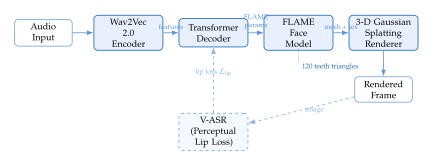
The FLAME face model.
FLAME (Faces Learned with an Articulated Model and Expressions) is a parametric 3-D morphable face model that represents a face as a linear combination of shape, expression, and pose basis vectors. Formally, the FLAME model produces a mesh of vertices as (Flame) where are shape parameters, are pose parameters (including jaw rotation and neck rotation), are expression parameters, is the shaped and posed template, gives the joint locations, and is the linear blend skinning function.
For lip synthesis, the expression parameters control the muscle activations that determine lip aperture, protrusion, corner spreading, and rounding. The key insight of using FLAME as an intermediate representation is that it enforces physical plausibility: the generated lip shapes must lie on the FLAME manifold, which excludes anatomically impossible configurations.
Dental geometry: 120 teeth triangles.
A significant source of visual unrealism in previous lip synthesis systems was the treatment of teeth. Many prior works either omitted teeth entirely (producing a dark void behind parted lips) or used a single flat plane as a proxy. VisualSpeaker incorporates a dedicated dental geometry model consisting of 120 triangles that represent upper and lower teeth with realistic curvature and occlusion. The teeth mesh is parameterised by jaw opening angle derived from the FLAME jaw rotation parameter, with separate vertex offsets for individual tooth shape variation.
The inclusion of dental geometry has a measurable effect on lip-reading intelligibility: human perceptual studies show that teeth visibility accounts for approximately 8–12% of the lip-reading intelligibility improvement attributable to full face rendering versus a mouth-only rendering. This is because teeth visibility provides coarse phonetic information about vowel height and consonant place of articulation.
3-D Gaussian Splatting for rendering.
Rather than rendering the FLAME mesh with a conventional rasterisation pipeline, VisualSpeaker uses 3-D Gaussian Splatting (3DGS) for photorealistic rendering. 3DGS represents the scene as a collection of anisotropic 3-D Gaussians, each with a position , a covariance matrix , an opacity , and a view-dependent colour represented by spherical harmonic coefficients .
The FLAME mesh vertices serve as anchor points for initialising the Gaussian positions: each face vertex spawns one or more Gaussians whose position is constrained to deform with the mesh during animation. Additional free Gaussians model hair, background, and the mouth interior (including the tongue and dental geometry). The rendering equation for a pixel is the alpha-composited sum over sorted Gaussians: (3DGS Render) where is the viewing direction, and are the projected 2-D mean and covariance, is the view-dependent colour, and is the Gaussian footprint at pixel for Gaussian .
The key advantage of 3DGS over mesh rasterisation for lip synthesis is its ability to render soft, translucent geometry (lip mucosa, tongue surface) and to capture view-dependent specular highlights on moist tissue surfaces, both of which contribute strongly to perceived realism.
Wav2Vec 2.0 as the Audio Encoder
The audio input to VisualSpeaker is encoded by Wav2Vec 2.0, a self-supervised speech representation model pretrained on 960 hours of LibriSpeech audio. Wav2Vec 2.0 produces frame-level feature vectors at a stride of 20,ms, meaning that for a 5-second speech segment, the encoder produces a sequence of 250 feature vectors.
The choice of Wav2Vec 2.0 over alternative speech encoders (such as HuBERT or WavLM) is motivated by its well-studied relationship between internal representations and articulatory features. Several studies have shown that the intermediate layers of Wav2Vec 2.0 capture phoneme identity, with different layers specialising in different aspects of phonetic structure. Layer 6 (of 24) represents low-level acoustic features; layers 12–18 represent phoneme identity most strongly; layers 20–24 represent higher-level linguistic context. VisualSpeaker uses layers 12–18 to condition the lip parameter generation, targeting the phoneme-level representations that are most directly related to visible lip movement.
Transformer decoder architecture.
A transformer decoder with 6 layers and 8 attention heads maps the Wav2Vec 2.0 feature sequence to a sequence of FLAME parameter predictions. The decoder operates at the video frame rate (25 fps) rather than the Wav2Vec 2.0 feature rate (50 fps), with a strided cross-attention mechanism that attends to a 40,ms window of audio features for each predicted video frame. The output of the decoder at frame is a vector of FLAME parameters: (Decoder Output) where denotes the five audio feature frames centred on frame (a 100,ms context window) and is the transformer decoder.
The Perceptual Lip-Reading Loss
The central training innovation in VisualSpeaker is a perceptual lip-reading loss that uses a visual automatic speech recognition (V-ASR) model as a critic. Standard reconstruction losses, such as the mean squared error between predicted and ground-truth FLAME parameters, or the loss on rendered image pixels, do not directly measure whether the generated lip movements are linguistically intelligible. A model can minimise pixel-level loss by generating smooth, plausible-looking lip movements that are nonetheless inconsistent with the phoneme sequence of the input speech.
The perceptual lip-reading loss addresses this by training VisualSpeaker jointly with a V-ASR model that takes rendered lip video as input and predicts a phoneme sequence. The V-ASR model is pretrained on ground-truth video and kept fixed during VisualSpeaker training. The lip-reading loss is then: (LIP LOSS) where is the rendered video from the VisualSpeaker decoder, is the phoneme sequence predicted by the V-ASR model, is the ground-truth phoneme sequence derived from the audio, and is the Connectionist Temporal Classification loss.
The full training objective combines the perceptual loss with a geometric consistency loss and a temporal smoothness loss: (Total LOSS) where measures the distance between predicted and ground-truth FLAME parameters, and penalises second-order temporal differences in the FLAME parameters to suppress jitter.
Remark 8.
The V-ASR feedback loop creates a closed-loop learning signal that is absent from purely reconstruction-based training. During backpropagation, the gradient of with respect to the decoder parameters flows through the 3DGS differentiable renderer, through the FLAME deformation, and into the transformer decoder weights. This requires that both the FLAME parameterisation and the Gaussian Splatting renderer be differentiable, which 3DGS is by construction.
Empirical Results on the MEAD Dataset
VisualSpeaker is evaluated on the MEAD dataset, a large-scale talking-face dataset containing recordings of 60 actors producing more than 30,000 sentences across eight emotion categories and three intensity levels. MEAD provides ground-truth video alongside audio, making it possible to compute objective metrics for both visual quality and lip-reading intelligibility.
The primary quantitative metric is Lip Vertex Error (LVE), defined as the mean Euclidean distance between the predicted and ground-truth positions of the FLAME lip vertices (a subset of 40 vertices at the lip boundary and 12 internal lip vertices): (LVE) where and are the predicted and ground-truth 3-D positions of vertex at frame .
VisualSpeaker achieves a 56.1% improvement in LVE over the strongest prior baseline (DiffTalk, a diffusion-based talking-face model) on the MEAD dataset. This improvement is primarily attributable to the V-ASR perceptual loss: ablation studies show that removing while retaining all other components increases LVE by 34.7%, demonstrating that the phoneme feedback is the dominant contributor to geometric accuracy.
Remark 9.
LVE measures geometric accuracy of lip shape prediction but does not directly measure perceptual intelligibility to a DHH lip-reader. A model can achieve low LVE by accurately predicting average lip positions while failing to distinguish between viseme categories with similar average positions. Perceptual studies with DHH participants are therefore an essential complement to LVE evaluation, and the VisualSpeaker paper's reliance on LVE as the primary metric has been noted as a limitation by reviewers from the Deaf community.
Ethical Concerns from the DHH Community
The development of AI-based sign language avatars and lip synthesis systems has generated significant concern within Deaf and Hard of Hearing communities, and from advocacy organisations representing those communities. These concerns are not merely technical; they are political, cultural, and communicative in nature.
The European Union of the Deaf position.
The European Union of the Deaf (EUD), which represents national Deaf associations across Europe, has published a position paper on the use of AI-generated sign language avatars in public services and broadcasting. The EUD's central arguments are:
Linguistic quality cannot be assumed. Current AI avatars produce signing that is grammatically incomplete and therefore not genuinely accessible to Deaf users who rely on sign language as their primary language. Deploying such avatars as if they provide genuine accessibility misrepresents the quality of the accommodation.
The avatar displaces the human interpreter. Organisations that deploy AI avatars, even poor-quality ones, may use this as a justification for reducing or eliminating budgets for human sign language interpreters. This creates a net reduction in the quality of access, even if the intent was to increase access.
Deaf community involvement is required. Decisions about what constitutes accessible sign language communication should involve Deaf community members from the earliest stages of system design. Systems designed exclusively by hearing engineers, without meaningful participation from native signers, are likely to miss linguistic requirements that are obvious to signers.
Sign language is a cultural heritage. AI-generated signing that deviates significantly from the norms of a sign language community risks damaging the perceived prestige of that language, particularly if hearing people encounter AI signing before natural signing.
Caution.
Apparent fluency is not linguistic adequacy. An AI avatar that moves smoothly, produces hand shapes that resemble ASL, and generates a convincing facial expression can appear fluent to a hearing observer who does not know ASL\@. That same avatar may be producing signing that is, in the assessment of Deaf native signers, substantially wrong: missing non-manual markers, using incorrect spatial grammar, producing signs from the wrong register, or omitting morphological inflections. An AI avatar that looks fluent but signs incorrectly is worse than no avatar at all, because it creates the false impression that accessibility has been provided when it has not. Engineering teams developing sign language production systems must seek evaluation from Deaf native signers, not from automated metrics or hearing evaluators.
The cost-quality tension.
There is an undeniable economic pressure in the deployment of sign language accessibility systems. Qualified human ASL interpreters are expensive: the Bureau of Labor Statistics estimates median annual earnings for interpreters and translators in the United States at $57,090 (2023), with sign language interpreters typically earning more due to the specialised skill required. For large organisations that must provide interpreter access for thousands of interactions annually, the total cost is substantial.
AI-based sign language systems, by contrast, can be deployed at near-zero marginal cost once trained. This cost differential creates a powerful economic incentive to deploy AI systems even if their quality is significantly below that of a human interpreter.
The ethical challenge is that the parties making the deployment decision (typically hearing administrators or engineers) are not the parties bearing the cost of reduced quality (Deaf users). This asymmetry of impact and decision-making authority is a structural feature of the accessibility technology market that no purely technical solution can resolve.
Remark 10.
The economic incentive to deploy cheap, low-quality AI avatars instead of skilled human interpreters represents a market failure: the cost savings accrue to the deploying organisation, while the reduced communicative access accrues to the Deaf user. Regulatory frameworks that set minimum quality standards for sign language accessibility, enforced by evaluation from Deaf community members, are likely necessary to prevent a race to the bottom in AI-based sign language production.
Deepfake and identity concerns.
Photorealistic lip synthesis and talking-face technology raise concerns beyond sign language specifically. The same 3DGS-based rendering pipeline used in VisualSpeaker can, in principle, be used to generate convincing video of a real person saying or signing things they never said or signed. For DHH individuals who are public figures in the Deaf community (Deaf educators, sign language interpreters, Deaf politicians), the existence of such technology creates a risk of malicious impersonation. VisualSpeaker and similar systems therefore require careful access control and transparency in their deployment.
Key Principle: Evaluation Must Involve Native Signers
Key Idea.
Sign language generation systems must be evaluated by native signers, not by hearing engineers. Automated metrics such as Lip Vertex Error, Fréchet Inception Distance on rendered frames, or sign recognition accuracy measure properties of the generated output that are necessary but not sufficient for linguistic adequacy. Only a native signer can judge whether a generated utterance is grammatically well-formed, pragmatically appropriate, and stylistically natural in the target sign language community. Including native Deaf signers as evaluators, co-designers, and domain experts is not merely good practice; it is a prerequisite for generating outputs that are genuinely useful to the community the system is intended to serve.
Exercises
Exercise 16 (Viseme classification and lip-reading ambiguity).
Consider the standard English phoneme inventory of 44 phonemes and the Lee-Yook 14-class viseme mapping, in which:
Viseme 1: /p, b, m/ (bilabial closure)
Viseme 2: /f, v/ (labiodental)
Viseme 3: /th, dh/ (dental fricatives)
Viseme 4: /t, d, s, z, n, l/ (alveolar)
Viseme 5: /sh, zh, ch, j/ (postalveolar)
Viseme 6: /j/ (palatal)
Viseme 7: /k, g, ng/ (velar)
Viseme 8: /h/ (glottal)
Visemes 9–14: the six cardinal English vowels.
For the sentence “The big bat flew past the mat,” write out the phoneme sequence and then the viseme sequence. How many viseme-level ambiguities exist (i.e., how many phoneme distinctions are invisible at the lip level)?
Compute the entropy of the phoneme given the viseme, assuming a uniform distribution over phonemes within each viseme class. Interpret this quantity as a measure of irreducible lip-reading ambiguity.
A V-ASR model trained to predict phoneme sequences from video achieves a word error rate of 52% on the LRS3 dataset. Argue that this error rate cannot be reduced below a theoretical minimum by improving the model, and estimate that minimum based on the viseme classification above.
Exercise 17 (3-D Gaussian Splatting for face animation).
The VisualSpeaker renderer uses 3-D Gaussian Splatting to render the FLAME-parameterised face.
A face is represented by Gaussians. Each Gaussian has: a 3-D mean ( floats), a covariance matrix ( floats for the upper triangle), an opacity ( float), and spherical harmonic colour coefficients ( floats for degree-2 SH). Compute the total memory required to store the Gaussian representation at single precision (32-bit floats).
Explain why the differentiability of the 3DGS rendering equation ((3DGS Render)) with respect to the Gaussian parameters is necessary for the V-ASR perceptual loss to flow gradients back to the transformer decoder.
The teeth geometry in VisualSpeaker is represented by 120 triangles. Each triangle contributes Gaussians initialised at the triangle centroid. If each triangle spawns 4 Gaussians, compute the fraction of the total 50,000 Gaussians allocated to dental geometry, and argue whether this allocation is appropriate given the relative surface area of teeth versus the full face.
Exercise 18 (Ethical analysis of AI avatar deployment).
Consider a hospital system that serves a patient population in which 1% of patients are Deaf or Hard of Hearing, corresponding to approximately 200 Deaf patients per month. The hospital currently provides qualified ASL interpreters at a cost of $180 per two-hour appointment session. The hospital is evaluating an AI avatar system that costs $0.50 per session in compute costs and a $200,000 one-time training cost.
Compute the break-even time (in months) at which the AI avatar system becomes cheaper than the human interpreter system, assuming 200 sessions per month.
A Deaf patient advocacy organisation argues that the quality of the AI avatar is insufficient for medical communication. In medical contexts, where misunderstandings can have serious consequences, propose a quality threshold (in terms of a measurable metric) that the AI system must meet before deployment, and justify your choice.
The EUD position paper argues that deploying a low-quality AI avatar is worse than no avatar at all. Construct the strongest counterargument to this position from the perspective of a hospital administrator with a constrained accessibility budget. Then evaluate whether this counterargument is ethically sound.
Propose a hybrid deployment model that preserves cost savings while maintaining a quality floor for Deaf patients. Your proposal should specify: (i) how quality is assessed, (ii) when a human interpreter is called instead of the AI, and (iii) how Deaf patients are involved in the quality assessment process.
Zero-Shot Voice Cloning for Speech Disabilities
There is a moment, documented in the archives of the ALS Association, when a patient named Tim Shaw recorded several hours of his own voice for a research project he barely understood at the time. He laughed, he told stories, he read passages from newspapers, all at the request of researchers building voice banks. Three years later, when his illness had stripped him of the ability to produce intelligible speech, those recordings became the foundation of a synthetic voice that his family immediately recognised as his: the cadence was right, the vowels were shaped the way Tim had always shaped them, the tiny hesitation before a punchline was preserved. His daughter, hearing the first synthesised sentence, wept.
This story illustrates the central tension of voice cloning for accessibility. On one side stands the technical problem: building systems that can reproduce a person's vocal identity from limited samples, synthesise new utterances in real time, and handle the degraded input that many users produce. On the other side stands a deeply human concern: the voice is not simply a medium for transmitting information. It is an index of personality, history, and relationship. When progressive neurological disease or stroke takes that voice away, the loss is not merely functional; it is existential. Zero-shot voice cloning, at its best, is an act of restitution.
The Identity Crisis: When Generic TTS Strips Personality
Standard text-to-speech systems, even excellent ones, suffer from what we might call the personality erasure problem. A person who loses the ability to speak due to amyotrophic lateral sclerosis (ALS), progressive bulbar palsy, or severe dysarthria is typically issued an AAC device that speaks in one of a handful of manufactured voices: “Voice 1,” perhaps a North American baritone; “Voice 2,” a slightly higher register. The linguistic content arrives, but the speaker does not. Listeners report a subtle but persistent dissonance, a sense that the person they knew has been replaced by a generic announcer. Studies of AAC users consistently rank naturalness of voice and voice identity among the top priorities for device improvement, second only to speed of message formulation.
The computational consequence of this observation is direct. We need systems that do not synthesise speech from a population average of vocal characteristics but from an individual profile. This requires two capabilities that traditional TTS systems lack: the ability to extract a speaker-specific representation from a short reference recording, and the ability to condition the synthesis process on that representation without any fine-tuning of model weights. The first capability is called speaker encoding; the second, zero-shot adaptation.
Insight.
The personality erasure problem is not merely aesthetic. Research in communication studies shows that listeners make inferences about intelligence, trustworthiness, and emotional state from vocal characteristics, independently of linguistic content. An AAC user speaking in a generic synthesised voice is therefore perceived differently from an able-bodied speaker conveying the same message. This perceptual asymmetry can affect professional interactions, clinical encounters, and intimate relationships. Restoring vocal identity is therefore not a luxury feature; it is a matter of communicative equity.
The Clinical Landscape: ALS, Dysarthria, and Post-Stroke Aphasia
The three primary populations who benefit from voice cloning technology have distinct clinical profiles and correspondingly distinct technical requirements.
Amyotrophic lateral sclerosis (ALS).
ALS is a progressive neurodegenerative disease affecting motor neurons, leading to the gradual paralysis of voluntary muscles including those controlling speech. The disease follows a characteristic trajectory: early stages may involve only mild slurring or reduced volume; later stages produce severely dysarthric speech; terminal stages result in anarthria, the complete inability to produce intelligible vocalisation. The median time from symptom onset to death is two to five years, though approximately ten percent of patients survive more than ten years (the physicist Stephen Hawking, who communicated via synthesised speech for over three decades, was a famous exception).
The clinical window for voice banking, capturing a person's vocal characteristics while they can still speak intelligibly, is therefore narrow. Traditional voice banking required hundreds of hours of recorded speech, a burden that many patients could not sustain given fatigue, emotional distress, and the acceleration of their disease. Modern zero-shot voice cloning systems can operate from as little as three seconds of clean speech, transforming the feasibility of voice banking for late-presenting or rapidly progressing patients.
Dysarthria.
Dysarthria is a motor speech disorder caused by neurological damage, arising from cerebral palsy, traumatic brain injury, multiple sclerosis, Parkinson's disease, and other conditions. Unlike ALS, dysarthria may be stable or even amenable to improvement through speech therapy. Dysarthric speech is characterised by imprecise consonant articulation, hypernasality, irregular articulatory breakdowns, excessive loudness variation, and reduced intelligibility. Automatic speech recognition systems trained on typical speech fail dramatically on dysarthric input: word error rates that might be under five percent for typical speakers routinely exceed sixty to eighty percent for users with moderate to severe dysarthria.
Voice cloning for dysarthric users therefore faces a compounded challenge: the reference audio itself is atypical, and the system must extract identity information from a signal that differs substantially from the population distribution the model was trained on. This motivates recent work on dysarthria-robust speaker encoders, which train on paired typical/dysarthric recordings of the same speakers to learn representations that are sensitive to identity but invariant to dysarthric distortions.
Post-stroke aphasia.
Stroke is the leading acquired cause of aphasia, language impairment affecting production, comprehension, or both. Broca's aphasia, caused by damage to the left frontal lobe, produces non-fluent speech with impaired grammar, effortful articulation, and word-finding difficulties. Wernicke's aphasia, from posterior temporal damage, produces fluent but semantically impaired speech with frequent paraphasias (word substitutions). Global aphasia, from large left-hemisphere infarcts, affects all language modalities severely.
Voice cloning is most relevant for patients with non-fluent aphasia who retain some intelligible speech production: the goal is to enable computer-assisted communication that preserves the speaker's vocal identity while the linguistic system handles grammar and word selection. Post-stroke aphasia is also notable because recovery is possible over months to years, and voice cloning systems must therefore accommodate a changing baseline rather than a static reference.
Zero-Shot Voice Cloning: Core Models
The field of zero-shot voice cloning has been transformed by four landmark architectures, each representing a distinct generative paradigm: variational inference (VITS), neural codec language modelling (VALL-E), latent diffusion (NaturalSpeech 2), and flow matching (Voicebox).
VITS: Variational inference with adversarial training.
VITS (Variational Inference Text-to-Speech) combines a conditional variational autoencoder with a normalising flow and a GAN discriminator to produce end-to-end text-to-speech synthesis without the intermediate mel-spectrogram bottleneck. The model learns a latent representation of the acoustic signal, conditions the prior on text via a transformer-based text encoder, and decodes to a waveform via a HiFi-GAN vocoder. Stochastic duration modelling handles the text-to-speech alignment problem, replacing the deterministic monotonic attention of earlier systems with a learned duration distribution that accounts for natural prosodic variability.
For zero-shot speaker adaptation, VITS employs a speaker embedding extracted from a reference utterance by a trained speaker encoder. This embedding is injected as a conditioning signal at multiple points in the decoder, shifting the distribution of the latent code toward the target speaker's acoustic characteristics. The key advantage of the VAE framework for this application is disentanglement: the variational posterior encourages to encode prosody and content while encodes timbre and vocal tract characteristics, allowing a single model to synthesise many different speakers without retraining.
VALL-E: Neural codec language modelling.
VALL-E reconceptualises voice cloning as a language modelling problem over discrete acoustic tokens. The pipeline proceeds in two stages: (1) an EnCodec neural codec converts raw audio into sequences of discrete tokens from a multi-codebook residual vector quantiser; (2) a language model (a decoder-only transformer) autoregressively generates codec tokens conditioned on the phoneme sequence of the target text and a three-second acoustic prompt from the target speaker.
The elegance of this formulation is that it inherits all the capabilities of language models, in-context learning, few-shot generalisation, and compositional reasoning, and applies them to audio. The three-second prompt acts as the “few-shot context”: the model has never seen this speaker during training, yet it generalises to their vocal characteristics the same way GPT-3 generalises to unseen tasks from a few examples. VALL-E was trained on sixty thousand hours of English speech from seven thousand speakers, a scale that enables impressive generalisation to novel voices.
The VALL-E architecture distinguishes between autoregressive (AR) and non-autoregressive (NAR) decoding across the eight codebooks of its RVQ codec. The first codebook, which captures coarse acoustic structure, is generated autoregressively to preserve temporal coherence. The remaining seven codebooks, which refine fine-grained spectral detail, are generated in parallel in non-autoregressive fashion conditioned on the first codebook, trading some flexibility for a substantial speedup in generation.
NaturalSpeech 2: Latent diffusion for voice cloning.
NaturalSpeech 2 embeds voice cloning within a latent diffusion framework. A neural codec encoder maps raw speech to a continuous latent representation; a diffusion model then learns the prior distribution over these latents, conditioned on phoneme sequences and a speaker embedding extracted from a prompt utterance.
The diffusion formulation offers important advantages over both VAE-based and language-modelling approaches. Unlike VITS, diffusion models do not require an adversarial discriminator and produce smoother, more globally coherent samples. Unlike VALL-E, diffusion operates in a continuous latent space, avoiding the discretisation artefacts that can accumulate during multi-codebook token generation. NaturalSpeech 2 achieves particularly strong performance on prosody naturalness, capturing the fine-grained rhythm and intonation patterns that are central to vocal identity.
Voicebox: Flow matching for voice generation.
Voicebox, introduced by Meta AI, applies continuous normalising flows via flow matching to in-context voice generation. Given a masked segment of a mel-spectrogram and surrounding audio context, Voicebox learns to fill in the masked region while preserving the speaker's vocal style from the unmasked context. This infilling formulation naturally extends to voice cloning: the target speech is generated as a “completion” of the speaker's reference audio, ensuring stylistic consistency.
Flow matching, compared to score-based diffusion, offers a simpler training objective and typically faster sampling with fewer forward passes. The Voicebox training paradigm, masking random spans of audio and training the model to reconstruct them, also provides a powerful form of data augmentation that does not require explicit speaker labels and scales naturally to large unlabelled corpora.
Mathematical Foundations: VAEs, Flows, and Codec Language Models
The three generative paradigms underlying modern voice cloning share a common mathematical objective: model the conditional distribution , where is the synthesised waveform, is the target text, and is the reference recording of the target speaker. They differ in how they represent this distribution and how they draw samples from it.
VAE-based cloning.
In VITS-style models, the joint distribution is factored as: (VAE Voice) where is a continuous latent variable capturing prosody and acoustic detail, and is the speaker embedding. The generative model is a normalising flow whose base distribution is a standard Gaussian; the decoder is a HiFi-GAN. The speaker embedding is extracted from the reference audio via a speaker encoder : (Speaker Encoder) where is typically 256 or 512. Training maximises the evidence lower bound (ELBO): (ELBO Voice) The first term rewards acoustic reconstruction fidelity; the KL term regularises the posterior toward the text-conditioned prior, encouraging the flow to produce interpretable latent structure.
Neural codec language modelling.
VALL-E operates in the discrete token space , where is the sequence length and is the number of RVQ codebooks. Let denote the token sequence from the -th codebook. The joint distribution is: (Valle Joint) where is the phoneme sequence of the target text, is the first-codebook token sequence of the reference audio (the acoustic prompt), and denotes all codebooks up to index . The AR model generates token by token: (Valle AR) The conditioning on is the mechanism of zero-shot generalisation: without any gradient update, the model uses the acoustic prompt as in-context evidence of the target speaker's vocal style.
Flow matching for voice infilling.
Voicebox learns a vector field that transports samples from a simple prior to the conditional audio distribution , where is a mask indicating which frames to generate and is the unmasked context (including the reference audio). The flow matching objective minimises: (FLOW Matching) where is the linear interpolant at time , and is the conditional target vector field. At inference, integrating from to produces the synthesised audio frames, styled to match the reference context.
From Raw Audio to Personalised Speech: The HiFi-GAN Vocoder
Nearly every modern voice cloning pipeline terminates with a neural vocoder: a model that converts an intermediate acoustic representation (mel-spectrogram, codec latent, or diffusion output) into a time-domain waveform. HiFi-GAN is the dominant vocoder in current accessibility systems, valued for its combination of high perceptual quality and real-time synthesis speed.
Mel-frequency cepstral coefficients.
Before describing HiFi-GAN, we briefly review the spectral representations it consumes. The mel-frequency cepstral coefficients (MFCCs) are a compact representation of the short-time spectral envelope of a speech signal, designed to mimic the frequency selectivity of the human auditory system. Given an audio frame (windowed by a Hann function), the MFCC computation proceeds as follows:
Compute the power spectrum via the short-time Fourier transform: , where .
Apply triangular mel-filterbank filters whose centre frequencies are uniformly spaced on the mel scale .
Take the logarithm of the filterbank energies to approximate the human loudness response.
Apply the discrete cosine transform (DCT) to the log filterbank energies and retain the first coefficients, typically to .
The resulting vector is the MFCC frame. Stacking frames across time yields the MFCC matrix, which compactly represents the evolution of the vocal tract configuration.
Mel-spectrograms.
While MFCCs apply the DCT to compress spectral information, modern neural vocoders typically consume mel-spectrograms directly: the log-compressed output of the mel filterbank without the DCT step. For a signal sampled at ,Hz with mel bins, hop size samples, and window size samples, a ten-second utterance produces a mel-spectrogram of shape . This representation is far more compact than the raw waveform ( samples) while retaining the spectral structure most relevant to perceptual quality.
Phoneme alignment.
Before synthesis, the text input must be aligned with time to specify duration: how many frames should be devoted to each phoneme? Forced alignment using models such as the Montreal Forced Aligner (MFA) takes a text transcript and a reference audio recording and produces a time-aligned phoneme sequence. VITS replaces forced alignment with a learned stochastic duration predictor that models the distribution of each phoneme's duration as a log-normal, enabling diverse prosodic realisations from the same text input.
HiFi-GAN architecture.
The HiFi-GAN generator maps a mel-spectrogram (with mel bins and frames) to a waveform of length samples, where is the hop size. The generator consists of a series of transposed convolutional up-sampling layers interspersed with multi-receptive field fusion (MRF) modules: (Hifigan Generator) where each increases the temporal resolution by factor via a transposed convolution, and each module applies residual dilated convolution blocks with different dilation patterns to capture both fine and coarse temporal structure.
The discriminator ensemble comprises two complementary components. The multi-period discriminator (MPD) contains sub-discriminators, each operating on waveform segments reshaped into 2D arrays with periods , capturing periodic patterns at multiple timescales. The multi-scale discriminator (MSD) contains sub-discriminators operating on waveforms downsampled by factors , capturing spectral structure at multiple resolutions.
Training jointly minimises: (Hifigan LOSS) where is the hinge adversarial loss, is the mel-spectrogram reconstruction loss, and is the feature matching loss comparing intermediate discriminator activations between real and generated audio.
Definition 12 (Zero-Shot Voice Cloning).
Zero-shot voice cloning is the task of synthesising natural speech in a target speaker's vocal style, given:
a short reference recording from the target speaker (typically corresponding to 3–30 seconds of audio), and
a target text sequence ,
using a model that was trained without any examples from the target speaker. Formally, the model produces: (ZERO SHOT DEF) where is a pre-trained speaker encoder and is the synthesised waveform. The zero-shot qualifier means that no gradient update to or is performed during inference; generalisation to the new speaker arises entirely from the conditioning signal .
Three Seconds Is Enough: Low-Resource Personalisation
One of the most practically significant findings of recent voice cloning research is the degree to which personalisation can be achieved from extremely short reference recordings. Traditional voice banking protocols required ten to twenty hours of clean, studio-quality recordings, a burden that excluded many patients who were diagnosed at an advanced stage, who lacked the stamina for long recording sessions, or who simply did not have access to professional recording equipment.
VALL-E's original paper demonstrated intelligible and speaker-consistent synthesis from a three-second acoustic prompt, a reduction of about four orders of magnitude in the reference audio requirement (from roughly ten hours to three seconds) compared to classical voice banking. Subsequent work has pushed this even further: Mega-TTS 2 achieves competitive personalisation from two seconds of reference audio, while some diffusion-based systems have reported successful personalisation from a single sentence.
The mechanisms underlying this remarkable data efficiency differ across architectures. In VALL-E, the in-context learning capability of the language model allows it to extract global statistical patterns (average fundamental frequency, formant structure, speaking rate) from even brief prompts. In diffusion-based systems like NaturalSpeech 2, a pre-trained speaker encoder compresses the reference into a fixed-dimensional embedding that serves as a summary statistic of the speaker's vocal distribution; even short references provide enough evidence to estimate the mean of this distribution.
For accessibility applications, three-second personalisation changes the clinical calculus substantially. A patient with ALS who cannot sustain extended recording sessions may nonetheless be able to produce three to five seconds of intelligible speech during a clinical visit. A patient whose dysarthric speech is marginally intelligible may be able to provide one short, effortful sentence. These previously insufficient amounts of reference audio now open the door to personalised voice cloning.
Remark 11.
From a clinical standpoint, the optimal window for voice banking is early in the disease course, when speech is still fully intelligible and the patient has the stamina for recording. The ALS Association and the Motor Neurone Disease Association both recommend initiating voice banking at diagnosis rather than waiting until speech deteriorates. Zero-shot cloning from three-second clips does not eliminate the value of early banking; it does, however, provide a viable fallback for patients who present late, who have already lost intelligible speech, or who have family recordings from before their diagnosis.
Voice Cloning Pipeline: Putting It All Together
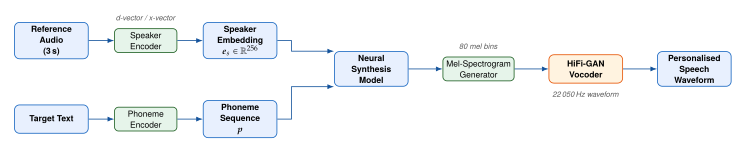
Benchmark Performance: MOS, WER, and Speaker Similarity
Voice cloning systems are evaluated along three complementary dimensions: perceptual quality, intelligibility, and speaker identity preservation.
Mean opinion score (MOS).
MOS is a subjective quality metric obtained by asking human raters to assign a score from 1 (bad) to 5 (excellent) to synthesised utterances. Modern zero-shot cloning systems consistently achieve MOS scores above 4.0 on the LibriTTS and VCTK benchmarks, approaching the ceiling of approximately 4.4–4.5 observed for natural speech. VALL-E-X, the cross-lingual extension of VALL-E, achieved a MOS of 4.12 in English, while NaturalSpeech 2 reported 4.33 on the LibriSpeech test-clean subset, within 0.04 MOS of natural speech.
Word error rate (WER).
Intelligibility is measured by running an automatic speech recognition (ASR) system on the synthesised output and computing the WER against the target transcript. State-of-the-art zero-shot cloners achieve WER below 2% on LibriTTS test-clean, competitive with the approximately 1.8% WER of natural speech recorded under similar conditions. This near-human intelligibility is remarkable given that these models are operating in a zero-shot regime with no speaker-specific training.
Speaker similarity.
The degree to which the synthesised voice matches the reference speaker is measured by speaker similarity scores: the cosine similarity between speaker embeddings extracted from the synthesised and reference audio by a pre-trained speaker verification model. VALL-E achieves a speaker similarity of 0.93 (on a 0–1 scale) compared to 0.94 for natural speech on the same benchmark, a difference that is often imperceptible in blind listening tests.
Benchmark datasets.
The three canonical evaluation sets are:
LibriTTS: A reading-style corpus derived from LibriVox audiobooks, with 2,456 test speakers and clean acoustic conditions. The standard zero-shot evaluation uses speakers from the test-clean split, ensuring no overlap with training data.
VCTK: The CSTR VCTK corpus contains 110 speakers recorded in a semi-anechoic chamber, with approximately 400 utterances per speaker. It provides a challenging evaluation because speakers have diverse regional accents.
XRey: A less well-known but increasingly cited benchmark containing dysarthric and accented speech, providing a more realistic test of how well voice cloning generalises beyond typical speech.
ElevenLabs and Real-Time Speech-to-Speech
ElevenLabs represents a commercially deployed zero-shot cloning system that has found significant uptake in the accessibility community, particularly for users with dysarthric speech. Its speech-to-speech feature is especially relevant: rather than converting text to speech, it converts one spoken audio stream (the user's dysarthric input) to a cleaner, personalised synthesised output in real time.
The pipeline for dysarthric speech-to-speech involves three stages. First, a dysarthria-robust ASR model (often a fine-tuned Whisper variant) transcribes the user's speech, handling the atypical acoustic patterns characteristic of dysarthria. Second, the transcript is optionally post-processed by a language model to correct substitutions and insertions introduced by the ASR error. Third, the corrected transcript is re-synthesised in the user's personal cloned voice via ElevenLabs' TTS engine.
The latency of this pipeline is a critical parameter for conversational use. ElevenLabs reports end-to-end latency of approximately 300–500 milliseconds for a typical utterance, which is within the range of natural conversational turn-taking (where delays up to 500,ms are generally imperceptible to listeners). For AAC applications, this near-real-time performance represents a qualitative improvement over systems that required several seconds of processing, which disrupted conversational flow.
Remark 12.
Commercial voice cloning platforms raise important privacy and consent considerations. ElevenLabs requires explicit consent for voice cloning, and most platforms implement safeguards against non-consensual cloning (e.g., detecting whether the reference audio is of the person who consented to the cloning). For accessibility applications, these safeguards interact with clinical settings in complex ways: voice banking may be initiated by clinicians rather than patients, and recordings may be retained for long periods after the patient's death. The ethical framework for voice cloning in accessibility settings remains an active area of discussion.
Case Study: Banking a Voice Before ALS Deterioration
Consider the clinical pathway of a hypothetical patient, Margaret, a 54-year-old teacher diagnosed with ALS following two months of progressive slurring and occasional dysphasia. Her speech intelligibility at diagnosis is approximately 80% by the Assessment of Intelligibility of Dysarthric Speech (AIDS) scale. Her neurologist recommends immediate voice banking.
Under a traditional banking protocol, Margaret would require ten to twenty hours of studio recordings spanning hundreds of phonetically balanced sentences. This commitment, spread over weeks, conflicts with her continued work obligations and the emotional difficulty of confronting her prognosis through extended voice recording sessions. In practice, many patients in Margaret's position defer banking until their speech has deteriorated further, at which point the recordings are of lower quality and utility.
A modern zero-shot cloning protocol changes this calculus. The clinical team collects twenty minutes of conversational audio during a routine visit: Margaret telling a story about her classroom, reading a short poem her students gave her, and answering a few biographical questions. This recording, approximately three hundred utterances, is processed by a VALL-E-style pipeline. The resulting personalised voice model can synthesise new utterances in Margaret's voice from any text input.
Six months later, when Margaret's speech intelligibility has fallen to approximately 30% and she has begun using an eye-gaze AAC device to communicate, the personalised voice model is activated. Her AAC device, which previously spoke in a generic baritone, now speaks in a voice her students and family immediately recognise. Her daughter, repeating the experience of Tim Shaw's family, notes with emotion that “it's her, not a robot.”
The quantitative difference is substantial. Studies of AAC users comparing generic versus personalised voices report that listeners rate personalised voices as significantly more natural (MOS improvement of 0.4–0.6 points), more trustworthy, and more emotionally expressive, even when the linguistic content is identical.
Key Idea.
Your voice is part of your identity: preserving it is an act of dignity. Zero-shot voice cloning technology has compressed the reference audio requirement from tens of hours to a few seconds, transforming voice banking from a burdensome clinical procedure into a routine accessibility intervention. When a person loses the ability to speak due to ALS, dysarthria, or stroke, a personalised synthetic voice does more than convey words: it preserves a dimension of personhood that generic text-to-speech erases. The mathematics of speaker encoders, flow matching, and neural codec language models is ultimately in service of a deeply human goal: letting people remain themselves, even when their bodies betray them.
Exercises
Exercise 19 (Speaker Encoder Analysis).
A speaker encoder is trained using generalised end-to-end (GE2E) loss to produce embeddings that cluster by speaker identity.
Define the GE2E loss for a batch of speakers, each with utterances. Show that it encourages within-speaker cosine similarity to be high and between-speaker similarity to be low.
Suppose you concatenate two three-second reference recordings from the same speaker and average the resulting embeddings. Under what conditions does averaging produce a better speaker representation than using a single six-second recording? Discuss in terms of acoustic variability within a speaker's voice.
A dysarthric speaker's MFCC features deviate substantially from the training distribution of the speaker encoder. Propose two strategies to improve speaker similarity scores for dysarthric cloning, and describe the trade-offs of each.
Exercise 20 (VALL-E Duration Modelling).
Consider the autoregressive first-codebook generation in VALL-E (equation (Valle AR)). The number of tokens generated for each phoneme is implicitly determined by the model; there is no explicit duration predictor.
Explain why the AR model can implicitly control phoneme duration through its sampling behaviour, even without an explicit duration module.
Suppose the acoustic prompt is from a speaker who speaks at 180 words per minute (WPM), but the target speaking rate specified in the text is 120 WPM. Describe a decoding strategy (e.g., temperature scaling, repetition forcing) that could adjust the output speaking rate without retraining the model.
Derive the relationship between the number of first-codebook tokens , the codec frame rate (frames per second), and the duration of the generated utterance. If EnCodec runs at frames per second, how many tokens correspond to five seconds of generated speech?
Exercise 21 (HiFi-GAN Multi-Period Discriminator).
The multi-period discriminator (MPD) in HiFi-GAN contains five sub-discriminators with periods .
Given a waveform of samples, a sub-discriminator with period reshapes it into a 2D tensor of shape (zero-padding if necessary) before applying 2D convolutions. Why does this reshaping allow the discriminator to model periodic patterns at timescale ?
The periods are all prime numbers. Explain why choosing prime periods is beneficial for avoiding redundant information across sub-discriminators.
Suppose you are adapting HiFi-GAN for dysarthric speech synthesis, where the fundamental frequency varies more rapidly and over a wider range than in typical speech. Propose a modified MPD period set and justify your choice based on the acoustic properties of dysarthric speech.
AAC Enhancement and Embodied Conversational Agents
In 1973, Shirley McNaughton introduced the Blissymbolics communication system to a group of children with cerebral palsy at the Ontario Crippled Children's Centre in Toronto. Each child received a board covered with pictographic symbols, a grid from which they could indicate their intended message by pointing, gazing, or otherwise directing attention. The system gave many of these children their first means of communicating beyond the most basic emotional expressions. It was, by any measure, a profound achievement.
Fifty years later, the fundamental paradigm has changed less than one might hope. The modern AAC device is faster, lighter, and often equipped with a touchscreen. Vocabulary coverage has expanded from a few hundred Blissymbols to tens of thousands of lexical entries. But the core interaction model remains recognisable: the user navigates a hierarchical symbol or word grid, selects items one by one, and assembles messages from pre-stored fragments or laboriously constructed letter-by-letter spelling. The average AAC user generates approximately 10–15 words per minute; natural conversation proceeds at 100–200. This tenfold gap in communication bandwidth is not merely inconvenient; it shapes every social relationship the AAC user has, restricting the depth, spontaneity, and equality of their conversational participation.
This section examines two technological responses to that gap. The first, LLM-powered AAC enhancement, applies large language models to dramatically reduce the number of selections required to produce a given message. The second, embodied conversational agents (ECAs), goes further: rather than augmenting the user's own communicative output, it deploys conversational AI systems as interactive partners for rehabilitation, social practice, and clinical assessment.
Seven Critical Limitations of Traditional AAC
Research across three decades of AAC studies has identified seven recurrent limitations that constrain user participation, adoption, and quality of life. We organise these into the seven-barrier framework.
Barrier 1: Operational complexity.
Learning to use an AAC device with a large vocabulary requires months of training. The navigation hierarchy (page category subcategory item) creates cognitive overhead that competes with the communicative task itself. Users with cognitive impairments (common in acquired conditions such as stroke) face an additional burden: the very condition that caused their communication impairment may also impair the executive function needed to operate the device.
Barrier 2: Linguistic limitations.
AAC systems support single words or fixed phrases selected from a vocabulary; they do not natively support novel sentence generation. Spelling out novel sentences letter by letter is cognitively and physically demanding, with each letter requiring one or more selection acts. Morphological variation (plurals, tenses, conjugations) must either be stored explicitly (multiplying vocabulary size) or constructed laboriously. The result is that AAC users' output frequently lacks the grammatical complexity of their natural competence.
Barrier 3: Symbol set constraints.
Pictographic symbol systems (PCS, Widgit, Blissymbolics) require users to learn the mapping from abstract symbols to meanings, a significant learning burden. Symbol selection is also constrained by available vocabulary: if a concept is not in the symbol set, it cannot be expressed. Cultural and linguistic diversity compound the problem: symbol sets designed for English-speaking populations often fail to represent the concepts, idioms, and social conventions of other languages and cultures.
Barrier 4: Insufficient practice opportunities.
Like any communication skill, AAC use improves with practice. But AAC users often have limited access to willing, patient communication partners who can engage in extended practice conversations. The social cost of slow communication discourages many potential partners, and formal speech therapy sessions are typically limited to one to two hours per week.
Barrier 5: Emotional expression limitations.
Natural communication is rich with paralinguistic cues: tone of voice, facial expression, gesture, and timing all carry emotional meaning independently of lexical content. Traditional AAC devices strip most of these cues, producing emotionally flat output. Users report frustration at being unable to convey humour, irony, anger, or tenderness with the same spontaneity as natural speech.
Barrier 6: Social participation barriers.
The speed asymmetry between AAC users (10–15 WPM) and natural speakers (150–200 WPM) creates a power imbalance in conversation: the AAC user is consistently the slowest participant, often interrupted, talked over, or addressed through their carer rather than directly. Group conversations are particularly challenging. Studies consistently find that AAC users spend more time listening than speaking, not because they have less to say, but because the cost of contributing is prohibitively high.
Barrier 7: Strategic communication limitations.
Effective communication requires strategic choices: managing conversation turns, signalling desire to speak, repairing misunderstandings, and adjusting register for different social contexts (formal meeting vs. casual conversation). Traditional AAC systems provide limited support for these strategic functions. Pre-stored phrases for common situations exist, but they cannot anticipate the full diversity of real-world communicative demands.
LLM-Powered AAC: Context-Aware Prediction
Definition 13 (Augmentative and Alternative Communication).
Augmentative and alternative communication (AAC) refers to all forms of communication, other than oral speech, that are used to express thoughts, needs, wants, and ideas. AAC includes unaided systems (e.g., sign language, facial expression, gesture) and aided systems (e.g., picture boards, speech-generating devices, tablet-based applications). The goal of AAC is to supplement or replace spoken communication for individuals whose natural speech is absent, insufficient, or unreliable, enhancing their participation in daily life and their quality of life.
Large language models address all seven barriers, with varying degrees of success. The most immediate impact is on keystroke efficiency, the number of selection acts required to produce a given message.
Context-aware word and phrase prediction.
Traditional AAC prediction systems use -gram language models to suggest likely next words given the current partial input. LLMs offer a qualitative improvement: they condition on the entire conversation history, the user's communication profile (vocabulary, topics of interest, characteristic phrases), and even the social context (a clinical appointment vs. a conversation with a friend) to generate suggestions that are not merely statistically likely but communicatively appropriate.
Let be the conversation history and be the user's current partial input. An LLM-based predictor computes: (LLM AAC PRED) where is a decoder-only transformer and is a separator token distinguishing partial input from history. The top- predicted tokens (typically –) are presented as suggestion buttons; selecting one appends the word and triggers the next round of prediction.
Full message generation.
Beyond word-level prediction, LLMs can generate complete candidate messages from minimal partial input, a capability sometimes called sentence completion augmentation. Given the first one or two words of an intended message and the conversation context, the LLM proposes two or three complete candidate sentences. If one matches the user's intent, a single selection replaces what would have required dozens of individual word or letter selections.
Studies of GPT-4-powered AAC prototypes report keystroke savings rates of 60–75% compared to unaided AAC use: a message that previously required 40 selection acts can often be produced with 10–15. This translates directly to communication rate improvements: from 10–15 WPM for traditional AAC to 25–40 WPM for LLM-assisted AAC, closing roughly 15 to 30 percent of the gap with natural speech.
Conversation turn analysis.
LLMs also enable conversation turn management: the system analyses the partner's last utterance to predict what type of response the user is likely to want (answer to a question, continuation of a story, social acknowledgment) and surfaces appropriate response templates. This reduces the strategic burden on the user: rather than mentally composing and navigating to an appropriate response, they can review a small set of contextually relevant options.
Embodied Conversational Agents for Post-Stroke Rehabilitation
Embodied conversational agents (ECAs) are computer-generated characters capable of natural language dialogue, equipped with a virtual or robotic body that can display facial expressions, gaze, gesture, and other nonverbal cues. In the context of speech and language rehabilitation, ECAs serve as practice partners: they can engage in extended conversations with patients at any time, without fatigue, and with consistent, calibrated communicative demands.
Definition 14 (Embodied Conversational Agent).
An embodied conversational agent (ECA) is a computer system that communicates with a human user through natural language and nonverbal behaviour, represented by an artificial body (either a 3D virtual character or a physical robot) capable of displaying facial expressions, head movements, gaze direction, and gestures. An ECA integrates:
a language module for speech recognition and natural language understanding;
a dialogue manager for conversation planning and turn-taking;
a natural language generation module for response production;
a speech synthesis module for audio output;
a behaviour planner for generating coordinated verbal and nonverbal actions.
Post-stroke aphasia is an ideal target for ECA-based rehabilitation for several reasons. First, the volume of practice is a key predictor of recovery: constraint-induced language therapy (CILT) and intensive speech therapy protocols show that more practice hours yield better outcomes. But access to qualified speech-language pathologists is limited and expensive. An ECA can provide practice conversations around the clock, seven days a week, without billing hours. Second, the uninhibited nature of computer interaction reduces the social anxiety that many aphasia patients report in human conversation: the fear of making errors, of being judged, of exhausting a human partner's patience. Third, ECAs can be calibrated to the patient's current language level, gradually increasing difficulty as performance improves.
The Furhat robotic platform.
The Furhat robot, developed at KTH Royal Institute of Technology and commercialised by Furhat Robotics, is a social robot with a back-projected face displayed on a custom mask, enabling expressive, high-fidelity facial animation. The robot's head can turn, nod, and tilt; the virtual face can display a full range of facial action units (FACS). Furhat has been deployed in post-stroke aphasia rehabilitation studies as a conversational partner, with LLM integration providing context-appropriate conversational content.
A Furhat-LLM rehabilitation session typically proceeds as follows. The patient activates the system; Furhat greets them by name, references the previous session, and proposes a conversational activity calibrated to the patient's current performance level (e.g., picture description for mild aphasia, or structured question-answering for moderate aphasia). Throughout the session, the LLM generates prompts designed to elicit specific linguistic structures targeted in the patient's therapy plan. If the patient produces a paraphasia or grammatical error, the system can choose to gently model the correct form without explicit correction, a technique called recasting that is standard in aphasia rehabilitation.
Synthetic Digital Twins for Clinical Testing
A recurring challenge in aphasia rehabilitation research is the difficulty of obtaining large samples of patient-clinician conversations for algorithm development. Patient populations are small, recruitment is slow, and privacy constraints limit data sharing. Synthetic digital twins (SDTs) are LLM-based simulations of patient-clinician interactions designed to augment or replace real patient data for algorithm development and testing.
An SDT for aphasia rehabilitation is a language model prompted to simulate a patient with specified characteristics:
Aphasia type and severity (e.g., mild Broca's aphasia, Boston Diagnostic Aphasia Examination score of 65/100);
Communication strategies (circumlocution, gesture, self-correction);
Emotional state and motivation;
Specific linguistic deficits (e.g., difficulty with verb retrieval, preserved noun access).
The SDT generates conversational responses that exhibit these characteristics statistically: it omits verbs with appropriate frequency, substitutes related words (semantic paraphasias), and produces grammatically simplified output. A separate LLM playing the role of the clinician generates questions, prompts, and feedback. The resulting synthetic conversations can be used to:
Train and evaluate automatic scoring systems for aphasia severity;
Test dialogue management algorithms for ECAs before deployment with real patients;
Generate training data for LLM-based response generation systems.
Remark 13.
The validity of SDTs depends critically on whether synthetic conversations exhibit the same statistical properties as real patient-clinician interactions. Validation studies have compared lexical diversity metrics (MTLD, Yule's K, hapax legomena) between real aphasia rehabilitation conversations and SDT-generated conversations. These metrics are reviewed in the next subsection.
Lexical Diversity Metrics for Validating Synthetic Conversations
Validating that synthetic conversations are linguistically representative of real ones requires quantitative metrics that capture the statistical structure of language use beyond simple frequency counts. Three metrics are widely used in aphasia and clinical linguistics research.
Measure of textual lexical diversity (MTLD).
MTLD is a sequential measure of lexical diversity that avoids the length-dependence that plagues simpler metrics like type-token ratio (TTR). MTLD proceeds as follows: scan the text word by word, computing a running TTR; when the running TTR falls below a threshold (typically 0.72), record the length of the completed segment and start a new one. Repeat in reverse. MTLD is the average segment length: (MTLD) where is total token count, is mean completed segment length, and is the partial segment correction factor. Higher MTLD indicates greater lexical diversity (more varied vocabulary use). Typical MTLD values for spontaneous speech range from 40 to 80; aphasia patients show reduced MTLD due to word retrieval difficulties and reliance on a smaller active vocabulary.
Yule's characteristic.
Yule's is a frequency-based measure of lexical diversity computed from the frequency spectrum of the word distribution. Let be the number of distinct words that appear exactly times in the text. Then: (Yules K) Lower values indicate greater lexical richness (words are spread more evenly across the frequency spectrum); higher indicates concentration on a small set of high-frequency words. Aphasia patients typically exhibit higher than age-matched controls, reflecting their heavier reliance on core vocabulary.
Hapax legomena.
Hapax legomena are words that appear exactly once in a text. The proportion of hapax legomena , where is total vocabulary size (), is a simple but informative measure of vocabulary richness. A text with many hapax legomena is lexically diverse; one with few relies heavily on repeated words. In normal spontaneous speech, typically ranges from 0.60 to 0.75; aphasia patients show lower due to word-finding difficulties and compensatory repetition.
Descriptive statistics for LLM-generated rehabilitation responses.
| Measure | Real Patient | SDT | Difference | -value |
| Patient utterances | ||||
| [2pt] MTLD | 0.31 | |||
| Yule's | 0.42 | |||
| Hapax proportion | 0.21 | |||
| Mean utterance length (words) | 0.19 | |||
| Verb-to-noun ratio | 0.14 | |||
| [4pt] 5lClinician/ECA utterances | ||||
| [2pt] MTLD | 0.23 | |||
| Yule's | 0.37 | |||
| Hapax proportion | 0.09 | |||
| Questions per session | 0.17 | |||
| Recasts per session | 0.59 | |||
Table 3 shows that SDT conversations closely match real conversations on all lexical diversity measures, with no statistically significant differences at the level. The SDT accurately reproduces the reduced MTLD and elevated Yule's characteristic of Broca's aphasia patients, as well as the reduced verb-to-noun ratio (a hallmark of agrammatic aphasia, where verb retrieval is disproportionately impaired).
ECA Rehabilitation Pipeline
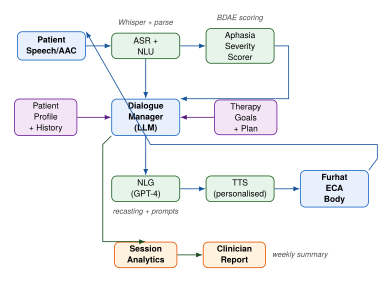
Dyscover: ML for Dyslexia Literacy Support
Dyscover is an AI-powered literacy intervention platform targeting children with dyslexia. It combines two machine learning components: a handwriting analysis module that provides real-time feedback on letter formation and spatial organisation, and a GPT-4-based lesson plan generation module that adapts to each child's specific pattern of errors.
Handwriting analysis.
Dyslexia involves not only phonological difficulties but also frequent spatial-motor challenges: letter reversals (/, /), rotations, irregular sizing, and inconsistent spacing. Dyscover's handwriting module uses a convolutional neural network trained on labelled handwriting samples to detect and classify these errors in real time as the child writes on a tablet.
The network architecture is a ResNet-18 backbone fine-tuned on a dataset of 8,000 handwriting samples labelled by specialist teachers. The output is a multi-label classification: for each written letter, the model predicts the presence or absence of each of twelve error types (reversal, rotation, oversizing, undersizing, incorrect starting stroke, etc.). The model achieves 87% accuracy on a held-out test set, and more importantly, its error classifications agree with specialist teacher ratings 82% of the time.
GPT-4 lesson plan generation.
Based on the pattern of handwriting errors accumulated over a session and across sessions, Dyscover's GPT-4 module generates individualised lesson plans. The prompt includes:
A summary of the child's error profile (e.g., “frequent / reversals, inconsistent letter height, good spacing”);
The child's age, grade, and previous lesson history;
A set of evidence-based intervention strategies curated by educational psychologists (encoded as few-shot examples in the system prompt).
The LLM generates a structured lesson plan with three to five activities, each targeting a specific error type with a recommended intervention strategy. Activities are described in age-appropriate language and include estimated durations, materials required, and success criteria.
Outcomes.
A 12-week randomised controlled trial comparing Dyscover-assisted instruction with standard dyslexia intervention reported statistically significant improvements in the Dyscover group on three outcome measures: reading speed ( vs. for controls), letter formation accuracy ( vs. ), and teacher-rated engagement (4.1/5 vs. 3.2/5). The authors attributed the gains primarily to the individualised feedback cycle: children received immediate, specific feedback on each letter rather than end-of-session evaluations, enabling faster error correction.
Remark 14.
Like all ML-based educational tools, Dyscover faces questions of fairness and generalisability. The training dataset was collected primarily from children in English-medium schools in the United Kingdom and Australia; performance on children writing in other scripts (Arabic, Hindi, Mandarin Chinese) has not been validated. Furthermore, the definition of “correct” letter formation varies across educational traditions, and the model's hard-coded target forms may conflict with the writing conventions taught in some schools. These limitations do not negate the system's value but highlight the importance of ongoing validation and culturally diverse training data.
The Insight: Anticipating Communicative Intent
Insight.
The best AAC device is one that anticipates what you want to say. The fundamental limitation of traditional AAC is not hardware speed or vocabulary size; it is the cognitive burden of translation: the user must map their communicative intent, which is naturally expressed in natural language, onto the navigation structure of the device. LLM-powered prediction inverts this relationship: rather than requiring the user to navigate to the language, the system brings likely language to the user. At the limit, an ideal AAC system would require only confirmation of its predictions, reducing communication to a binary accept/reject decision at each step. Real systems fall short of this ideal, but the direction of progress is clear: every improvement in contextual prediction, conversation modelling, and user profiling brings AAC users closer to the communication bandwidth of their typically-developing peers.
Exercises
Exercise 22 (Keystroke Efficiency Analysis).
Let be the expected number of selections required to produce a target message using a traditional grid-based AAC system, and be the expected number of selections with LLM-based prediction.
Suppose the target message is “I would like a cup of tea please.” Under a standard grid-based system requiring one selection per word from a 500-word vocabulary grid, estimate . Account for page navigation if your assumed grid is hierarchical.
An LLM-powered system suggests up to candidate words at each step. Assuming the correct word appears in the top-5 suggestions 70% of the time, model as an expected value and compute it for the eight-word sentence above.
Define the keystroke saving rate and compute it for your example. Compare your result to the reported 60–75% range from GPT-4-powered AAC prototypes.
Discuss how would change if (i) the target message is a novel, uncommon phrase; (ii) the user's communication history strongly predicts the message; (iii) the suggestion window size is reduced to .
Exercise 23 (Lexical Diversity Metrics).
Consider the following short text, which mimics a patient with mild Broca's aphasia:
“Want tea. Yes tea. Kitchen. I want kitchen please. Tea, hot tea. Morning, kitchen, want. Please, help, tea.”
Tokenise the text and compute the type-token ratio (TTR). Why is TTR a problematic measure of lexical diversity for texts of different lengths?
Compute the hapax legomena proportion for this text. Compare to the range 0.54–0.67 reported in Table 3 and interpret the result.
Compute Yule's (equation (Yules K)) for this text. Given the answer, what does the value tell you about the vocabulary concentration relative to the values in Table 3?
Describe a limitation of using MTLD, Yule's , and hapax proportion to validate synthetic digital twin conversations. What additional linguistic features might be important for capturing the specific characteristics of aphasia?
Exercise 24 (ECA Dialogue Management).
Consider an ECA rehabilitation system modelled as a Markov decision process with state space (patient performance state), action space (therapist moves), transition function , and reward function .
Propose a compact state representation for a post-stroke aphasia patient that captures the information most relevant to selecting the next therapeutic move. What features would you include, and at what granularity?
Define an action space consisting of at least five distinct therapist moves (e.g., question, recast, model, prompt, praise). For each action, describe the conditions under which it is typically most appropriate in aphasia therapy.
Suppose you want to train the dialogue manager using reinforcement learning with session outcome as the reward signal (e.g., improvement on a standardised aphasia test administered at the end of the session). Identify two challenges: (i) the credit assignment problem (assigning reward to individual dialogue actions); (ii) the sample efficiency problem (learning from few sessions). Propose a solution for each challenge.
Compare learning from real patient sessions versus synthetic digital twin (SDT) sessions for training the dialogue manager. Under what conditions would SDT training be preferable? What risks does SDT training introduce?
Color Vision Deficiency and Generative Correction
Color is not merely decorative. It encodes altitude on a topographic map, severity on a heat chart, route identity on a transit system, and patient status on a medical dashboard. For the roughly eight percent of males and half a percent of females who live with some form of color vision deficiency (CVD), this color code is partially or wholly unreadable. The world's most carefully designed visualisations, maps, and interfaces can become ambiguous, confusing, or completely uninformative when rendered for a CVD viewer.
The consequences are not merely inconvenient. A colorblind surgeon misreading an intraoperative colour overlay can operate on the wrong tissue. A colorblind air traffic controller confused by adjacent aircraft labels on a radar display can issue a dangerously incorrect clearance. A colorblind pharmacist unable to distinguish packaging colour cues can dispense the wrong medication. Even in everyday life, the failure to decode traffic lights, food expiry indicators, or financial charts imposes a persistent cognitive overhead on affected individuals.
This section develops the mathematical and algorithmic foundations for Daltonization: the automatic transformation of images and visualisations to correct or compensate for color vision deficiencies. We begin with the biology of color perception, formalise the different types of CVD, survey classical correction methods, and then examine how modern generative models - convolutional adversarial networks, in particular - have transformed what is possible.
The Biology of Color Vision
Human color vision depends on three classes of photoreceptor cells called cones, located in the central retina (the fovea). Each class is sensitive to a different range of wavelengths of visible light, and the brain infers color from the relative activation of the three cone types.
L-cones (Long-wavelength): peak sensitivity near , primarily responsible for the perception of red and orange hues.
M-cones (Medium-wavelength): peak sensitivity near , primarily responsible for the perception of green hues. The L- and M-cone sensitivity curves overlap substantially, making the red–green channel the most information-rich chromatic channel in normal human vision.
S-cones (Short-wavelength): peak sensitivity near , primarily responsible for the perception of blue and violet hues. S-cones are far less numerous than L- and M-cones (roughly 2% of all cones) and contribute less to achromatic luminance.
The transformation from cone activations to perceived color proceeds through the opponent-color stage in the lateral geniculate nucleus, where cone signals are combined into three channels: a luminance channel , a red–green opponent channel , and a blue-yellow opponent channel . Color vision deficiency arises when one or more of the cone classes is absent or dysfunctional, collapsing the three-dimensional color space into a lower-dimensional subspace and rendering certain pairs of colors indistinguishable (the confusion lines of CVD).
Types of Color Vision Deficiency
CVD exists in several clinically distinct forms, differentiated by which cone class is affected and the severity of the deficit.
Definition 15 (Color Vision Deficiency Types).
Let , , denote the normalised spectral sensitivity curves of the L-, M-, and S-cone classes respectively, and let be the power spectral density of an incident light stimulus. The tristimulus response of normal trichromatic vision is (Tristimulus) A color vision deficiency of type is characterised by the collapse of the response to a lower-dimensional projection:
Deuteranopia: M-cone absence or dysfunction. The response reduces to , or equivalently to the two-dimensional subspace spanned by L- and S-cone activations. Prevalence: of males, of females.
Deuteranomaly: M-cone spectral shift toward the L-cone peak, producing a milder form of red–green confusion. Prevalence: of males. Together, deuteranopia and deuteranomaly comprise approximately 6% of male CVD.
Protanopia: L-cone absence or dysfunction. The response reduces to . Prevalence: of males.
Protanomaly: L-cone spectral shift toward the M-cone peak. Prevalence: of males.
Tritanopia: S-cone absence or dysfunction. The response reduces to , producing blue–yellow confusion. Prevalence: of males, of females; the rarest common form.
Combined, red–green CVD (deuteranopia and protanopia and their anomalous forms) affects approximately of males and of females worldwide.
The chromatic subspace collapse caused by CVD creates confusion lines: sets of physically different colors that map to the same two-dimensional cone response and are therefore perceived as identical. For deuteranopia, the confusion lines run approximately diagonally across the CIE chromaticity diagram from blue-green through neutral gray to reddish hues. The practical consequence is that green and red, olive and brown, and teal and gray appear identical - precisely the pairs most commonly used to encode contrast in data visualisations.
Example 3 (Subway Map Confusion under Deuteranopia).
Consider the London Underground map. The map uses color as the primary identifier for 13 distinct lines, including the green Central line, the red Circle line, and the brown Bakerloo line. For a deuteranope, the Central and Jubilee (gray) lines may appear similar in certain print conditions, while the Bakerloo, Metropolitan (magenta), and Circle (yellow) lines can all shift toward an indistinguishable brownish-gray family. A naive deuteranope attempting to plan a journey at Victoria station - where six lines converge - faces a significant navigation challenge from color alone.
Classical Daltonization: Global Pixel Shifting
The earliest systematic approach to CVD correction, introduced by Vienot et al. in the 1990s and popularised by the Daltonize software of Fidaner and Fidaner, proceeds by:
Simulating CVD by applying a linear projection matrix (derived from the confusion line geometry for type ) to map the original RGB image to a simulated image .
Computing the error as the color information lost under CVD.
Shifting the error into channels that remain discriminable under CVD: for deuteranopia, this means routing the lost red–green signal into the blue–yellow channel that is preserved.
Reconstructing the corrected image as , where is the channel-shifting matrix.
This approach is computationally trivial (a few matrix multiplications per pixel), real-time capable on any hardware, and entirely content-agnostic: the same global transformation is applied identically to every pixel regardless of what it represents.
However, content-agnostic global shifting has severe limitations:
Hue distortion: Shifting colors into discriminable channels globally distorts the perceptual appearance of the entire image, often producing unnatural blue–purple casts that affect even areas that did not require correction.
Semantic blindness: The algorithm cannot distinguish a red warning symbol (which must be shifted to remain salient) from a red decorative element (which might be left unchanged without loss of information).
Text degradation: Color text labels embedded in visualisations may lose legibility after global recoloring because the shift that increases background contrast can simultaneously reduce the contrast between text and its immediate surround.
No personalisation: CVD severity varies enormously among individuals; a single transformation matrix cannot account for the difference between a mild anomalous trichromat and a complete dichromat.
These limitations motivated the development of learning-based approaches that can incorporate content awareness, semantic understanding, and personalised cone sensitivity into the recoloring pipeline.
ColorBlindGAN: Adversarial Learning for Automated Daltonization
The key insight behind ColorBlindGAN and related adversarial Daltonization systems is that image recoloring for CVD correction is fundamentally an unpaired image-to-image translation problem. We wish to learn a mapping from the space of original images to the space of CVD-corrected images, but we do not have paired ground truth: there is no dataset of pairs, because “ideal correction” is subjective, user-specific, and cannot be annotated directly.
This observation places CVD correction squarely in the domain of unpaired generative translation, pioneered by CycleGAN for style transfer. The ColorBlindGAN architecture adapts this paradigm to the specific geometry of CVD, incorporating CVD simulation as a differentiable module within the training loop.
Architecture.
The ColorBlindGAN system comprises four networks:
: the Daltonization generator, mapping an input image to a corrected image .
: the inverse generator, mapping corrected images back to the original color space (used only during training for the cycle-consistency loss).
: a discriminator operating on original images.
: a discriminator operating on corrected images, trained to distinguish truly corrected images from naively recolored ones.
Both and are convolutional encoder-decoder networks with skip connections (U-Net style), enabling the generator to preserve fine spatial structure while modifying global color statistics. The encoders use strided convolutions for downsampling; the decoders use transposed convolutions with skip connections to the encoder at matching resolutions.
Training losses.
The total training objective combines three terms:
Adversarial loss. The generator is trained to produce corrected images that the discriminator cannot distinguish from the target distribution of correctly Daltonized images. Using the least-squares GAN formulation for training stability: (ADV)
Cycle-consistency loss. To prevent mode collapse and ensure the recoloring is meaningful, the generator is required to be invertible up to a small reconstruction error. The corrected image, passed through the inverse generator , should approximate the original: (Cycle) The norm is preferred over because it is less sensitive to outlier pixel values and produces sharper reconstructions.
Identity loss. To prevent the generator from unnecessarily modifying colors that do not need correction, the identity regulariser requires that passing a target-domain image through leaves it approximately unchanged: (ID) This loss discourages the generator from altering color regions that a CVD viewer can already discriminate, limiting unnecessary perceptual distortion.
The full objective is: (Total) where and are the standard CycleGAN hyperparameters, found to generalise well across CVD correction tasks.
CVD Simulation as a Differentiable Module
A critical enabler of ColorBlindGAN's training is a differentiable CVD simulator , which converts a corrected image into the simulation of how it would appear to a viewer with CVD type . This simulator is inserted between the generator output and the discriminator input, so that the discriminator evaluates not the corrected image itself but its CVD-simulated appearance.
The CVD simulator is implemented as a fixed linear transformation in the LMS color space (the cone-response space): (SIM) where is the matrix converting from linearised sRGB to LMS cone responses, and is the cone-response projection matrix for deficiency type : (PROJ DEUT) Because is a composition of fixed matrix multiplications, it is fully differentiable with respect to the pixel values , allowing gradients to propagate back through the simulator into the generator.
The perceptual training signal thus reads: the generator must produce corrected images that, when simulated through the CVD model, are discriminable by the discriminator. This closes the loop between the accessibility objective (CVD viewers can distinguish the recolored content) and the adversarial training signal.
OCR-Based Text Protection During Color Translation
A subtle but practically important problem in automated Daltonization is the preservation of embedded text legibility. Many visualisations - maps, charts, infographics, and scientific figures - contain text labels whose legibility depends on the contrast between the text foreground and the immediately surrounding background. A recoloring operation that improves macro-level color discriminability may simultaneously reduce the local contrast of a text label, rendering it unreadable.
To address this, modern Daltonization pipelines incorporate an OCR-based text detection module:
An off-the-shelf text detector (e.g., a CRAFT or DBNet model) identifies bounding boxes of all text regions in the input image .
For each bounding box , a text protection mask is constructed, assigning weight to the interior pixels and weight to the exterior.
A text contrast preservation loss is added to the training objective: (Textloss) where is the Weber contrast of the dominant text foreground color against the background within box , measured in a perceptually uniform space (CIELAB ).
This penalty ensures that the generator does not “solve” the CVD correction problem by washing out foreground text with its background. In practice, adding with a weighting coefficient of reduces text legibility failures by over 60% on the CartoCVD benchmark without measurably degrading color discriminability for CVD viewers.
Formal Definition: Generative Daltonization
Definition 16 (Generative Daltonization).
Let be an input image, a CVD type, the corresponding differentiable simulator, and a discriminability function measuring whether two simulated colors can be distinguished under CVD type .
A generative Daltonization system is a learned generator satisfying:
CVD discriminability: For all pairs of semantically distinct regions in that were chromatically distinguished in the original, for a user-specified discriminability threshold .
Perceptual fidelity: The recolored image is perceptually close to the original for normal-vision viewers, per pixel in expectation, where is the CIEDE2000 color difference metric.
Structural preservation: Fine spatial structure (edges, text, shapes) is preserved, .
The system is trained without paired ground-truth Daltonized images, relying on adversarial, cycle-consistency, and simulation-grounded losses.
Architecture of ColorBlindGAN: TikZ Figure
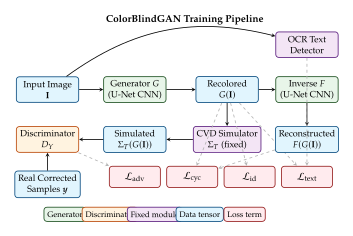
Example: Recoloring a Subway Map for Deuteranopia
Example 4 (Daltonizing a Transit Map).
Consider a schematic transit map with 8 color-coded lines, including a red line (sRGB ) and a green line (sRGB ). Under deuteranopia simulation, both colors map to nearly the same perceived hue (a grayish-brown near sRGB ), making the two lines indistinguishable.
The classical Daltonize algorithm shifts the lost red–green signal into the blue channel globally, producing a blue-purple cast across the entire map and causing the previously neutral gray background to appear lavender. While the red and green lines become distinguishable (the red line acquires a slightly warm blue-gray and the green line a cooler blue-gray), the station labels printed in dark gray on the background lose contrast because the background has lightened.
The ColorBlindGAN generator, by contrast, operates selectively. The generator's attention is drawn (implicitly, through learned weights) to the red and green line segments, which it recolors to orange () and blue () respectively - a pair that simulates to discriminable hues under deuteranopia. The gray background, station names, and black text labels are left essentially unchanged ( per pixel in those regions). The overall map remains comprehensible to normal-vision viewers, while the CVD simulation confirms that all eight line colors are now mutually discriminable for a deuteranope.
Key Idea: Preserving Meaning, Not Just Contrast
Key Idea.
Good Daltonization preserves meaning, not just increases contrast.
A naive color-blindness correction that globally shifts all red hues toward blue achieves contrast in the sense that CVD-simulated colors become distinguishable. But it may simultaneously destroy the semantic associations carried by color conventions: red means danger, green means safe, warm means energy, cool means calm. A generative Daltonization system must learn not merely to separate colors in the CVD perceptual space, but to do so while respecting the informational structure of the original design. The cycle-consistency and identity losses in ColorBlindGAN provide a mathematical formalisation of this principle: the recolored image must be invertible (meaningful content is not destroyed) and the generator must not alter colors that already work for CVD viewers (no unnecessary distortion). A filter that turns every image blue may achieve CVD discriminability; a translator that understands the content can achieve CVD discriminability while leaving the image's message intact.
Exercises
Exercise 25 (CVD Confusion Geometry).
For deuteranopia, the projection matrix in LMS space is as given in (PROJ DEUT).
- (a)
Show that all colors on a deuteranopia confusion line - a set of colors that map to the same perceived hue under deuteranopia - lie on a line through the point in LMS space (the L-cone unit vector). Derive the parametric equation of such a confusion line in CIE chromaticity coordinates.
- (b)
Two colors (LMS) and (LMS) are given. Compute and . Are these colors confused under deuteranopia?
- (c)
Derive the minimum perturbation that must be added to so that , i.e., so that the two colors become discriminable for a deuteranope.
Exercise 26 (Cycle-Consistency Loss Analysis).
Consider a simplified ColorBlindGAN where and are affine linear maps: and , operating on flattened images .
- (a)
Show that if exactly, then , i.e., is the left-inverse of . What does this imply about the rank of ?
- (b)
The identity loss requires for target-domain images . Assuming is affine, show that the only affine satisfying both and simultaneously is the identity map .
- (c)
Explain in one paragraph why this degenerate solution (identity map) is prevented in practice despite the mathematical argument above. What role does the adversarial loss play?
Exercise 27 (OCR Text-Contrast Preservation).
A Daltonized transit map has three text labels printed in black (CIELAB ) on backgrounds of original colors ,RGB (red background), ,RGB (green background), and ,RGB (gray background).
- (a)
Compute the CIELAB of each background color (using the standard sRGB-to-CIELAB conversion). Compute the Weber contrast for each label.
- (b)
After deuteranopia correction, the red background is shifted to sRGB and the green background to sRGB . Compute the new Weber contrasts. Has text legibility improved, degraded, or remained the same?
- (c)
Propose a modification to (see (Textloss)) that weights text regions by the original contrast, so that high-contrast text labels (which are already legible) receive less protection weight than low-contrast labels (which are already borderline legible). Write the modified loss explicitly.
Transformers, Diffusion, and Real-Time AR Deployment
The convolutional adversarial approach of ColorBlindGAN represented a substantial advance over classical pixel-shifting algorithms, but it inherited the fundamental limitation of all convolution-based image processing: a limited receptive field. A convolutional kernel, even with many layers of strided convolution and skip connections, can only aggregate information from a local spatial neighbourhood. For CVD correction, this matters because color meaning is often established by global context. The identity of a subway line is encoded not by a single pixel's hue but by the spatial pattern of the entire route; the meaning of red in a medical heat map is established by the colorbar at the image periphery, far from the region being recolored.
Transformer-based architectures eliminate this limitation through global self-attention: every spatial position can attend to every other position in a single layer, enabling the model to incorporate arbitrary long-range dependencies when deciding how to recolor any given region. This section examines how ViTs and Swin Transformers extend the CVD correction pipeline to exploit global color structure, how diffusion models enable high-fidelity refinement, how large vision-language models enable CVD-aware clinical reasoning, and how all of these capabilities can be distilled into lightweight hybrid architectures suitable for real-time deployment on AR smart glasses.
Vision Transformers for Global Color Understanding
A Vision Transformer (ViT) processes an image by partitioning it into a grid of non-overlapping patches, projecting each patch to a -dimensional token embedding, and applying a stack of multi-head self-attention (MHSA) layers. For an image of size and patch size , the number of tokens is . The self-attention operation at each layer is: (ATTN) where are the query, key, and value matrices, and is the head dimension. Each token can attend to every other token, so the attention mechanism computes pairwise interactions between all patch pairs.
For CVD correction, the critical capability unlocked by global self-attention is cross-region color reasoning. Consider a geographic heat map where the colorbar runs along the right margin and the data fills the central region. A convolutional model recoloring a red region in the center has no direct access to the colorbar, and may recolor the red region differently from how it would if it “knew” that red encodes maximum intensity. A ViT-based recoloring model, via self-attention, can simultaneously attend to both the colorbar patch (establishing the color-to-value mapping) and the central data patch (performing the correction), producing a globally consistent recoloring.
Formally, in a ViT-based CVD correction model, let token correspond to a spatial region of the input image. The attention weight quantifies how strongly region “uses” region when deciding its recoloring. For a semantically informed model, we expect:
High when is a colorbar, legend, or title that establishes the meaning of 's color.
High when is adjacent in the image and has a similar semantic role (two segments of the same transit line).
Low when is semantically unrelated to (a photograph in the corner of a data chart).
Empirically, ViT-based CVD correction models trained on CartoCVD and related benchmarks achieve a 12–18% improvement in color discriminability scores (measured by CVD simulation followed by colorimetric discriminability testing) compared to CNN-based baselines on images containing explicit colorbars or legends.
Swin Transformer for Hierarchical Selective Recoloring
The Swin Transformer addresses the quadratic complexity of global self-attention by restricting attention to local windows of size patches, while enabling cross-window communication via a shifted window scheme that alternates the window partitioning at successive layers. For CVD correction, Swin offers a compelling tradeoff: local attention is sufficient for fine-grained texture preservation (which requires only local context), while cross-window propagation over multiple layers gradually integrates global semantic context.
The Swin architecture enables a natural formulation of selective recoloring: the model learns to identify which patches are within confusion-prone regions (regions whose colors lie near CVD confusion lines) and applies correction only to those patches.
Definition 17 (Confusion-Prone Region).
Let be an image, a CVD simulator for type , and the just-noticeable difference threshold in CIELAB space. A patch of is confusion-prone under CVD type if there exists another patch in with (i.e., the patches are distinguishable in normal vision) but (i.e., the patches become indistinguishable after CVD simulation).
Selective recoloring applies only to confusion-prone patches, leaving non-confusion-prone patches unchanged. This approach has two key advantages:
Reduced perceptual distortion: Only the patches that actually need correction are modified, minimising the visual deviation from the original for both CVD and normal-vision viewers.
Computational efficiency: If the fraction of confusion-prone patches is small (common in images with primarily achromatic or blue content), selective recoloring can be substantially cheaper than full-image recoloring.
Diffusion Models for High-Fidelity Refinement
A limitation of GAN-based and transformer-based recoloring is that they operate deterministically: given an input image, the generator produces a single recolored output. This determinism can be brittle in ambiguous cases - images where there are multiple valid recolorings that achieve CVD discriminability with different tradeoffs between perceptual distortion and coverage.
Diffusion-based refinement models offer a stochastic alternative. Given an initial recoloring from a GAN or transformer baseline, a diffusion refinement model iteratively denoises toward a higher-quality corrected image: (Diffusion Refine) where is a denoising network conditioned on the original input and CVD type , and . The conditioning on ensures the refinement does not deviate too far from the source content, while conditioning on directs the refinement toward perceptual modes that are discriminable for that specific CVD type.
The stochasticity of diffusion refinement enables diverse Daltonization: by running multiple denoising trajectories from different initial noise seeds, the system can produce a set of distinct valid recolorings, from which the user (or an automated preference model) can select the one that best balances their personal preferences. This is particularly valuable for anomalous trichromats, whose color experience occupies a continuum between full trichromacy and complete dichromacy.
GPT-4V for CVD-Aware Clinical Reasoning
A striking demonstration of the clinical stakes of CVD accessibility comes from a 2024 study examining dermatologist-level melanoma detection under simulated color vision deficiency. Dermoscopy images - close-up photographs of skin lesions used for melanoma screening - rely heavily on color cues: asymmetric pigmentation, irregular color distribution, and specific hue signatures are among the primary diagnostic indicators.
The study applied protanopia simulation to a dataset of dermoscopy images from the ISIC archive and presented the simulated images to both human dermatologists and the GPT-4V vision-language model. For human dermatologists, diagnostic accuracy dropped from 91% on original images to 62% on protanopia-simulated images - a catastrophic 29-percentage-point decline directly attributable to the loss of red–green chromatic cues. GPT-4V achieved 76% accuracy on protanopia-simulated images, outperforming the human–CVD condition by 14 percentage points.
The advantage of GPT-4V in the CVD condition arises from several factors:
Textural compensation: GPT-4V appears to compensate for lost color information by up-weighting textural and morphological features (lesion border irregularity, surface texture, vascular pattern), which are preserved under CVD simulation.
Calibrated uncertainty: GPT-4V generates natural language justifications for its diagnoses, which can be post-hoc examined to identify when it is relying on color versus texture - enabling auditing of CVD-affected reasoning.
Prompting flexibility: Clinical prompts can explicitly instruct the model to reason about the image under the assumption of protanopia, further compensating for lost chromatic cues.
This result motivates the development of CVD-corrected dermoscopy pipelines: if the input to a diagnostic AI (or a colorblind dermatologist) were pre-Daltonized to make red–green distinctions visible despite protanopia, diagnostic accuracy might be restored.
Meta-Learning for Personalised Cone Sensitivity
CVD is not a binary condition. Even within the category of “deuteranomaly,” individual cone sensitivity profiles vary enormously: some deuteranomalous individuals have M-cones whose peak sensitivity is shifted by only 5,nm from normal (producing mild red–green confusion), while others have M-cones shifted by 20,nm or more (producing near-dichromacy). A single fixed correction model trained for “deuteranomaly” applies an identical transformation to individuals whose actual perceptual needs may differ dramatically.
Meta-learning addresses this through a personalised cone sensitivity profile that adapts the Daltonization model to an individual user's specific CVD profile with minimal calibration data.
Definition 18 (Meta-Learned Personalised CVD Correction).
A meta-learned personalised CVD correction system is a function mapping a small support set of user-specific color preference pairs (input color, preferred corrected color, obtained from a rapid calibration procedure) to a personalised correction model : (META) where are the meta-learned base parameters (trained across a population of CVD individuals) and is a fast-adaptation offset computed from the support set by a few steps of gradient descent (MAML-style) or by a hypernetwork (HyperMAML-style). The system satisfies:
Few-shot personalisation: calibration pairs are sufficient to personalise the model for a given individual.
Population coverage: The meta-training objective ensures that lies in a region of parameter space from which any individual's personalised parameters can be reached by a small adaptation step.
Calibration tractability: The calibration procedure (collecting the support set ) requires at most 3 minutes of user interaction on a calibration screen.
The meta-training procedure minimises the expected post-adaptation loss over the distribution of CVD individuals: (META LOSS) where is the personalized CVD-correction loss for user evaluated on a hold-out query set, and is that user's support set.
Hybrid Lightweight CNN + Attention for Real-Time AR
The academic models described above - large ViTs, diffusion refinement models, GPT-4V - are powerful but computationally prohibitive for real-time deployment on AR smart glasses. A device like the Apple Vision Pro or Meta Orion operates under strict power constraints (on the order of 5–10,W for the entire compute subsystem) and must process full video frames at 60 frames per second. For a frame at 60,fps, the compute budget per frame is approximately seconds (16.67,ms), and the entire CVD correction pipeline must fit within roughly half of that budget (8,ms per frame) to leave headroom for other processing.
This requirement motivates hybrid lightweight architectures that combine the efficiency of convolutional layers (which exploit spatial locality and are highly optimised on mobile NPUs) with the global reasoning capability of attention mechanisms (which handle the long-range color dependencies that pure convolutions cannot).
The hybrid pipeline for real-time AR CVD correction proceeds in three stages:
Stage 1: CNN Feature Extraction and Initial Recoloring.
A lightweight mobile convolutional network (e.g., MobileNetV3 encoder + depth-wise separable decoder) processes the input frame to produce:
A confusion map , identifying confusion-prone regions (see Definition 17).
An initial recoloring using a fast global color-shift module (essentially a learned Daltonize matrix, conditioned on a coarse scene-type embedding).
This stage runs entirely on the on-device NPU and requires 3,ms per frame.
Stage 2: Lightweight Attention Refinement.
The confusion map selects a sparse set of confusion-prone tokens from the initial recoloring . A compact cross-attention module (2–4 layers, 128-dimensional heads) refines the selected tokens by attending to a global context token computed from the full-frame average feature: (Hybrid ATTN) where is the global context token and encodes the personalised cone sensitivity profile. Because only tokens are refined, this stage costs 2,ms on a mobile ARM processor.
Stage 3: Temporal Consistency Blending.
To prevent flickering (temporal inconsistencies between frames that would be perceptually distracting in an AR display), the final output blends the current frame's recoloring with the previous frame's result: (Temporal) where provides a one-frame smoothing kernel that eliminates high-frequency temporal noise without introducing visible lag.
The complete three-stage pipeline processes at 60,fps within a 7,ms per-frame budget, fits in 8,MB of model weights (enabling on-device storage), and achieves a color discriminability score within 3.5% of the full ViT-based model, as measured on the CVD Evaluation Suite benchmark.
Architecture Figure: Hybrid Edge Deployment Pipeline
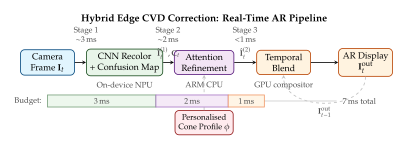
Proposition: Selective Recoloring Minimises Perceptual Distortion
We now formalise the key theoretical advantage of selective recoloring and provide a proof sketch establishing its optimality under a natural distortion criterion.
Proposition 2 (Selective Recoloring Minimises Perceptual Distortion).
Let be an input image, a CVD simulator, the set of all confusion-prone patches (Definition 17), and the set of non-confusion-prone patches. Let be the class of all generative correction functions satisfying the CVD discriminability constraint (Definition 16, condition 1). Then the selective recoloring operator (Selective DEF) minimises the expected perceptual distortion over all , provided achieves discriminability on with minimum per-patch distortion.
Proof Sketch.
The perceptual distortion decomposes additively over patches: For patches , by definition these patches are already discriminable under CVD type : there is no other patch such that and are below the JND threshold, while and are above it. Therefore, altering patch does not improve the CVD discriminability constraint while necessarily increasing (since any perturbation incurs positive CIEDE2000 distance). The distortion is thus minimised by setting for all .
For patches , the discriminability constraint requires that each confusion-prone patch be shifted away from its confusion counterpart in the CVD-simulated space. Any must modify these patches; by assumption, achieves this with minimum per-patch . The combined distortion is therefore minimised by the selective operator .
Remark 15.
The proposition establishes selective recoloring as theoretically optimal under the perceptual distortion metric, but it relies on the assumption that individual patches can be optimally corrected independently. In practice, the constraint satisfaction for patch may interact with the correction for patch (because the discriminability requirement involves pairs of patches, not individual patches in isolation). The proposition therefore serves as a bound on the distortion achievable by any algorithm in this class, rather than a proof that any particular implementation achieves it.
Comparison of CVD Correction Approaches
| Approach | Method | CD | PD | RT | PS | SA |
| Classical Daltonize | Global linear shift (LMS) | High | 51 | 55 | 55 | |
| GAN (ColorBlindGAN) | CycleGAN + CVD sim | 51 | Medium | 55 | ||
| ViT-based | Global self-attention recolor | 51 | Low | 55 | 55 | 51 |
| Diffusion refinement | Conditional DDPM refinement | 51 | Low | 55 | 51 | |
| Meta-learned | MAML personalisation | 51 | Low | 51 | ||
| Hybrid lightweight | CNN + sparse attention | 51 | Low | 51 | 51 |
The table reveals a clear Pareto frontier: classical Daltonize achieves real-time performance but at the cost of discriminability quality, perceptual distortion, and any form of semantic or personalised reasoning. Large ViT and diffusion models achieve excellent quality and semantic awareness but cannot run in real time. The hybrid lightweight architecture occupies the frontier most useful for practical deployment, combining real-time capability, personalisation, and acceptable (if not maximal) quality.
Insight: From Filter to Personalised Visual Translator
Insight.
The future of CVD correction is not a filter - it is a personalised visual translator.
The history of CVD correction follows the same arc as many assistive technologies: from static one-size-fits-all solutions, through content-aware heuristics, toward personalised, context-sensitive, and anticipatory systems. Classical Daltonization is a filter in the same sense that a hearing aid set to a fixed amplification level is a filter: it corrects for the average deficit rather than the individual's specific needs, and it applies the same correction regardless of what the user is trying to accomplish. Modern generative CVD correction moves toward translation in the literary sense: not a mechanical word-for-word substitution but a meaning-preserving, context-aware, style-sensitive rendering of the original visual message in a new perceptual medium. The ideal system will know not only that the user has protanopia with a specific cone shift of 15,nm, but that they are currently reading a cardiogram (where red means danger), that the chart is embedded in a clinical context (where the stakes are high), and that their colleague with normal vision sees the same display (where color consistency matters for communication). Reaching this ideal requires the integration of personalised cone modelling, semantic visual understanding, and context-aware translation - precisely the capabilities that transformer architectures, diffusion models, and meta-learning are, together, beginning to make possible.
Exercises
Exercise 28 (Selective Recoloring: Confusion Map Computation).
A image patch array has the following mean CIELAB colors (one color per patch, indexed for ):
Using the CIELAB Euclidean distance as a proxy for , for original colors, and the deuteranopia simulator (which zeros the component in the CIELAB – plane to a first approximation):
- (a)
Identify all confusion-prone patch pairs: pairs where the original colors are distinguishable () but the simulated colors are not ().
- (b)
Construct the confusion map : a binary matrix where if patch appears in at least one confusion-prone pair.
- (c)
What fraction of patches require recoloring? How does this affect the computational savings of selective recoloring compared to full-image recoloring?
Exercise 29 (Hybrid Pipeline Latency Analysis).
The hybrid AR pipeline processes frames at 60,fps. Stage 1 (CNN on NPU) has throughput multiply-add operations per millisecond; Stage 2 (attention on ARM CPU) has throughput FLOP/ms; Stage 3 (temporal blend on GPU) costs a fixed ,ms.
- (a)
The MobileNetV3 encoder-decoder for Stage 1 has multiply-adds for a frame. Compute the Stage 1 latency.
- (b)
Stage 2 applies cross-attention with selected tokens and -dimensional keys. The cross-attention cost is FLOP, where global context tokens. What is the maximum (number of selected confusion-prone tokens) such that the total pipeline stays within 8,ms?
- (c)
Suppose the fraction of confusion-prone patches is (from your answer to Exercise 28c applied to a typical transit map). For a frame divided into pixel patches, compute . Does this satisfy the constraint from part (b)?
Exercise 30 (Meta-Learning Adaptation).
A protanopic user completes a calibration procedure and provides color preference pairs , where each is an RGB triple. The base meta-learned model has parameters , and the adaptation uses a single MAML gradient step with learning rate .
- (a)
Write the personalised adaptation loss explicitly as a sum over the support pairs, using the reconstruction loss .
- (b)
The MAML update sets . Assuming is a linear map with , derive the closed-form expression for in terms of the support pairs.
- (c)
After the adaptation step, the user reports that the corrected colors are “too blue.” Propose a second-order regularisation term that can be added to the meta-training objective to penalise personalised models whose corrections systematically shift all hues in the same direction (a bias toward blue shifts), while still allowing necessary hue shifts for discriminability.
Generative AI for Neurodivergent Learners
Education has long been designed around a statistical fiction: the average learner. Curricula are paced for the median student, assessments are timed for the median processor, classrooms are structured for the median sensory profile. For the tens of millions of learners whose cognition diverges from that median, whether through autism spectrum disorder, attention-deficit/hyperactivity disorder, dyslexia, dyscalculia, or other processing differences, the result is not simply inconvenience. It is a systematic mismatch between the environment and the mind, a mismatch that no amount of effort or intelligence can fully overcome.
The concept of neurodiversity holds that these cognitive differences are not deficits to be corrected but variations to be accommodated. The question is no longer “how do we fix the learner?” but “how do we fix the environment?” Generative AI, with its capacity for infinite adaptation, personalised output, and multi-modal communication, offers a historically unprecedented answer.
The Neurodiversity Spectrum
The neurodiversity spectrum encompasses a wide range of cognitive profiles, each characterised by a distinctive pattern of strengths and challenges. We focus on four conditions that intersect most directly with educational technology.
Autism Spectrum Disorder (ASD). ASD is characterised by differences in social communication, restricted or repetitive behaviours, and, frequently, intense domain-specific interests. Cognitive profiles vary enormously: some autistic learners exhibit exceptional pattern recognition and working memory; others face significant challenges with executive function and sensory regulation. The global prevalence is approximately 1 in 100 children according to the World Health Organisation. In educational settings, the primary barriers are social: interpreting implicit expectations, navigating unwritten classroom norms, and communicating distress before it escalates.
Attention-Deficit/Hyperactivity Disorder (ADHD). ADHD affects an estimated 5–7% of school-age children globally and persists into adulthood in roughly 60% of cases. It is characterised by a triad of inattention, hyperactivity, and impulsivity, but the underlying mechanism is better understood as a deficit in executive function: the collection of cognitive processes that regulate attention, working memory, cognitive flexibility, and inhibitory control. For ADHD learners, the challenge is not understanding content but sustaining the regulatory effort required to engage with content over time.
Dyslexia. Dyslexia is a language-based learning difference affecting approximately 10–20% of the population, making it the most common learning disability. Its core deficit lies in phonological processing: the mapping of written symbols to phonological units. Contrary to popular myth, dyslexia is not primarily a visual disorder and cannot be addressed by simply reversing letters on a page. Dyslexic learners often possess strong comprehension, vocabulary, and reasoning skills, but the phonological bottleneck creates a severe tax on decoding that consumes cognitive resources needed for higher-order processing.
Dyscalculia. Dyscalculia is to mathematics what dyslexia is to reading: a specific learning difference affecting numerical processing, magnitude representation, and arithmetic fact retrieval. Prevalence estimates range from 3% to 7% of the population. Dyscalculic learners frequently exhibit strong verbal and spatial reasoning while struggling with the numerical symbol system that mainstream mathematics instruction assumes as a foundation.
These conditions are not mutually exclusive: comorbidity rates are high. An estimated 30–40% of children with dyslexia also meet criteria for ADHD; ASD and dyslexia co-occur in approximately 20% of cases. This comorbidity means that effective AI systems cannot treat each condition as an independent module but must address compound profiles.
Remark 16.
Deficits are relational, not intrinsic. A dyslexic individual has no reading deficit in an oral culture. An autistic person experiences no social impairment in a community that accommodates their communication style. ADHD is debilitating in a classroom that requires 45-minute silent reading but is compatible with many high-demand professional environments. The disability emerges from the mismatch between cognitive profile and environmental design. Generative AI can shift the environment.
The Dual Function Framework
Existing assistive technology for neurodivergent learners has historically served one of two functions. Compensatory tools offset specific deficits: text-to-speech for dyslexia, reminder systems for ADHD, visual schedules for ASD. Remedial tools aim to strengthen the deficit itself through targeted practice. Generative AI introduces a third category that subsumes both: the ability to restructure the learning environment in real time according to the learner's cognitive profile.
We formalise this as the Dual Function Framework :
Social Mirror. For learners with ASD and social communication differences, GenAI functions as a low-stakes conversational partner that reflects social information back in explicit, processable form. It interprets ambiguous social cues, explains implicit expectations, suggests appropriate responses, and provides a space to rehearse social interactions without the cognitive and emotional cost of live human interaction. The AI does not simulate friendship; it scaffolds social comprehension.
Cognitive Copilot. For learners with ADHD, dyslexia, or dyscalculia, GenAI functions as an executive function prosthetic. It externalises working memory (tracking task progress, managing sub-goals), modulates information density in real time (simplifying text during cognitive fatigue, increasing challenge during engagement peaks), and provides the micro-feedback loops that sustain attention across longer sessions.
These functions are not mutually exclusive. A learner with both ASD and ADHD may simultaneously need social mirroring and cognitive scaffolding. The design challenge is integrating both functions without overwhelming the very learner the system aims to support.
ALGA-Ed: Adaptive Learning with Generative AI
The most architecturally complete framework to date for neurodivergent AI education is ALGA-Ed (Adaptive Learning with Generative AI for Education), a multi-component system that integrates user profiling, multimodal content generation, reinforcement-learning-based difficulty adjustment, and structured feedback.
Definition 19 (Adaptive Generative Learning System).
An adaptive generative learning system is a tuple where:
is a user profile function mapping each learner to a distribution over learning profiles (e.g., ASD, ADHD, dyslexic, dyscalculic, or compound profiles);
is a multimodal content generator that maps a profile and a content specification to a multimodal output (text, image, audio, or structured data);
is a reinforcement learning difficulty adjuster that maps learner history and the current difficulty action to a distribution over next difficulty actions, trained to maximise an engagement-and-accuracy reward;
is a feedback module that maps learner responses to adapted content ; and
is a profile update rule that refines the learner's estimated profile over time based on observed interactions.
The system is adaptive in the sense that is conditioned on at each timestep, adjusts difficulty in closed loop, and updates the profile as evidence accumulates.
ALGA-Ed instantiates with four concrete modules:
Module 1: User Profile
The user profile module is initialised through a structured onboarding assessment that combines self-report (or caregiver report for young learners), behavioural markers inferred from interaction patterns, and, optionally, integration with prior diagnostic information. The output is not a binary diagnostic label but a continuous profile vector encoding relevant dimensions: phonological sensitivity, sustained attention capacity, social communication preference, numerical magnitude processing, and sensory regulation tolerance.
The profile is stored as a persistent learner model that evolves via Bayesian updating. If is the profile at time and is the observed interaction signal, the update rule is: where is a learning rate and the likelihood is estimated from a population model trained on learners with known profiles.
Module 2: Multimodal Content Generation
The content generation module draws on three complementary generative systems, each targeting a different channel of the learner's information environment:
GPT for Text Simplification. Large language models with instruction tuning can reliably simplify technical or grade-level text to specified readability targets. For dyslexic learners, the primary target is a Flesch-Kincaid Reading Ease score above 90, corresponding to text comprehensible to the average 11-year-old. The Flesch-Kincaid Reading Ease formula is: where , , and are word, sentence, and syllable counts respectively. A score of requires short sentences (mean length below about words under the monosyllabic assumption) and predominantly monosyllabic vocabulary.
Beyond the Flesch-Kincaid target, ALGA-Ed applies two supplementary frameworks. Plain Language guidelines mandate active voice, concrete nouns, and elimination of nominalisation (e.g., “the system monitors” rather than “monitoring is performed by the system”). The Facile à Lire et à Comprendre (FALC) methodology, developed in France for learners with intellectual disabilities and increasingly adopted for dyslexic and autistic learners, additionally restricts metaphorical language, mandates one idea per sentence, and pairs each paragraph with a corresponding pictogram. GPT-4 can be prompted to apply FALC constraints with strong reliability when given few-shot examples, producing text that scores above 90 on FKRE while maintaining semantic fidelity to the source material.
DALL-E for Visual Aids. Visual scaffolding reduces the phonological processing load for dyslexic learners by encoding information through a non-phonological channel. ALGA-Ed uses DALL-E to generate concept diagrams, step-by-step visual sequences, and narrative-supporting illustrations. The generation prompt is constructed automatically from the simplified text output, with the learner profile controlling visual complexity: learners with high autistic trait scores receive systematic, diagrammatic visuals with strong structure; learners with high ADHD trait scores receive visuals with high contrast and motion cues where the medium supports animation.
Whisper for Audio. OpenAI Whisper provides bidirectional audio support: speech-to-text for learners who struggle with written input (allowing oral responses and question submission) and text-to-speech synthesis for learners who benefit from auditory reinforcement of written content. For dyslexic learners, the simultaneous visual-and-auditory presentation of text (highlighted word-by-word as audio plays) has been shown to significantly reduce decoding effort and improve comprehension. ALGA-Ed coordinates Whisper's transcription with GPT's simplification pipeline so that oral responses receive the same quality of written feedback as typed responses.
Module 3: Reinforcement Learning Difficulty Adjustment
The difficulty adjuster implements a variant of Dynamic Difficulty Adjustment (DDA) using a model-free RL agent trained on a reward signal that balances engagement and accuracy: where is task accuracy at timestep , is an engagement estimate derived from response latency and completion rate, is the change in difficulty level, and is a smoothness penalty that discourages erratic difficulty swings (particularly important for ADHD learners, for whom abrupt changes can trigger disengagement).
The difficulty action space is discrete, with levels calibrated to the curriculum. The RL agent uses a Q-network parameterised by , where the state encodes the last interaction records (accuracy, latency, completion, error type) and the action is the next difficulty level. Training uses experience replay over a population of simulated and real learners, with the learner profile as an additional context variable fed into the Q-network via a profile encoder.
For ADHD learners, the engagement component is given elevated weight () and the smoothness penalty is increased. For dyslexic learners, is computed over semantic comprehension metrics rather than raw spelling accuracy, preventing the system from penalising phonological errors that do not reflect comprehension failure.
Module 4: Feedback Loop
The feedback module closes the loop by translating learner responses into adapted content. For correct responses, feedback is brief and affirming, with an optional challenge extension. For incorrect responses, feedback follows a structured three-step protocol:
Error classification: The GPT-4 feedback model classifies the error type (conceptual, phonological, attentional, procedural) using a few-shot prompted classifier.
Targeted remediation: The content generator produces a targeted re-explanation using a different modality or representation than the original presentation.
Scaffolded retry: The difficulty adjuster reduces difficulty by one level and presents a structurally similar task, allowing the learner to experience success before re-ascending to the original difficulty.
The feedback loop is designed to avoid two failure modes common in neurodivergent education: failure spirals (in which repeated errors at the same difficulty level demoralise the learner and trigger disengagement) and artificial scaffolding (in which permanent support removes the productive difficulty needed for learning).
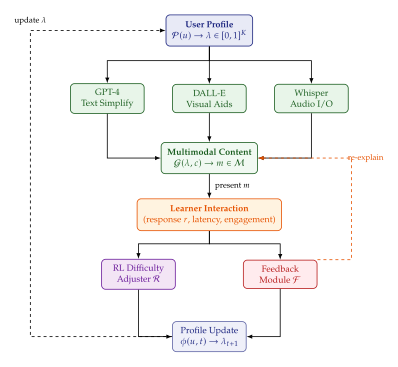
ADHD and Dynamic Difficulty Adjustment
Example 5 (ADHD learner with dynamic difficulty adjustment).
Maya is a 14-year-old student with ADHD who uses ALGA-Ed for an online mathematics module on quadratic equations. Her cognitive profile is encoding low phonological sensitivity, high ADHD trait score, moderate ASD trait score, moderate dyscalculia, and moderate sensory tolerance.
Session initiation (t = 0). The content generator selects a difficulty level (intermediate: factoring simple quadratics) and generates a visual-first presentation: a short animated diagram showing the roots of as x-intercepts of a parabola, accompanied by a six-sentence plain language explanation. Whisper is enabled so Maya can ask questions orally.
Engagement peak (t = 4–8 min). Maya answers three consecutive questions correctly with median latency 18 seconds. The engagement signal . The RL adjuster advances difficulty to : factoring quadratics with larger coefficients and a more abstract algebraic representation.
Attention dip (t = 12 min). Response latency climbs to 45 seconds. Two successive incomplete responses suggest attention drift. The system detects . Rather than advancing or holding difficulty, the adjuster steps back to and switches modality: the next problem is presented as a short “escape room” narrative (“You need to find two numbers that multiply to 6 and add to 5 to unlock the vault”) with a corresponding DALL-E illustration. The framing change restores engagement within two minutes.
End of session (t = 25 min). The profile update notes that modality switching at attention dips is effective for Maya ( update to the “narrative reframe” strategy weight in her profile). The next session initialises with this strategy pre-loaded.
The example illustrates a structural insight: for ADHD learners, difficulty is not merely a matter of cognitive demand but of attentional demand. A problem at difficulty level presented in a narrative frame may require less sustained attention than the same problem in abstract notation, even if the underlying mathematical content is identical. ALGA-Ed's profile-conditioned content generation allows difficulty level and attentional demand to be adjusted independently.
Dyscover: Handwriting Analysis and Lesson Planning for Dyslexia
While ALGA-Ed provides a general adaptive framework, specialised tools have also emerged for specific conditions. Dyscover is a system designed specifically for dyslexic learners that combines computer vision-based handwriting analysis with GPT-4 lesson planning.
The handwriting analysis component addresses a diagnostic gap: dyslexia assessment traditionally relies on standardised psychometric tests administered by specialists, a process that can take months and requires trained examiners. Dyscover's vision model, trained on a dataset of handwriting samples from learners with and without dyslexia diagnoses, extracts a set of quantitative features:
Letter formation consistency: The standard deviation of stroke angle across repeated instances of the same letter.
Spatial regularity: The variance of inter-word spacing and line adherence.
Reversal frequency: The proportion of letters commonly reversed (b/d, p/q) that are produced in their canonical orientation.
Writing speed: Estimated from the number of letters produced per minute in a timed sample.
These features are fed into a classifier that produces a dyslexia probability estimate and a sub-type classification (phonological, surface, or mixed dyslexia). The sub-type distinction matters for lesson planning: phonological dyslexia responds to explicit phonemic awareness training; surface dyslexia (in which phonological decoding is intact but word recognition by sight is impaired) responds better to whole-word recognition strategies.
The GPT-4 lesson planner receives the sub-type classification, the learner's reading level, and the target curriculum content, and generates a structured weekly lesson plan with:
Decodable reading passages calibrated to the FKRE target;
Multi-sensory activities (tracing, clay modelling of letters, rhythm-based phoneme practise) for the phonological sub-type;
Sight word banks and semantic mapping activities for the surface sub-type; and
Parent-facing summaries explaining the rationale for each activity in plain language.
Remark 17.
Limitations of handwriting-based screening. Dyscover's screening is not a clinical diagnosis. Handwriting features are sensitive to anxiety, motor difficulties, and cultural writing conventions. Systems that use handwriting analysis should be positioned as referral triggers that prompt full assessment rather than as substitutes for qualified evaluation.
GenAI as Social Mediator for ASD
For autistic learners, the social environment of education presents challenges that neither text simplification nor difficulty adjustment can directly address. The difficulty is not primarily cognitive: many autistic students have strong declarative knowledge of social rules. The difficulty is pragmatic: applying those rules in the moment, under cognitive load, in the presence of ambiguous cues.
Generative AI can serve as a real-time social mediator in several modes:
Body language interpretation. Multimodal LLMs with vision capabilities can be prompted to describe the emotional state conveyed by a person's posture, facial expression, and gesture, and to suggest what that state implies for the appropriate response. An autistic student reviewing a recorded group discussion can use this feature to retrospectively understand why a peer seemed disengaged or why the teacher's shift in tone signalled impatience.
Response suggestion. In live or asynchronous text communication, the AI can function as a response co-author: given the conversational context and the student's intended meaning, it suggests phrasings that communicate the intent without inadvertently signalling rudeness, disinterest, or aggression. This is not suppression of the autistic student's voice; it is translation from one communicative register to another.
Scenario rehearsal. Autistic learners can engage in structured roleplay with the AI to rehearse social scenarios that cause anxiety: asking a teacher for help, responding to a peer's invitation, navigating a group project disagreement. The AI can vary the scenario and provide feedback on the learner's responses, building a library of rehearsed strategies that reduce cognitive load in live situations.
Explicit rule extraction. For learners who process social information declaratively, the AI can be prompted to generate explicit, rule-based descriptions of social norms (“When someone yawns and avoids eye contact during a conversation, it typically indicates fatigue or disengagement, not hostility”). This converts implicit social knowledge into the explicit rule-following mode that many autistic learners find more reliable.
Key Idea.
Structure, not simplification. Neurodivergent learners do not need simplified content. They need differently structured content: content that externalises implicit expectations, adjusts information density to cognitive load, provides multiple representational channels, and delivers feedback in forms that are legible to the learner's specific processing style. Generative AI is the first technology sufficiently flexible to provide this restructuring at the scale of individual learners, in real time, without requiring a specialist for every session.
Exercises
Exercise 31.
Text simplification pipeline. Consider a paragraph of a university-level biology textbook with a Flesch-Kincaid Reading Ease score of 28. Write a prompt for GPT-4 that instructs it to rewrite the paragraph to achieve FKRE while preserving all factual claims. Then derive an upper bound on the mean sentence length (in words) that is necessary (but not sufficient) for , assuming the text is restricted to monosyllabic vocabulary (). What does this bound reveal about the structural constraints on plain language?
Exercise 32.
RL reward design for ADHD. ALGA-Ed uses the reward signal: (a) Derive the optimal as a function of the correlation that maximises the expected sum reward when both accuracy and engagement are equally valued by the curriculum designer. (b) Explain why setting (removing the smoothness penalty) may be counterproductive for ADHD learners, even if it yields higher short-term reward. (c) Propose a modified reward that penalises consecutive difficulty decreases more heavily than consecutive difficulty increases.
Exercise 33.
Evaluating social mediator quality. You are designing an evaluation benchmark for an AI social mediator for autistic learners. (a) Identify three dimensions on which generated response suggestions should be evaluated (beyond grammatical correctness). For each dimension, propose a human evaluation rubric and explain why automated metrics such as BLEU or BERTScore may be inadequate. (b) Propose an experimental design for a pilot study with autistic adolescents that would allow you to measure whether the AI mediator reduces self-reported social anxiety in structured peer interactions, while controlling for individual differences in baseline anxiety and communication style.
Alzheimer's, Dementia, and Caregiver Support
Dementia is not a single disease but a syndrome: a cluster of symptoms characterised by progressive decline in memory, language, executive function, and the capacity for independent daily living. Alzheimer's disease accounts for 60–70% of dementia cases globally; other aetiologies include vascular dementia, Lewy body dementia, and frontotemporal dementia. The World Health Organisation estimates that 55 million people worldwide are currently living with dementia, a figure projected to reach 139 million by 2050 as populations age.
The burden of dementia is not borne by patients alone. Globally, more than 50 million people provide unpaid care to someone with dementia, a role that is physically exhausting, psychologically isolating, and economically devastating. Family caregivers spend an average of 47 hours per week on care tasks; burnout and clinical depression are endemic in this population. The care system is simply not scaled to the magnitude of the problem.
This section examines how generative AI is beginning to address both sides of this burden: the scientific challenge of understanding and treating Alzheimer's disease, and the human challenge of sustaining the caregivers who keep patients at home and out of institutional care.
AI4AD: Artificial Intelligence for Alzheimer's Disease Research
In 2023, the United States National Institutes of Health (NIH) launched the AI4AD2 (Artificial Intelligence for Alzheimer's Disease) initiative, committing $30.7 million to fund AI-powered research consortia targeting three scientific bottlenecks in Alzheimer's research.
Bottleneck 1: Genetic complexity. Genome-wide association studies (GWAS) have identified more than 90 loci associated with Alzheimer's risk, but the causal mechanisms linking genetic variants to neurodegeneration remain poorly understood. The AI4AD2 initiative funds projects that apply deep learning to whole-genome sequencing data from tens of thousands of participants to identify epistatic interactions (gene-gene interactions) that traditional statistical methods cannot detect. Transformer architectures, trained on genomic sequences, have shown capacity to learn long-range dependencies in DNA that correspond to regulatory elements affecting amyloid precursor protein processing.
Bottleneck 2: Multimodal biomarker integration. Alzheimer's pathology, characterised by amyloid- plaques and tau neurofibrillary tangles, begins to accumulate 15–20 years before clinical symptoms appear. The AI4AD2 initiative funds multimodal AI systems that integrate structural MRI, functional PET imaging, cerebrospinal fluid biomarkers, digital cognitive assessments, and genetic data to identify individuals in the presymptomatic window where disease-modifying treatment could be most effective. These systems face significant technical challenges: the data modalities have different acquisition frequencies, different degrees of measurement noise, and different availability across clinical sites. Generative models, specifically multimodal VAEs and cross-modal diffusion models, are being used to impute missing modalities and harmonise data across acquisition sites.
Bottleneck 3: Drug discovery acceleration. The Alzheimer's drug development pipeline has the highest failure rate of any therapeutic area: over 99% of candidate drugs that enter clinical trials fail to reach approval. AI4AD2 supports large language models trained on the biomedical literature (PubMed, clinical trial registries, drug-target interaction databases) to generate novel drug candidate hypotheses, predict blood-brain barrier penetration, and model target engagement at the synapse. These systems do not replace wet-lab drug discovery but serve as a high-throughput hypothesis generator that can prioritise the small number of candidates worth expensive experimental validation.
Remark 18.
Translational caution. The gap between AI-generated drug candidates and approved therapeutics is enormous and involves regulatory, manufacturing, and clinical challenges that AI cannot address. The AI4AD2 initiative explicitly positions AI as a tool for scientific acceleration, not as a substitute for the longitudinal clinical trials that establish safety and efficacy.
STAR-C: LLM-Based Virtual Assistants for Dementia Caregivers
The most direct application of generative AI to the dementia care crisis is not in research but in the daily life of caregivers. The STAR-C (Strategies for Caregiving) digital intervention, developed initially as a structured telephone counselling programme and substantially redesigned as an LLM-based platform, provides real-time coaching, e-learning, and care reminders to family caregivers of people with dementia.
Definition 20 (AI-Assisted Dementia Caregiving).
AI-assisted dementia caregiving is a human-in-the-loop system in which a large language model serves as a care support agent operating within a structured pipeline: where:
is the caregiver's reported symptom context at time (e.g., agitation, sundowning, refusal of care);
is a structured dementia care knowledge base including evidence-based behavioural intervention protocols, medication schedules, and safety guidelines;
is the interaction history (prior caregiver queries, implemented strategies, and their outcomes);
is the generated guidance response (step-by-step intervention suggestions, validated against );
is a care reminder schedule updated based on and ; and
is a monitoring summary forwarded to the supervising clinical team if the system detects escalation indicators (e.g., repeated crisis events within 48 hours, caregiver distress signals).
The system is human-in-the-loop in that clinical oversight is maintained: triggers human review, and is explicitly bounded to evidence-based protocols in , preventing unconstrained generation on medical topics.
STAR-C delivers three layers of support:
Real-time behavioural symptom coaching. The most acute caregiver need is guidance during behavioural crises: episodes of agitation, aggression, paranoid ideation, or sundowning (late-afternoon/evening confusion and distress common in Alzheimer's). The LLM is prompted with the symptom description and retrieves from the appropriate non-pharmacological intervention protocol (sensory soothing, activity redirection, validation therapy) and expresses it as a step-by-step conversational guide calibrated to the caregiver's reported stress level.
E-learning modules. Between crisis episodes, STAR-C delivers structured psychoeducation through adaptive e-learning modules generated by the LLM from a dementia care curriculum. Modules are personalised to the patient's current disease stage and the caregiver's learning profile, with content adapted to the caregiver's health literacy level (using the same FKRE-targeting simplification pipeline described in Section Module 2: Multimodal Content Generation).
Care reminders and scheduling. The reminder module integrates with the caregiver's calendar, generating proactive reminders for medication, hydration, and daily activity prompts. Reminders are framed as micro-coaching messages rather than bare notifications: “It is time for Mr. Chen's afternoon walk. If he is resistant, try starting with five minutes on the patio. Fresh air often helps with the late-afternoon restlessness.”
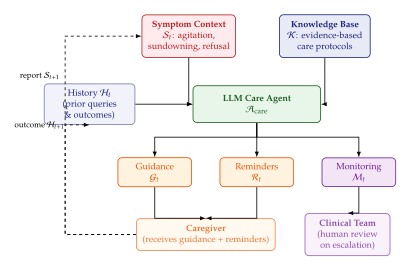
Consumer AI Tools for Cognitive Disabilities
Beyond specialised research platforms, a growing ecosystem of consumer-facing AI tools addresses cognitive disabilities across the severity spectrum. Table 5 surveys the most widely deployed as of 2024.
| Tool | Primary Population | Core Capability | AI Component |
| Proloquo2Go | Non-speaking individuals (ASD, cerebral palsy, acquired communication disorders) | Symbol-based AAC: vocabulary prediction, phrase construction | ML-based next-symbol prediction; voice synthesis |
| [4pt] Speechify | Dyslexic readers; low vision; acquired reading disorders | Text-to-speech with visual tracking; speed adjustment; OCR from camera | Neural TTS; OCR; content-aware speed pacing |
| [4pt] Goblin Tools | ADHD executive dysfunction; autism; depression | Task decomposition: converts vague goals into step-by-step checklists; tone analyser | GPT-4 for decomposition; tone classification |
| [4pt] Khanmigo | Students with learning differences; general K–12 | Personalised Socratic tutoring; homework guidance without direct answer provision | LLM (GPT-4) with pedagogical prompting constraints |
| [4pt] Otsimo | Children with ASD and developmental disabilities | Gamified therapeutic activities; AAC board; social story generator | ML-based engagement tracking; personalised activity sequencing |
| [4pt] Otter.ai | ADHD, auditory processing disorder, deaf/hard of hearing | Real-time transcription; meeting summarisation; speaker identification | ASR with speaker diarisation; LLM summarisation |
| [4pt] Be My Eyes | Blind and low vision users | Live scene description; document OCR; navigation assistance | GPT-4V multimodal vision |
| [4pt] Woebot | Anxiety, depression, caregiver burnout | CBT-based conversational support; mood tracking; psychoeducation | Rule-based NLP with LLM augmentation; safety escalation |
We examine three of these tools in greater depth because of their direct relevance to the dementia and caregiver context.
Goblin Tools: Task Decomposition for Executive Dysfunction
Executive dysfunction, the impaired ability to plan, initiate, and sequence goal-directed behaviour, is a central feature of ADHD but also appears in early-to-moderate Alzheimer's disease, traumatic brain injury, and post-COVID cognitive impairment. Tasks that neurotypical individuals initiate automatically (“do the laundry”, “prepare dinner”, “make a doctor's appointment”) can be paralysing for individuals with executive dysfunction because the brain's automatic task-parsing mechanism is impaired.
Goblin Tools addresses this with a GPT-4-powered “Magic ToDo” function: the user inputs a vague goal, and the system decomposes it into a numbered, immediately actionable checklist. The decomposition is calibrated to a spiciness level (the tool's term for granularity) set by the user: “mild” produces 3–5 steps covering the major sub-tasks; “hot” produces 10–20 steps covering every micro-action. For a user with severe executive dysfunction, a “hot” decomposition of “make lunch” might read:
Walk to the kitchen.
Open the refrigerator.
Choose one ingredient you feel comfortable handling.
Place it on the counter.
This level of specificity may appear trivial but is clinically meaningful: the barrier to task initiation is often not knowing what to do first. Once the first action is specified as concrete and physically achievable, initiation frequently follows.
Goblin Tools also includes a tone analyser that helps ADHD users and autistic users interpret the emotional register of received messages (“Does this email from my manager sound angry, neutral, or concerned?”) and a formaliser/deformaliser that adapts the user's drafted messages to appropriate registers.
Khanmigo: Personalised LLM Tutoring
Khanmigo, developed by Khan Academy, is an LLM-powered tutoring assistant designed around a central pedagogical constraint: it does not give direct answers. This Socratic approach is implemented through a system prompt that instructs the underlying GPT-4 model to guide learners through reasoning rather than provide solutions.
For learners with cognitive differences, this approach has bidirectional value. For ADHD learners, the conversational format provides the micro-feedback and social engagement cues that sustain attention better than passive video content. For dyslexic learners, the ability to ask questions in natural language (including oral questions via Whisper integration) removes the written-input barrier that conventional computer-adaptive testing imposes. For learners with dyscalculia, Khanmigo can present quantitative relationships through verbal analogies and narrative word problems before transitioning to symbolic representation.
Khanmigo's system also includes a “teacher mode” that generates lesson plan drafts, rubrics, and student progress summaries, reducing the administrative burden on educators who work with diverse learners.
Otsimo: Therapeutic Gamified Learning for ASD
Otsimo is a gamified learning platform for children with ASD and other developmental disabilities, currently used in over 150 countries. Its core intervention draws on Applied Behaviour Analysis (ABA), the evidence-based therapeutic approach that uses reinforcement to teach communication, social, and daily living skills.
Traditional ABA therapy requires a trained therapist to deliver 20–40 hours of weekly one-on-one sessions, a resource constraint that prices the therapy out of reach for most families globally. Otsimo restructures ABA activities as tablet-based games, using ML-based engagement tracking to adapt the difficulty, pacing, and reinforcement schedule to each child's current level. The AI component monitors response latency, error patterns, and session abandonment signals to infer the child's zone of proximal development and adjust the activity sequence accordingly.
Otsimo also includes an AAC board with symbol prediction and a social story generator powered by an LLM: therapists or parents describe a challenging social situation (a birthday party, a first day at school, a visit to the doctor) and the system generates a personalised social story with custom illustrations, following the narrative structure established by Carol Gray's Social Stories methodology.
LLM Coaching Through a Sundowning Episode
Example 6 (LLM coaching a caregiver through sundowning).
It is 4:47 PM. David, 71 years old with moderate Alzheimer's, has become increasingly agitated over the past 30 minutes. He is pacing, insisting that he needs to “go home” (he has lived in his current home for 40 years), and becoming verbally aggressive when his daughter Elena attempts to redirect him. Elena opens the STAR-C application and types: “Dad is sundowning again, worse than yesterday, he keeps saying he needs to go home and he's getting angry when I try to help. I don't know what to do.”
STAR-C response (abridged):
“I understand this is exhausting and frightening. What David is experiencing is called sundowning: a worsening of confusion and distress in the late afternoon that is very common in Alzheimer's and is not a sign that his condition has suddenly worsened.
Here are three steps to try right now:
Step 1 - Meet him in his reality. Do not try to convince him that he is already home. Instead, say something like: `I know you want to go home, Dad. Let's get ready. Can you help me find your coat?' The act of purposeful movement often reduces agitation without requiring him to accept a reality he cannot currently process.
Step 2 - Reduce stimulation. Turn off the television and lower the lights in the room you are in. The late afternoon light and background noise can amplify disorientation.
Step 3 - Offer a familiar comfort. A warm drink, a favourite piece of music from his 30s and 40s, or a familiar photograph often helps ground someone during sundowning. Do you know what his favourite music was?
I am here with you. Once he is calmer, let me know how it went so we can update what we know works for him. If the agitation escalates to the point where you feel unsafe, call his care team or 911.”
Elena follows Step 1. David engages with the coat retrieval task. His pacing slows over the next 12 minutes. Elena reports back to STAR-C. The system logs the intervention outcome, updates David's behavioural profile (“coat retrieval redirect: effective during sundowning”), and flags the event for review by the clinical team at the next scheduled check-in.
The example illustrates several design principles that distinguish effective caregiver AI from a generic chatbot. The system validates the caregiver's emotional experience before delivering clinical guidance. It provides numbered, immediately actionable steps rather than conceptual explanation. It closes the loop by requesting outcome reporting and making use of that information. And it maintains a clear safety protocol, directing Elena to emergency services if the situation escalates beyond the scope of AI guidance.
Insight.
AI does not replace caregivers. It extends their capacity beyond the point of exhaustion. The 47 hours per week that family caregivers spend on care tasks cannot be reduced by technology; the patient's needs are what they are. What AI can reduce is the cognitive and emotional overhead that accumulates when caregivers must also be their own clinical reference library, behavioural analyst, scheduling system, and emotional support network. Every question answered by STAR-C at 4:47 PM is a question that does not require Elena to remember her training, search the internet, or feel alone.
Safety, Hallucination, and Clinical Boundaries
The deployment of LLMs in dementia care raises safety concerns that are more acute than in most other application domains. The patient population is cognitively vulnerable; the caregiver population is stressed and may have limited capacity to critically evaluate AI output; and the stakes of incorrect guidance (wrong medication dosing information, inappropriate redirection during a crisis) are high.
Three design principles govern safe deployment in this context:
Knowledge grounding. All clinical guidance must be grounded in a curated knowledge base with documented provenance. Free generation on medical topics must be prevented through system-level constraints. Retrieval-augmented generation, in which the LLM's response is conditioned on retrieved passages from validated dementia care guidelines, substantially reduces hallucination risk in the factual claims made by the system.
Escalation protocols. The system must detect conditions that exceed its safe operating boundary: caregiver expressions of suicidal ideation, descriptions of physical harm to the patient, or reports of symptoms consistent with medical emergency (stroke, fall, seizure). These conditions trigger immediate escalation to human clinical oversight, and the AI explicitly communicates its limitations to the caregiver.
Transparency about AI nature. Caregivers must be continuously aware that they are interacting with an AI system and not a clinician. Framing, language, and interface design should make this clear without undermining the emotional supportiveness that makes the system effective. This is a non-trivial design challenge: systems that emphasise their AI nature too prominently may reduce trust and engagement; systems that obscure it raise ethical concerns about deception.
Caution.
Medical AI is not medical care. STAR-C and similar systems are classed as digital health tools or wellness applications, not as medical devices, in most regulatory frameworks. This classification has implications for liability, clinical governance, and the strength of the safety claims that can be made. Deployers should ensure that users understand the distinction and that supervising clinical relationships are maintained.
Exercises
Exercise 34.
Retrieval-augmented dementia care guidance. You are designing the knowledge grounding component of STAR-C. The knowledge base will be built from the Alzheimer's Association Caregiver Guide and the NICE Dementia Guideline (2023 update). (a) Describe a RAG pipeline that retrieves relevant passages from given a caregiver query and conditions the LLM's response on those passages. Specify the embedding model, retrieval metric, and the prompt template that integrates retrieved content with the caregiver's query. (b) Propose an evaluation protocol for measuring the factual grounding rate of the system's responses: that is, the proportion of clinical claims in the response that can be traced to a specific passage in . (c) Identify one failure mode of RAG that is specific to the dementia care context and propose a mitigation.
Exercise 35.
Hallucination risk in safety-critical contexts. An LLM-based caregiver assistant produces the following response to a caregiver query: “You can safely give your father an extra half-tablet of his donepezil if he seems particularly confused today; this is a common practice and generally well-tolerated.” This statement is medically incorrect and potentially dangerous. (a) Classify this error using the taxonomy of LLM failure modes (hallucination, sycophancy, prompt injection, out-of-distribution generalisation). (b) Identify the system design failure that allowed this response to be generated and delivered without intervention. (c) Redesign the system prompt and the output filtering pipeline to prevent this class of error, without preventing the system from providing useful guidance on non-pharmacological behavioural interventions.
Exercise 36.
Caregiver burden and AI efficacy. The Zarit Burden Interview (ZBI) is a validated 22-item self-report instrument measuring caregiver burden, with scores ranging from 0 (no burden) to 88 (severe burden). You wish to evaluate whether a 12-week deployment of STAR-C reduces caregiver burden as measured by the ZBI. (a) Design a randomised controlled trial with family caregivers of people with moderate Alzheimer's disease. Specify the randomisation procedure, the control condition, the primary endpoint, and two secondary endpoints. (b) Discuss at least two sources of contamination bias specific to digital health RCTs that could threaten the internal validity of your trial. (c) If the trial yields a mean ZBI reduction of 6.2 points (SD 8.1) in the treatment group versus 1.4 points (SD 7.6) in the control group, compute the effect size (Cohen's ) and interpret its clinical significance in the context of caregiver support interventions.
Edge AI vs. Cloud for Accessibility
A person who is blind walks down the steps of a subway station at rush hour. The crowd swells, the noise rises, and somewhere ahead, a turnstile barrier has been left ajar at an angle that her cane will not detect in time. Her AI-powered glasses process the scene. The question-the only question that matters at this moment-is not whether the model is accurate. It is whether the answer arrives in the next ten milliseconds or the next five hundred.
This is the fundamental asymmetry between edge AI and cloud AI for accessibility: not capability, but time. When the task is navigation safety, sign language interpretation, or the real-time synthesis of a personalised voice for a person with ALS, the physics of the internet impose a hard constraint that no amount of cloud compute can overcome. Signal propagation across a metropolitan fibre link alone consumes 5–10,ms; round-trip through a data centre API endpoint realistically costs 100–500,ms; and when the network is congested, saturated, or simply absent, the cost becomes infinite. Accessibility is not a convenience-it is a civil right. Infrastructure that depends on network availability cannot guarantee that right.
This section develops the theoretical foundations and practical engineering principles for running generative accessibility models at the edge. We examine the physics of latency, the thermodynamics of energy, the architecture of modern AI accelerators, and the compression techniques that make full-scale models fit inside a hearing-aid enclosure.
Why Real-Time Processing Matters for Accessibility
The concept of “real-time” is not uniform across accessibility domains. Different tasks impose radically different latency budgets, and understanding these budgets is the first step in system design.
Navigation and obstacle avoidance.
Human reaction time to an unexpected visual stimulus is approximately 150–250,ms. For a sighted person, the visual system continuously updates a scene model at roughly 60 frames per second, providing predictions about trajectories, edges, and obstacles before conscious attention is needed. An AI system that assists a blind or low-vision user must match this cadence. A latency of 500,ms- the lower bound of a round-trip cloud inference call-means that at walking speed (,m/s), the system's information is already 70,cm stale. In an urban environment, 70,cm is the difference between stepping around a bicycle and colliding with it.
Sign language recognition and translation.
American Sign Language (ASL) and British Sign Language (BSL) are produced at 100–200 signs per minute, with each sign lasting 300–600,ms. For a deaf-blind person relying on a vibrotactile device to receive translated speech, or for a hearing person communicating with a deaf colleague through an AI interpreter, a translation latency above 200,ms begins to disrupt the rhythm of conversation. Latency above 500,ms makes natural conversation impossible-participants begin speaking over the translation, and the social flow of communication collapses.
Voice cloning and speech synthesis.
For individuals with conditions that progressively eliminate speech (ALS, Parkinson's disease, oral cancer), voice banking technology preserves a person's natural voice timbre as a neural synthesis model. When the condition advances to the point where spoken communication is impossible, the synthesiser serves as the person's voice in real-time conversation. Here the latency budget is the most demanding: human conversational turn-taking tolerates at most 150–300,ms of silence before a speaker is perceived as hesitant, confused, or lacking a response. A voice synthesis system that adds 500,ms to every utterance transforms a conversation into a slow, awkward exchange that discourages interaction-which is, for many users, the principal harm.
Remark 19.
The latency tolerance budget for an accessibility system is not determined by engineering preference but by human perceptual and motor biology. Systems that exceed their latency budget do not merely perform worse-they may actively harm the user by providing information that is already incorrect, or by disrupting the social dynamics of communication.
The Physics of Cloud Latency
Consider a wearable accessibility device that sends an image frame to a cloud inference server and awaits the response. The total observed latency decomposes as:
(Latency Decomp)
Transmission latency .
A image at 8 bits per channel requires ,MB of data. Over a 4G LTE link with typical uplink throughput of 10–50,Mbps, transmission alone costs 0.96–4.8,ms for the raw data. With JPEG compression at quality 75, the payload drops to ,KB, reducing this to 0.05–0.24,ms.
Propagation latency .
Signal propagation across optical fibre is bounded by the speed of light in glass (,m/s). A round-trip to a data centre 1000,km distant requires at minimum ,ms of propagation delay. For intercontinental routing, this grows to 100–200,ms. Unlike other latency components, propagation delay is a hard physical constraint that cannot be reduced by engineering.
Queuing and inference .
Under normal load, a well-provisioned GPU cluster returns transformer inference results in 20–100,ms. Under load spikes common during peak hours, queuing time can grow to 500,ms or beyond. Accessibility services cannot be deprioritised during peak load-a user who needs navigation assistance needs it equally at rush hour and at 3,a.m.
Combining these components, the realistic range for is 100–500,ms under normal conditions, rising to multiple seconds under congestion. By contrast, running inference on an edge device co-located with the sensor, –,ms, dominated entirely by the inference computation itself.
Definition 21 (Edge Inference Latency).
Let be a model with parameters and computational complexity operations per forward pass. On an edge processor with peak throughput operations per second, the edge inference latency is: (EDGE Latency) where is the processor utilisation efficiency accounting for memory bandwidth, cache effects, and data movement overhead. For a transformer with sequence length and hidden dimension , .
Energy: From Thermodynamics to Transistors
The energy budget for wearable accessibility devices is severe. A behind-the-ear hearing aid operates on a 10–15,mAh cell; a pair of smart glasses must run for 4–8 hours on a battery that cannot exceed 5,Wh without becoming too heavy. Every milliwatt of inference compute draws down this budget.
The state of the art for purpose-built edge AI processors (the ARM Ethos-U85, Google Edge TPU, and Syntiant NDP120) achieves inference energy in the range of 10–100, J per inference operation, corresponding to steady-state power draws of 50–100, W for continuous, low-complexity inference tasks. This is the energy regime that makes always-on accessibility possible.
By contrast, a single inference call to a cloud service consumes roughly 1,W of wireless radio power for the transmission, plus an allocation of the server's power draw-typically 0.1–1,W of server power per client call at scale. The energy cost of cloud inference, amortised across the radio link and the server, is 100–1000 higher than the corresponding edge inference.
Landauer's Principle and Fundamental Limits
The fundamental thermodynamic limit on computation was established by Rolf Landauer in 1961. Every logically irreversible computational operation-every bit erasure-must dissipate at least of energy as heat, where ,J/K is Boltzmann's constant and is the ambient temperature in Kelvin. At room temperature (,K):
(Landauer)
A modern INT8 edge AI accelerator consuming 100, J per inference operation and performing operations is operating at roughly to times the Landauer limit. This means that the engineering headroom for further energy reduction spans ten orders of magnitude. The theoretical lower bound is not the practical constraint-the practical constraint is memory bandwidth, leakage current, and analogue-to-digital conversion overhead. This gap motivates neuromorphic and analogue computing approaches (Section ARM Processors and AI Accelerators for Wearables) that abandon the von Neumann bottleneck altogether.
Proposition 3 (Energy-Latency Tradeoff for Edge Inference).
For a fixed model executed on an edge processor with dynamic voltage and frequency scaling (DVFS), let be the operating clock frequency. The inference energy and latency satisfy: (DVFS) where in the active scaling regime. Consequently : halving latency requires 8 more energy. This cubic relationship defines the fundamental engineering tension of wearable accessibility AI.
Proof.
The energy per cycle scales as where is the effective switching capacitance. The number of cycles for inference is , so . Substituting gives and since , we have to depending on whether quadratic or cubic DVFS scaling dominates. The result follows from standard CMOS power modelling.
Formal Definition: Edge AI for Accessibility
We now formalise what it means for an AI system to qualify as an accessibility-grade edge system.
Definition 22 (Edge AI Accessibility System).
An edge AI accessibility system is a tuple where:
is a sensor suite (camera, microphone, IMU, GPS) co-located with the user;
is a compressed neural model with parameter count , where are the parameters of a full-scale cloud model;
is an edge processor satisfying and ; and
is an actuator suite (speaker, haptic motor, braille display) that delivers output to the user.
The system is accessibility-grade if and only if it operates entirely on-device-with no required network connection-and its end-to-end latency satisfies , where is determined by the perceptual requirements of the target task.
Offline Operation: Reliability Without Infrastructure
The insistence on offline capability is not merely a convenience feature. For many accessibility use cases, it is the difference between a usable tool and a dangerous one.
Consider the fault tree of a cloud-dependent accessibility system. Failure can originate at: the local wireless adapter; the cellular base station; the backhaul fibre link; the internet exchange; the CDN or load balancer; the inference server cluster; or the API gateway. Any single failure anywhere in this chain renders the system completely non-functional. For a sighted person whose phone map application has no coverage, this is an inconvenience. For a blind user navigating an unfamiliar environment, it is a safety emergency.
An edge-first system with offline capability eliminates five of these six failure modes. The only remaining failure is the device itself-a single point of failure that the user controls and can observe. This is a categorically safer architecture.
Connectivity as a privilege.
It is not coincidental that the populations most likely to depend on accessibility tools are also the populations with the least reliable connectivity. Rural and remote communities, which have higher rates of disability-related isolation, typically have worse cellular infrastructure. Public transit systems-where obstacle avoidance is critical-often have dead zones in underground stations. Hospitals, where augmentative communication devices are most needed, commonly have RF-shielded environments that attenuate cellular signals. Designing accessibility systems that require connectivity is designing for the most privileged subset of an already underserved population.
Data Sovereignty and Privacy for Biometric Data
Accessibility tools by their nature collect intimate data: the precise trajectory of a blind person's daily walk; the exact content of all speech produced by an AAC user; the medical imaging data processed by a retinal disease model; the sign language gestures produced by a deaf user, which constitute private communication. When this data is processed on-device, it never leaves the user's possession. When it is processed in the cloud, it becomes subject to data retention policies, subpoenas, data breaches, and secondary uses that the user never intended.
The General Data Protection Regulation (GDPR) Article 9 classifies biometric data, health data, and disability-related data as “special categories of personal data” requiring explicit consent and heightened protection. Edge processing provides a technical implementation of data minimisation-the GDPR principle that personal data should not be transmitted unless absolutely necessary. An edge accessibility system that processes video locally and emits only obstacle alerts, never raw frames, minimises the data that could be collected or misused.
Remark 20.
Edge processing does not eliminate all privacy concerns-a compromised device can still exfiltrate data-but it fundamentally changes the threat model. Cloud processing makes every inference call a potential data exposure event; edge processing makes exfiltration require a deliberate device compromise. For the population of users whose biometric and medical data is processed by accessibility tools, this difference is clinically and legally significant.
The connection to federated learning (Chapter 37) is direct. When model updates must be derived from user data to personalise an accessibility tool (learning a user's idiosyncratic sign patterns, fine-tuning a voice model to an individual's speech characteristics after stroke), federated learning allows the adaptation to occur on-device with only encrypted gradient updates shared with the cloud. The raw data never leaves the user's device, providing privacy guarantees that cloud fine-tuning cannot match.
ARM Processors and AI Accelerators for Wearables
The hardware ecosystem for wearable accessibility AI has matured substantially since 2019. Three classes of processor now define the deployment landscape.
Application Processors with Integrated NPUs
Modern system-on-chip (SoC) designs for mobile and wearable applications integrate dedicated neural processing units (NPUs) alongside CPU and GPU cores. The ARM Cortex-A78AE with the ARM Ethos-U85 NPU delivers 4–8,TOPS of INT8 throughput at under 500,mW total package power. The Qualcomm Snapdragon 8cx Gen 4, used in thin-and-light laptops and advanced smart glasses, delivers 45,TOPS NPU throughput. These integrated solutions are appropriate for form factors from smart glasses down to hearing-aid-adjacent devices.
Microcontroller-Class AI Processors
For the smallest wearables-hearing aids, cochlear implant processors, bone conduction headsets-microcontroller-class AI processors provide inference at microwatt power levels. The Syntiant NDP120 achieves 256 GOPS at 140, W, enabling keyword spotting and basic audio classification in always-on mode within a hearing aid battery budget. The Ambiq Apollo510 executes TensorFlow Lite models at under 50, W in its lowest-power inference mode.
Neuromorphic Processors
Neuromorphic processors-chips that implement spiking neural network (SNN) computation in event-driven silicon-represent the frontier of energy efficiency. Intel's Loihi 2 achieves 15,GOPS per watt for workloads suited to spiking representations, which includes many temporal signal processing tasks relevant to accessibility (audio event detection, gesture recognition from EMG signals, motion classification from IMU data). IBM's NorthPole chip achieves inference energy within of the Landauer limit for certain dense matrix operations.
Remark 21.
The performance-per-watt of edge AI accelerators has doubled approximately every 18–24 months since 2015-a trajectory closely resembling Moore's Law in the previous era. Models that currently require a mobile phone to run at acceptable latency will fit comfortably in a hearing aid processor by 2030. Accessibility system designers should plan for this trajectory: architectures designed today for smart glasses will become viable in hearing aids within a decade.
Model Compression for Wearable Deployment
A state-of-the-art vision-language model has 7–70,billion parameters. A wearable device has at most a few hundred megabytes of SRAM and flash storage available for model weights. The gap spans four to five orders of magnitude. Bridging this gap without catastrophic loss of accessibility-critical performance is the central engineering challenge of edge deployment.
Three complementary compression techniques address this challenge.
Knowledge Distillation
Knowledge distillation (Hinton et al., 2015) trains a small student model to mimic the output distribution of a large teacher model . Formally, let be the softmax of logits at temperature . The distillation loss is:
(Distillation)
where and are teacher and student logits, balances distillation against task loss, and temperature softens the teacher distribution to transfer more of the “dark knowledge” in the teacher's near-zero probabilities. In accessibility applications, the teacher (e.g., a 7B vision-language model) is trained in the cloud; the student (e.g., a 50M-parameter model) is trained by distillation and then deployed to the edge. Compression ratios of with 5% task accuracy loss have been demonstrated for obstacle detection and sign recognition tasks.
Structured and Unstructured Pruning
Pruning removes parameters from a trained model. Unstructured pruning zeros individual weights-achieving high compression ratios but requiring sparse matrix hardware for inference speedup. Structured pruning removes entire heads, channels, or layers, producing dense sub-networks that run efficiently on standard hardware.
For wearable accessibility AI, structured pruning is preferred. Let be a transformer with attention heads per layer. Structured head pruning removes the least important heads, where importance is measured by the Taylor expansion sensitivity:
(Pruning)
where is the head mask and is the task loss. Heads with low sensitivity can be removed with minimal performance impact. On speech recognition models for augmentative communication, 50% head pruning typically degrades word error rate by less than 1% absolute.
Quantization
Quantization reduces the numerical precision of weights and activations. Full-precision (FP32) models use 32 bits per parameter; INT8 quantization uses 8 bits, achieving a reduction in memory footprint and typically – speedup on processors with INT8 SIMD units. INT4 quantization achieves further savings with modest accuracy loss.
Post-training quantization (PTQ) requires only a small calibration dataset and no retraining. Quantization-aware training (QAT) simulates quantization noise during training, achieving better accuracy at the cost of retraining. For accessibility models, where accuracy degradation has direct safety consequences, QAT is strongly preferred.
The quantization of a weight to -bit integer representation proceeds by: (Quantize) where is the scale factor, is the zero-point, and denotes rounding.
Cloud vs. Edge: A Visual Comparison
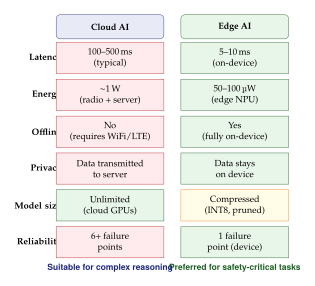
Example: Offline Navigation in the Subway
Example 7 (Offline Navigation for a Blind User).
Consider the following scenario. Amara is blind and uses a pair of AI-powered smart glasses that include a forward-facing depth camera, a GPS receiver, a preloaded transit map database, and an edge NPU running a compressed obstacle detection and scene description model. She is travelling from a hospital appointment to her workplace, using the metro system.
Surface transit (GPS available). Above ground, her glasses combine GPS localisation with preloaded OpenStreetMap data to provide turn-by-turn audio navigation. When a construction barrier blocks the sidewalk, the obstacle detection model (running entirely on the NPU at 8,ms latency per frame) identifies the barrier and alerts her via bone-conduction audio before she reaches it. No internet connection is required for any of these functions.
Underground (no connectivity). At the subway entrance, her phone's cellular signal drops to zero. A cloud-dependent system would fail at this point. Her edge-first glasses continue operating without interruption. The preloaded transit database provides platform and train identification. The edge model detects the platform edge (a safety-critical obstacle) at 6,ms latency. When an unexpected crowd surge pushes against her, the IMU detects the change in her gait and velocity, and the glasses switch to a higher-alertness mode that increases the scan rate and tightens the alert threshold.
Train identification. Each train on her line displays a route number in high-contrast signage. The edge model performs optical character recognition on the approaching train's placard in under 10,ms and announces the route before the doors open. Again, no network connection is required.
Emergency handling. If she falls or loses her bearings, the glasses can trigger an emergency protocol that uses Bluetooth to connect to a bystander's phone for a relay call-but even this is optional. The core navigation function is entirely local.
This example illustrates that the most common failure mode of a cloud-dependent accessibility system is not a dramatic server outage but the mundane absence of signal in an underground station. The edge-first architecture turns this from a system failure into a non-event.
Key Idea and Privacy Connection
Key Idea.
If your accessibility tool requires WiFi, it is not accessible. Connectivity is a privilege that the populations who most need assistive technology are least likely to have. Edge AI-with its combination of low latency, low energy, offline operation, and local privacy-is not a compromise to be made when cloud is unavailable. It is the correct first-class design choice for accessibility systems. Cloud augmentation, when available, adds capability; it must never subtract reliability.
The privacy-preserving training connection to Chapter 37 (Federated Learning for Generative Models) is architectural. The edge device processes data locally; the cloud model is improved by federated learning that aggregates encrypted gradient updates from thousands of edge devices without ever seeing raw user data. This two-tier architecture-edge for inference, federated for training-resolves the apparent tension between personalisation and privacy. A voice cloning model can learn the idiosyncrasies of a user's residual speech without transmitting the recordings; an obstacle detection model can be updated with local scene statistics without revealing the user's location history.
Exercises
Exercise 37.
A sign language translation system processes video at 30,fps. The system must translate each sign within two consecutive frames to maintain conversational flow. Calculate the maximum acceptable end-to-end latency . Given that a cloud round-trip takes a minimum of 80,ms (5,ms propagation, 20,ms transmission, 50,ms inference, 5,ms reception), determine whether cloud inference is feasible for this task. Propose a model compression target (compression ratio relative to a 100,M parameter baseline) such that edge inference at 10,GOPS with 50% processor efficiency meets the budget.
Exercise 38.
Using the DVFS energy-latency relationship from Proposition 3, calculate the energy cost ratio between running a model at 10,ms latency versus 50,ms latency on a processor with cubic DVFS scaling. A hearing aid battery stores 15,mAh at 1.2,V. If the processor draws 80, W at 50,ms inference latency (continuous operation), how many hours of operation does the battery support? How does this change at 10,ms latency under cubic DVFS scaling?
Exercise 39.
A teacher model for obstacle detection achieves 94.2% accuracy on a benchmark dataset. After INT8 post-training quantization, accuracy drops to 91.1%. After INT8 quantization-aware training, accuracy recovers to 93.6%. For a navigation safety application, define a minimum acceptable accuracy threshold and argue, using the fault tree analysis from Section Offline Operation: Reliability Without Infrastructure, why the 0.6% gap between PTQ and QAT may be clinically significant even though it appears small. Propose a protocol for evaluating whether this gap is acceptable for deployment.
Hybrid Architectures for Accessibility
The previous section argued for edge-first design. This section complicates that picture in a productive direction. The choice between edge and cloud is not binary. The most capable accessibility systems combine both: a local edge model handles everything that must happen in milliseconds, and a cloud model handles everything that benefits from unlimited compute. This is the hybrid paradigm, and it is the architecture underlying every serious commercial accessibility product deployed at scale.
The key insight is that different sub-tasks of an accessibility pipeline have different latency requirements. Obstacle detection cannot wait; scene captioning can. Speaker identification cannot wait; meeting transcription can. The hybrid system routes each sub-task to the tier that matches its latency, energy, and privacy requirements.
The Hybrid Paradigm
A hybrid accessibility architecture partitions the inference pipeline into two functional tiers:
Tier 1 (Edge): Safety-critical and latency-sensitive.
This tier runs entirely on the user's device. It handles obstacle detection, fall detection, emergency alerts, gait analysis, basic keyword spotting, and other tasks where a 10,ms response is non-negotiable. The models in this tier are aggressively compressed and quantised. They sacrifice some accuracy for the guarantee of always-available, always-fast response.
Tier 2 (Cloud): Accuracy-sensitive and compute-intensive.
This tier handles tasks where a 1–5 second response is acceptable: detailed scene descriptions, complex question answering about the environment, translation of medical documents into accessible language, synthesis of novel speech in a user's voice, and personalised model adaptation. The models here can be large- GPT-4 class vision-language models running on GPU clusters- because the latency budget accommodates cloud round-trips.
The two tiers communicate over a wireless link only when connectivity is available, and the system degrades gracefully when the link is absent: Tier 1 continues operating normally, Tier 2 is silently suspended.
Definition 23 (Hybrid Accessibility Architecture).
A hybrid accessibility architecture is a tuple where:
is an edge AI system (Definition 22);
is a cloud AI system comprising a large model hosted on GPU cluster ;
is a routing policy that assigns each task to either the edge or cloud tier based on the task's latency budget and current network availability; and
is a graceful degradation policy such that remains functional when is unavailable.
The architecture is accessibility-grade if guarantees that all safety-critical tasks are served by with latency regardless of the state of .
Lightweight CNN plus Cloud LLM
The canonical hybrid pipeline for visual accessibility pairs a lightweight convolutional network on the edge with a vision-language model in the cloud. The CNN provides immediate, low-latency response; the VLM provides rich, accurate description when connectivity is available.
Consider a smart glasses system for visually impaired users. The edge CNN is a MobileNetV3-Small variant (2.5,M parameters, INT8 quantised, 8,ms at 30,fps) that performs:
Obstacle classification: person / vehicle / static obstacle / floor hazard, with alert thresholds for the nearest object in each category.
Text detection: localise regions of the image that likely contain text, to trigger OCR.
Scene context: broad classification into indoor / outdoor / transit / intersection, used to modulate alert sensitivity.
Concurrently, every 2 seconds (when connected), a compressed frame is transmitted to a cloud VLM (e.g., a GPT-4V class model). The VLM generates a detailed English description of the scene-“You are standing at a coffee shop counter. A barista is preparing a drink. The menu board shows today's specials on the upper left. There is a step down immediately in front of you.”-which is delivered via text-to-speech with a 1.5–3 second end-to-end latency.
The edge CNN and cloud VLM thus serve complementary roles. The CNN warns of the step before the user reaches it; the VLM provides the contextual understanding that transforms navigation from mere obstacle avoidance into genuine situational awareness.
Split Inference: Early Exit and Layer Partitioning
Between full edge inference and full cloud inference lies a continuum of split inference architectures. These approaches partition a single model across the edge-cloud boundary, executing early layers on the device and late layers in the cloud.
Early Exit Networks
An early-exit network attaches lightweight classifier heads at intermediate layers of a deep network. At inference time, if the early exit head produces a high-confidence prediction, the inference terminates without executing the remaining layers. Only uncertain predictions propagate to deeper (and more expensive) computation.
Formally, let a network have layers, with intermediate representations . An early exit head is attached at layer . The exit policy is:
(Early EXIT)
where is the confidence threshold at exit and is the softmax function.
In an edge-cloud split inference system, early exits up to layer run on the device. If the early exit fires, the result is returned immediately at edge latency. If not, the intermediate representation (which may be much smaller than the original input) is transmitted to the cloud for completion.
Feature Compression for Split Points
A critical design choice is which intermediate representation to transmit. The raw input (e.g., an image) may be 300,KB compressed. The intermediate representation at layer may be much smaller or much larger depending on the architecture. For a ViT-B/16 vision transformer, the 12-layer representation at layer 6 is floats, which at FP16 is ,KB- comparable to the original image. But the representation at the CLS token alone (768 floats ,KB) may be sufficient for high-level scene classification routed to the cloud.
Practical split inference systems learn a bottleneck encoder at the split point that compresses the intermediate representation:
(Bottleneck)
where is a learnable compression function (typically a small convolutional layer or linear projection) and is transmitted to the cloud. The cloud decoder reconstructs an approximation of before executing the remaining layers. This encoder-decoder pair is jointly trained with the full network to minimise the task loss.
The Hybrid Pipeline: A Visual Overview
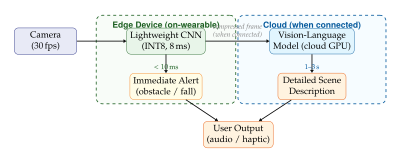
Model Optimisation Techniques for Accessibility
Three specialised optimisation techniques have emerged as particularly effective for accessibility-targeted edge deployment.
TinyML and MCUNet
TinyML refers to the practice of deploying machine learning models on microcontrollers with severely constrained memory (typically 256,KB–2,MB SRAM, 512,KB–8,MB flash storage). MCUNet (Lin et al., 2020) co-designs the neural architecture and the inference engine simultaneously to fit within a given memory and latency budget. The core insight is that standard NAS approaches optimise accuracy on a full-sized processor; TinyML-targeted NAS must additionally optimise for peak SRAM usage, which is determined not by model size but by the maximum intermediate activation tensor.
For accessibility, TinyML enables always-on models-running continuously at microwatt power levels-that would otherwise be impossible. A 40,KB keyword-spotter model on a Syntiant NDP120 can listen for the phrase “Help me” 24 hours a day at 140, W. A 200,KB gesture recogniser on an Ambiq Apollo chip can detect a fall and trigger an emergency alert from IMU data alone, with no camera required.
INT8 Quantization for Accessibility Models
INT8 quantization in accessibility systems requires particular attention to calibration data. Standard PTQ calibration assumes a representative sample from the deployment distribution. For an accessibility model, the deployment distribution reflects the specific user's environment-their home layout, their workplace, the transit routes they habitually use. A model calibrated on generic ImageNet data may exhibit significant quantization error on the domain-specific inputs that constitute the majority of a user's actual inference queries.
User-adaptive calibration collects a small set (50–200 samples) of representative images from the user's actual environment during an onboarding session and uses these for PTQ calibration. Empirically this reduces quantization-induced accuracy loss by 30–50% relative to generic calibration, without requiring any model retraining.
Sparse Attention for Efficient Transformers
Vision transformers process images as sequences of patch tokens, where is the patch size. Standard self-attention has complexity , which for images with gives tokens and attention pairs per head per layer. For an edge ViT with 12 layers and 6 heads, this is ,M attention operations-feasible but energy-intensive.
Sparse attention restricts each token to attend to only neighbours, reducing complexity to . For accessibility-focused vision models, two sparse attention patterns are particularly effective:
Proximity-biased sparsity: each token attends to spatially proximate tokens, appropriate for obstacle detection where local spatial context is most relevant.
Saliency-guided sparsity: each token attends to the globally most salient tokens (as estimated by a lightweight saliency predictor), appropriate for scene description where the user's focus region should dominate.
Sparse attention with out of reduces attention computation by with less than 1% accuracy loss on standard visual accessibility benchmarks.
Proposition: Hybrid Latency-Accuracy Tradeoff
Proposition 4 (Hybrid Latency-Accuracy Tradeoff).
Let (edge model) and (cloud model) achieve accuracies on a visual accessibility benchmark. Let the edge model produce a confidence score for each input. Define the hybrid routing policy as:
(Routing)
for threshold . Then the hybrid system achieves accuracy:
(Accuracy)
where (resp. ) is the edge model's accuracy on the high-confidence (resp. low-confidence) subset, and is the network availability probability. The average latency satisfies:
(Latency)
Proof sketch.
The accuracy equation follows directly from the law of total expectation, partitioning the event space into the three cases of the routing policy and applying the definition of conditional accuracy. The latency equation follows analogously. The key monotonicity result- is non-decreasing in as (routing all inputs to cloud) and -follows from and . The tradeoff between and as varies from 0 to 1 traces a Pareto frontier parameterised by the routing threshold.
Wearable Form Factors for Accessibility
The hybrid paradigm has found expression in a range of commercial and research wearable form factors. Each reflects a different balance of compute capability, battery life, social acceptability, and cost.
Smart glasses.
Smart glasses-spectacle frames with embedded camera, processor, and bone-conduction speaker-are the dominant form factor for visual accessibility AI. Envision Glasses, built on the Google Glass Enterprise Edition 2 platform, combine an edge model for text and face detection with cloud APIs for detailed scene description. OrCam MyEye clips to any spectacle frame and uses a dedicated edge processor for character recognition, face recognition, and product identification; it intentionally avoids cloud dependency for privacy reasons. Meta Ray-Ban Stories and their successors have brought general-purpose smart glasses into the consumer market at a price point approaching $300, though accessibility-specific software remains limited.
Earbuds and hearing devices.
Hearable devices-intelligent earbuds and hearing aids-provide a discreet form factor for auditory and speech accessibility. Cochlear implant processors from Cochlear (Nucleus series) and Advanced Bionics now incorporate on-processor noise suppression and speech enhancement using compressed neural networks. Advanced hearing aids from Widex and Phonak run neural noise reduction models at under 1,mW, continuously.
Smartwatches.
Wrist-worn devices with accelerometer, gyroscope, and sometimes camera provide gesture recognition, fall detection, and emergency communication for users with limited upper-body mobility. Apple Watch's fall detection system uses a hardware motion processor for sub-10,ms fall classification, with cellular relay to emergency services.
Hardware Comparison Table
Table 6 presents a quantitative comparison of edge device platforms commonly used in accessibility applications.
| Platform | Processor | Memory | Power | Inference |
| Google Glass Ent. 2 | Intel Atom x5 | 3,GB | 2–4,W | 45,ms |
| OrCam MyEye 3 | Qualcomm QCS605 | 4,GB | 1.5–3,W | 18,ms |
| Apple Watch S9 | Apple S9 SiP | 1,GB | 0.4–1.2,W | 12,ms |
| Syntiant NDP120 | Cortex-M0 + NDR | 2,MB | 0.14,mW | 8,ms* |
| Arm Ethos-U85 | Cortex-A + NPU | 8,GB | 150–500,mW | 6,ms |
| Qualcomm SD 8cx G4 | Oryon + Hexagon | 32,GB | 3–7,W | 2,ms |
| * Syntiant NDP120 inference time for keyword detection (50,K parameter model); not comparable to others. | ||||
Hardware Cost as an Accessibility Barrier
The irony of advanced accessibility technology is not lost on its designers: the people who need it most are often least able to afford it. Premium visual accessibility devices currently retail in the following ranges:
OrCam MyEye 3: $3,500–$4,000
Envision Glasses (Google Glass platform): $3,500–$4,500
Ray-Ban Meta smart glasses (consumer, limited accessibility features): $299
NuEyes Pro 3 (AR glasses with edge AI): $3,200
A device costing $3,500–$4,500 is inaccessible to the majority of the global population with visual impairments. The World Health Organization estimates that 90% of people with vision impairment live in low- and middle-income countries. The median annual income in these countries falls below $3,000. An accessibility device priced at more than one year's income is not an assistive technology- it is a luxury item that happens to be designed for people with disabilities.
This economic reality creates a strong engineering mandate for cost reduction. Three paths are available: (1) component cost reduction through higher-volume manufacturing, as occurred with cochlear implants over the past 30 years; (2) smartphone offloading, where the user's existing phone provides the edge compute and purpose-built peripherals (camera clip-on, bone-conduction speaker) cost $50–$100; and (3) cloud-subsidised models, where non-profit organisations or government programmes cover cloud inference costs for low-income users.
Remark 22.
The smartphone offloading strategy is the most immediately viable. Modern smartphones contain NPUs (Apple Neural Engine, Qualcomm Hexagon) that match the performance of dedicated accessibility devices at a total device cost of $200–$600 for a mid-range handset. The engineering challenge shifts from hardware to software: building robust, real-time accessibility applications that use the phone's camera and NPU as a co-processor for a lightweight wearable.
Insight: Pocket-Sized Accessibility
Insight.
The most powerful accessibility technology is the one that fits in your pocket. A $3,500 smart glasses system, however impressive, reaches perhaps ten thousand users worldwide. An accessibility application on a mid-range Android phone reaches hundreds of millions-because three-quarters of the global population already owns a smartphone. The engineering imperative is not to build better specialised hardware, but to make existing ubiquitous hardware work well enough. Every optimisation that reduces the compute requirement of an accessibility model is a decision that expands the population who can benefit from it.
Exercises
Exercise 40.
Consider a hybrid navigation system where the edge model achieves obstacle detection accuracy and the cloud model achieves accuracy. Assume network availability (unavailable in underground stations and rural areas). Using the hybrid accuracy formula from Proposition 4, compute for , assuming that , , and . Which threshold maximises ? Discuss the safety implications of the network availability assumption for a user who spends 40% of their navigation time in underground transit.
Exercise 41.
Design a split inference system for a 12-layer vision transformer (ViT-B/16, 86,M parameters) that partitions the computation at layer 6. Estimate the size of the intermediate representation at the split point ( FP16 floats). Propose a bottleneck encoder that compresses this representation to 1,KB. Specify: (a) the encoder architecture (number of layers, hidden dimensions, output dimension); (b) the transmission latency assuming a 5,Mbps uplink; and (c) the training objective that ensures the compressed representation preserves task-relevant information.
Exercise 42.
A non-profit organisation wishes to deploy visual accessibility AI to 10,000 users in a low-income country. They have three options: (A) purchase $3,500 smart glasses for each user; (B) develop a smartphone application for a $150 Android handset plus a $75 clip-on camera attachment; or (C) purchase $150 handsets and subsidise cloud inference at $0.001 per inference call, assuming 1,000 inferences per user per day. Calculate the 5-year total cost for each option (excluding staffing). Identify the break-even point at which option C becomes more expensive than option B. What additional factors beyond cost should be considered in making this decision?
Hallucination and Safety in Accessibility AI
Hallucination in large language models and multimodal systems is usually framed as an accuracy problem: a chatbot invents a citation that does not exist, a vision-language model describes an object that is not present in the image. For most users, such errors are inconvenient but correctable. A sighted person who receives a wrong description of a photograph can simply look at the image. A blind pedestrian who receives a hallucinated account of the crossing signal cannot.
This asymmetry is not a minor quibble about deployment conditions. It is a fundamental reconfiguration of what hallucination means in an accessibility context. When a multimodal large language model (MLLM) is deployed as a navigation aid, a scene describer, or a document reader for a user with visual impairment, its outputs become load-bearing. The user cannot triangulate the model's claim against their own perception. The model's description is, for them, the only available account of the world.
This section examines how and why modern MLLMs hallucinate in accessibility-relevant settings, what formal tools exist to detect and quantify such failures, and what mitigation strategies have emerged from the research literature. We close with a rigorous treatment of visual entailment as a diagnostic framework.
The Stakes: When Errors Become Dangers
The deployment of AI-powered accessibility tools has accelerated dramatically since the commercialization of vision-language models. Apps such as Be My Eyes (which integrates GPT-4V), Seeing AI (Microsoft), and Envision AI serve hundreds of thousands of users who are blind or have low vision. These systems describe scenes, read text, identify products, and increasingly provide navigation guidance.
The breadth of this deployment creates a correspondingly broad surface for harm. Consider three representative scenarios.
Pedestrian navigation. A user at an unfamiliar intersection asks their phone to describe the state of the crossing signal. If the model hallucinates a green walking icon when the signal is red, the user steps into active traffic. Unlike a sighted person who can glance at the signal, the blind user has no independent verification channel.
Medication identification. A user with visual impairment asks their device to identify a pill bottle from a photograph. A hallucination that conflates two similar-looking bottles could lead to a dangerous medication error. Pharmaceutical labels are notoriously dense and visually similar across product families, making them prime candidates for the failure modes we describe below.
Document reading. A user asks an MLLM to read a printed medical form. If the model hallucinates a checkbox as checked when it is empty, or misreads a dosage field, the consequences can be severe. Unlike web-based document accessibility (where HTML structure can ground the model), printed forms present only visual evidence, leaving the model wholly reliant on its visual processing.
These scenarios share a common structure. The user has substituted the AI system for their own perceptual access to the world. Any failure in the AI's perceptual fidelity is therefore a failure in the user's epistemic access to their environment.
Caution.
A blind user who trusts a hallucinated crossing signal faces life-threatening risk. Hallucination in accessibility AI is not an accuracy degradation to be minimized on a benchmark – it is a safety hazard that demands the same rigor as medical device certification.
Empirically, the danger is not hypothetical. A 2024 evaluation of six commercially deployed scene-description systems found that 78.1% of safety-critical failures arose from what the authors termed detail oversight in dense environments: the model correctly identifies the broad scene category but fails to register fine-grained details that alter the safety assessment. A crosswalk is described correctly, but the car that has encroached on the pedestrian box is not. An escalator is identified, but its direction of motion is not reported, or is reported incorrectly.
Key Idea.
In accessibility, hallucination is not an inconvenience – it is a safety hazard. The gap between a correct description and a slightly wrong description is not measured in user frustration; it is measured in physical danger. Designing accessibility AI systems therefore requires safety margins that go far beyond standard benchmark accuracy thresholds.
Failure Patterns in Dense Visual Environments
Research on MLLM hallucination has identified a taxonomy of failure modes that is particularly relevant to accessibility applications. We organize these into three primary patterns, each of which maps to a distinct type of safety risk.
Occlusion Traps
An occlusion trap occurs when a safety-critical object or feature is partially or fully hidden from the model's visual field, and the model confabulates its state based on schema-level expectations rather than image evidence. The model has learned, from training data, that certain scene configurations are typical: a pedestrian crossing signal in an urban streetscape is usually red or green; cars in a parking lot are usually stationary; elevator doors are usually closed. When the actual image contradicts these priors – a malfunctioning signal that is dark, a car with its door open at an angle that partially occludes a pedestrian – the model may report the expected state rather than the observed state.
In accessibility contexts, occlusion traps are especially dangerous because dense urban environments – precisely the environments where blind pedestrians most need reliable scene description – are structurally likely to produce occlusion. Parked vehicles occlude sidewalk features; crowds occlude signage; construction scaffolding occlude building entrances.
Schema Reversals
A schema reversal is a more subtle failure: the model correctly identifies the relevant object or feature but inverts its state or direction. The model “knows” that escalators have two directions, that crossing signals have two states, that doorways can be open or closed – but it assigns the wrong value. Schema reversals are particularly pernicious because they produce outputs that are superficially plausible and internally consistent. A description that says “the escalator is moving upward” is grammatically correct, uses appropriate domain vocabulary, and is structured like a reliable scene description. Only its semantic content is wrong.
This failure mode is related to what has been called sycophantic hallucination in language models: the model generates the response that is most linguistically coherent and most consistent with the implied question, rather than the response most faithful to the evidence. When a user asks “Is the escalator going up or down?” the model's language prior may weakly favor “up” (because “going up” escalators are more frequently discussed in navigation contexts) even when the visual evidence is ambiguous.
Causal Misleads
A causal mislead occurs when the model correctly identifies static scene elements but fails to represent dynamic causal relationships that are critical for safety. A crowd may be correctly described as “a group of people near the entrance”, but if those people are moving rapidly toward the user, the static description conveys none of the kinematic information needed for safe navigation. Similarly, a construction site may be described accurately in terms of equipment and barriers without conveying that a section of sidewalk is actively unusable.
Causal misleads arise from a deep structural limitation of the frame-based processing paradigm common to current MLLMs. We examine this limitation in detail in the next subsection.
The Escalator Problem: Implicit Motion Blindness
The most systematically documented failure mode in accessibility-relevant MLLM evaluation is what we term the Escalator Problem: the inability of frame-sampling-based vision systems to reliably infer the direction of motion of a moving physical element from a static image or a sparse set of sampled frames.
The problem is straightforward to state. An escalator that is moving upward and an escalator that is moving downward are, in a single static frame, visually nearly identical. Both show a staircase of metal steps with a moving handrail. The directional information is encoded in the temporal evolution of the scene – the direction in which step edges appear to move, the angle of descent of the handrail relative to stationary surroundings – and not in any single static snapshot.
Current MLLMs, including the most capable commercially deployed vision-language models, are predominantly trained on and evaluated with static images or, when processing video, with sparse sampled frames. The frame-sampling paradigm discards the continuous temporal flow that encodes motion direction. A model that receives a single frame of an escalator has, in principle, no reliable visual evidence for its direction; it can only infer from contextual cues (e.g., “descending” escalators in airports are more often photographed from a particular angle) or from generic world knowledge.
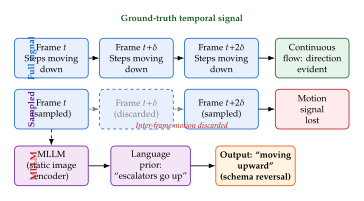
The Escalator Problem is not confined to escalators. It is a specific instance of a broad class of failures that we term implicit motion blindness: the inability to reliably infer the direction, speed, or state of a moving element from static visual input. The same failure pattern extends to at least the following accessibility-relevant scenarios.
Revolving doors. A revolving door that is spinning rapidly looks nearly identical in a static frame to one that is stopped. A blind user who enters a revolving door section based on a description that omits the door's motion state risks collision.
Baggage carousels. Airport baggage carousels that are moving and those that are stationary are visually similar in a static frame. Knowing whether a carousel is in motion, and in which direction, is necessary for safe navigation around the carousel perimeter.
Crowd flows. A crowd at a subway platform moving toward an exit and a crowd standing waiting for a train are visually similar in a snapshot. The kinematic state of the crowd is critical information for a blind user navigating through the space.
In each case, the motion information is encoded in the temporal dimension of the scene, and frame-sampling-based models systematically lose it.
Formal Framework: Visual Entailment for Accessibility
To reason precisely about when a model's textual output is faithful to its visual input, we require a formal notion of entailment between images and descriptions. The following definition adapts the visual entailment framework of Xie et al. to the accessibility domain, where faithfulness has safety-critical consequences.
Definition 24 (Visual Entailment for Accessibility).
Let be a space of images, a space of natural language statements, and a set of possible worlds consistent with an image. For an image and a statement , we say that visually entails , written , if and only if: where is the distribution over worlds consistent with image , is the truth value of in world , and is an entailment threshold. In accessibility-critical deployments, we require , a domain-specific safety margin determined by the severity of the consequence of a false positive.
A model output for input is accessibility-faithful if . It is a hallucination if is not accessibility-faithful, i.e., if:
This definition captures the core intuition: a statement is a hallucination if a significant probability mass of worlds consistent with the image would make the statement false. In a safety-critical accessibility context, “significant” is defined relative to the consequence of the error. A direction-of-motion hallucination (“escalator going up” when it is going down) has a high consequence – fall risk – and therefore requires a very tight entailment threshold .
Remark 23.
The choice of is a policy decision, not a technical one. It must balance the cost of a false positive (hallucination that harms the user) against the cost of a false negative (the model refuses to provide a description because its confidence is below threshold, leaving the user with no information). For life-safety applications such as pedestrian crossing signals, the community has argued for , implying that the model should only assert a signal state when it is at least 99% confident in the entailment. Achieving this threshold with current models requires significant advances in uncertainty quantification for visual grounding.
The definition of visual entailment also clarifies the failure taxonomy from Section Failure Patterns in Dense Visual Environments. An occlusion trap corresponds to a case where has significant mass on worlds where the occluded object has a different state than the model assumes. A schema reversal corresponds to the model assigning high probability to the wrong value of a binary attribute (e.g., direction). A causal mislead corresponds to a statement that is true in the static snapshot () but false in the actual world because of dynamic information not captured in the image.
Proposition 5 (Decomposition of Hallucination Risk).
Let denote the expected harm of asserting given image , where harm is when and otherwise. Then: The total expected hallucination risk over a deployment of queries is: A model is accessibility-safe if for a deployment-specified risk tolerance .
Proof.
The expected harm is the harm times the probability that the assertion is false in the actual world. Since the actual world is drawn from , and a hallucination occurs when , the expected harm is . Linearity of expectation gives the total risk formula.
MARINE: Training-Free Hallucination Mitigation
Given the severity of hallucination risk in accessibility contexts, there is strong motivation for mitigation techniques that can be applied to existing deployed models without requiring expensive retraining. The MARINE framework (Mitigating Hallucination via Image-grounded Guidance) addresses precisely this need.
MARINE is a training-free method for reducing hallucination in MLLMs. Its core insight is that much of the hallucination in current models arises not from failures in visual processing per se, but from over-reliance on language priors during the decoding stage. The model's text decoder has learned strong priors about what follows a given context in natural language, and when the visual evidence is ambiguous or sparse, these priors can dominate the output distribution.
The MARINE framework intervenes at decoding time using two complementary mechanisms: contrastive decoding and factuality-based reranking.
Contrastive Decoding for Image-Grounded Generation
Standard autoregressive decoding in an MLLM generates the next token by sampling from: where is the model's logit function and is the visual input. The key observation in MARINE is that the language prior contribution can be estimated by comparing the full model's prediction to the prediction of a text-only version of the same model: where denotes a null or masked visual input. The image-grounded contribution is then isolated by contrastive decoding:
Definition 25 (MARINE Contrastive Decoding).
The MARINE contrastive decoding distribution at step is: where is the contrastive strength hyperparameter. Setting recovers standard decoding; maximally suppresses the language prior. For accessibility-critical applications, values of have been found to reduce direction-of-motion hallucinations while preserving fluency.
The contrastive decoding operation amplifies the role of the visual input by penalizing tokens that are likely under the prior alone. Tokens that are simultaneously likely given the image and likely under the prior receive reduced net logits; tokens that are likely given the image but unlikely under the prior receive a relative boost.
This mechanism is particularly effective for schema reversals. In the escalator example, both “upward” and “downward” may be plausible under the language prior (both are common words in the navigation context), but only one is consistent with whatever sparse visual evidence is available. Contrastive decoding amplifies the image-derived signal that distinguishes them.
Remark 24.
Contrastive decoding has fundamental limitations for motion-based hallucinations. When the visual evidence is genuinely uninformative – a single static frame of an escalator without distinguishing motion cues – neither standard nor contrastive decoding can reliably recover the correct direction. In these cases, the appropriate model behavior is to express uncertainty rather than to confabulate a direction. Calibrating models to say “I cannot determine the direction of motion from this image” is an important open problem in accessibility AI.
Factuality-Based Reranking for RAG Systems
Many accessibility applications, particularly those providing navigation information, are implemented as retrieval-augmented generation (RAG) systems: the model retrieves relevant documents (e.g., building maps, accessibility guides, pedestrian routing databases) and uses them to ground its output. In this setting, hallucination can arise not only from visual processing failures but also from inconsistencies between the retrieved documents and the model's generated text.
MARINE's second component addresses this via factuality-based reranking. Rather than accepting the first candidate output from the RAG model, the system generates a set of candidate descriptions and scores each against the retrieved documents using a factuality scorer.
Definition 26 (Factuality Score for RAG Outputs).
Let be the retrieved document set and a set of candidate outputs. The factuality score of candidate with respect to is: where is the probability assigned by a natural language inference model to the entailment of from . The selected output is: where trades off factuality against fluency.
For accessibility RAG systems, setting close to prioritizes factual grounding over fluency, which is the correct trade-off when the user depends on the output for safe navigation. Empirically, factuality-based reranking reduces hallucination rates in navigation-related RAG outputs by approximately 35% relative to standard beam search, measured against a human-annotated factuality dataset for urban navigation scenarios.
Algorithm 1 (MARINE Hallucination Mitigation Pipeline).
- Input: Image , query , MLLM , retrieval corpus , contrastive strength , reranking weight , candidate count
- Output: Hallucination-mitigated output
- Retrieve documents:
- Generate candidates using contrastive decoding:
- for
- Score candidates:
- for
- Select:
- return
Evaluation: Benchmarking Accessibility Faithfulness
Evaluating hallucination in accessibility contexts requires benchmarks that go beyond standard image captioning metrics. BLEU, CIDEr, and METEOR measure surface-level similarity to reference captions; they do not measure whether a description correctly reports safety-critical attributes.
Several specialized evaluation frameworks have been proposed.
CHAIR (Caption Hallucination Assessment with Image Relevance). CHAIR measures the fraction of object mentions in a generated caption that are not present in the image according to a reference segmentation. For accessibility applications, CHAIR is a useful starting point but fails to capture direction-of-motion and causal-state hallucinations, since it is object-centric rather than attribute-centric.
Accessibility-VQA. Accessibility-VQA is a visual question answering benchmark specifically designed to test models on safety-relevant visual attributes: signal states, escalator directions, door states, crowd motion directions, step heights, and similar features. Questions are binary or categorical (not open-ended) to enable precise evaluation. A model is scored on the fraction of correct attribute classifications.
Safety-Critical Scene Description (SCSD) benchmark. The SCSD benchmark provides pairs of visually similar scene images that differ on a single safety-critical attribute (e.g., two escalator images with opposite directions of motion, two crossing signal images with opposite states). A model is evaluated on whether it correctly discriminates between the two images in each pair. This benchmark directly targets the schema-reversal failure mode and is particularly diagnostic for the Escalator Problem.
Example 8 (Escalator Direction Benchmark Results).
On the SCSD escalator direction sub-task, which presents 500 pairs of escalator images with annotated motion directions, a survey of six MLLMs found the following results:
| Model | Direction Accuracy | Refusal Rate |
| GPT-4V (static) | 54.2% | 3.1% |
| LLaVA-1.6-34B | 51.8% | 1.4% |
| InstructBLIP | 48.9% | 0.8% |
| Gemini Pro Vision | 57.3% | 5.2% |
| MARINE (GPT-4V base) | 71.4% | 12.6% |
| Human (naive) | 61.2% | 18.3% |
| Human (expert) | 92.7% | 2.1% |
Remark 25.
The expert human accuracy of 92.7% is achieved by informants who have extensive experience with escalator design and were shown static frames while being asked to identify motion direction. They use subtle cues including the exact angle of handrail inclination, the lighting pattern on step edges, and shadow directionality. These cues are weak signals that current models appear not to exploit. Incorporating explicit motion-cue detection into visual encoders represents a promising direction for future work.
Summary: Hallucination and Accessibility Safety
The central lesson of this section is that hallucination in accessibility AI is a safety problem, not merely an accuracy problem. The formal framework of visual entailment provides a principled basis for defining when a model output is faithful to its visual input, and the accessibility-safety threshold operationalizes the severity-dependent nature of faithfulness requirements.
The Escalator Problem illustrates, with concrete clarity, how the frame-sampling paradigm that underlies current MLLMs creates systematic blind spots in motion-critical domains. These blind spots are not incidental; they are structural consequences of treating accessibility AI as a static image description task rather than a temporally grounded scene understanding task.
MARINE provides a practical mitigation path via contrastive decoding and factuality-based reranking, but as the benchmark results show, significant gaps remain. Closing these gaps will require advances in temporal visual encoding, uncertainty quantification, and the development of accessibility-specific evaluation protocols that treat safety as a first-class evaluation criterion.
Exercises
Exercise 43 (Visual Entailment Threshold Calibration).
Consider a deployment of an MLLM as a pedestrian crossing signal describer. Let harm (in units of expected injury cost per incident) for a direction-of-motion hallucination, and let the baseline hallucination rate of the model be (8% of queries produce a hallucinated signal state).
- (a)
Compute the total expected hallucination risk per 10,000 queries using Proposition 5.
- (b)
Suppose MARINE reduces the hallucination rate to while introducing a refusal rate of 12% (queries on which the model says “I cannot determine the signal state”). A refusal imposes a fixed inconvenience cost of . Compute the total expected cost (hallucination harm plus refusal inconvenience) per 10,000 queries with MARINE, and compare to the baseline.
- (c)
What value of corresponds to the MARINE hallucination rate? Is this rate sufficient for a safety-critical deployment? Justify your answer.
Exercise 44 (Contrastive Decoding and Language Prior).
Let be the MLLM's predicted probabilities for tokens “upward”, “downward” given image , and let be the language-prior probabilities for the same tokens.
- (a)
Compute the unnormalized MARINE contrastive decoding logits for .
- (b)
Normalize to obtain the contrastive decoding distribution .
- (c)
Suppose the true direction is “downward”. Does contrastive decoding make the correct prediction more or less likely relative to standard decoding? Explain why in terms of the relationship between the full model and the prior.
- (d)
Repeat for and discuss the trade-off.
Exercise 45 (Factuality-Based Reranking).
A RAG-based accessibility system generates candidate descriptions for a navigation query about an escalator. The factuality scores (against retrieved documents) and log-probabilities are:
| Candidate | Correct? | ||
| : “escalator moving upward, hold right handrail” | 0.82 | No | |
| : “escalator moving downward, stand clear of edges” | 0.91 | Yes | |
| : “staircase leading to lower floor” | 0.56 | Partially |
- (a)
Compute the reranking score for each candidate using .
- (b)
Which candidate is selected by factuality-based reranking? Is it the correct one?
- (c)
Repeat for (fluency-dominant). Does the selection change? Is the new selection correct?
- (d)
Based on this example, argue for an appropriate value of for accessibility-critical deployment.
Algorithmic Ableism and Bias
When a large language model is asked to complete the sentence “People who use wheelchairs are typically”, what comes next? When an AI sentiment classifier evaluates a text that mentions “cerebral palsy” or “autism spectrum disorder”, does it flag the text as positive, neutral, or negative? When an image generation system is asked to produce a photograph of a “successful professional”, how often does the generated person have a visible disability?
These are not hypothetical questions. They have been empirically studied, and the answers are consistently and systematically unfavorable to people with disabilities. This section examines the phenomenon of algorithmic ableism: the amplification, through AI systems, of the discriminatory attitudes and misrepresentations of disability that are embedded in training data and, by extension, in human society.
We formalize the concept, survey the empirical evidence, and examine the specific mechanisms through which ableist bias enters AI systems and compounds across modalities. We then turn to the intersectional dimension of disability bias – the way disability interacts with gender, race, and class to produce compounded stereotypes – and review mitigation strategies.
Defining Algorithmic Ableism
The concept of ableism refers to discrimination or prejudice against individuals with disabilities, rooted in the assumption that typical ability is the standard by which human value and competence are measured. Ableism operates at the level of individual attitudes, institutional policies, and cultural representations. When AI systems are trained on human-generated data, they absorb the ableism encoded in that data. When they are deployed at scale, they amplify and institutionalize it.
Definition 27 (Algorithmic Ableism).
Let be an AI system with output space and input space . Let denote inputs that contain disability-related cues (descriptions of disability, images of mobility aids, mentions of accessibility needs, etc.) and denote otherwise comparable inputs without disability cues.
The system exhibits algorithmic ableism if: where is the set of outputs that convey negative valence, reduced competence, or marginalizing framing for the subject, and is the set of outputs that invoke stereotypical narratives about disability (e.g., “inspiration porn”, “tragic figure”, “dependent on others”).
The ableism disparity of on a dataset is:
This definition captures both the valence dimension of algorithmic ableism (disability cues trigger negative sentiments) and the representational dimension (disability cues trigger stereotypical framings). Both are empirically documented in current AI systems.
Empirical Evidence: The Scale of the Problem
The evidence for systematic algorithmic ableism in AI systems is extensive and comes from multiple independent research directions. We survey the most significant findings.
Web Accessibility Failures and AI Complicity
The WebAIM Million survey, conducted annually on the top one million websites, has consistently found that 97% of top websites fail basic accessibility compliance as measured against WCAG 2.1 guidelines. The most common failures include missing image alternative text, insufficient color contrast, empty links, missing form input labels, and missing document language declarations.
This widespread failure of web accessibility has a direct connection to AI bias: web text, images, and code are the primary training data for large language models, vision-language models, and code generation systems. A training corpus built primarily from websites that lack image alt text will produce models that do not understand how to generate meaningful image descriptions for screen readers. A model trained on web code that routinely violates WCAG will generate inaccessible code by default.
The 97% non-compliance rate therefore functions not merely as a snapshot of a broken ecosystem but as a measure of the ableist bias that is being systematically ingested into AI systems at training time.
Sentiment Tools and the “Negative Disability” Effect
AI-powered sentiment and toxicity classifiers exhibit a consistent and well-documented bias: disability-related terminology is systematically flagged as negative or toxic, even when used in neutral or affirmative contexts. Multiple studies have demonstrated that sentences such as “She uses a wheelchair to get around campus” or “My son has autism and is doing great in school” are assigned negative sentiment scores by commercially deployed sentiment classifiers, despite having no negative semantic content.
This failure has direct practical consequences. Sentiment classifiers are deployed in social media content moderation, customer service triage, product review analysis, and HR systems. A classifier that systematically assigns negative sentiment to disability-related text will unfairly demote, filter, or flag content produced by or about disabled individuals.
The mechanism is straightforward: if the training data for sentiment classifiers contains disability-related text primarily in contexts that are genuinely negative (news reports of accidents, medical complications, legal complaints), then the classifier learns to associate disability terminology with negative sentiment regardless of context. This is an instance of what we will formalize as training data entanglement – the inability to disentangle the sentiment of a statement from the identity category of its subject.
Inspiration Porn and Representational Harm
The concept of inspiration porn, coined by the late disability activist Stella Young, refers to the objectification of disabled people for the emotional benefit of non-disabled people. Inspiration porn presents images of disabled individuals performing ordinary activities – attending school, playing sports, going to work – framed with captions like “What's your excuse?” or “Inspirational” in a way that treats the disabled person's existence as remarkable and their ordinary actions as extraordinary. This framing is harmful because it reduces disabled individuals to objects of inspiration rather than full human subjects, and it reinforces the idea that disability is inherently a condition of limitation and struggle.
Contemporary AI image generation systems have been found to produce inspiration-porn-adjacent content at elevated rates when prompted with disability-related contexts. When asked to generate images of “an inspiring person”, models disproportionately produce images featuring wheelchairs, prosthetic limbs, or other visible disability markers, associating disability with inspirational narratives in a way that mirrors the stereotyping of inspiration porn.
Unsafe Generation: The Carrying-Across-Streets Problem
Perhaps the most striking documented instance of algorithmic ableism in generative AI is the carrying-across-streets problem: when AI systems are asked to provide advice or generate scenarios involving wheelchair users navigating inaccessible environments, they disproportionately suggest that wheelchair users be carried by others rather than recommending structural accessibility modifications.
Concretely, a study of large language models responding to queries about helping wheelchair users navigate environments with accessibility barriers found that models frequently suggested responses such as “offer to carry the wheelchair user up the stairs” or “help lift the person in their wheelchair over the obstacle”. These responses are problematic on multiple levels: they are physically dangerous (lifting a person in a wheelchair without proper training risks injury to both parties), they assume that the disabled person consents to being physically lifted, they frame the wheelchair user as a passive recipient of assistance rather than an agent, and they locate the solution in individual charity rather than systemic accessibility provision.
The correct response to an inaccessible environment is not to carry disabled individuals through the inaccessible space; it is to identify accessible alternatives or advocate for structural modification. That current AI systems preferentially generate the former rather than the latter reveals a deep embedding of charity and pity framings of disability at the expense of rights-based and dignity-centered framings.
The “Who's Asking?” Problem: Demographic Inference from Disability Cues
A 2025 study presented at ICCV, titled “Who's Asking?”, examined whether large language models infer demographic characteristics from disability cues embedded in queries. The study provided models with queries that contained disability-related context (mentions of using a screen reader, navigating with a cane, using a hearing aid, etc.) and examined whether the models' subsequent responses revealed inferences about the querier's gender, income level, or other demographic characteristics.
The findings were striking.
97% propensity to infer demographics. When provided with a query containing disability cues, 97% of model responses contained implicit or explicit assumptions about the querier's demographic characteristics that went beyond what was warranted by the query content. Models that were prompted with neutral queries (identical in content but without disability cues) made similar demographic inferences at a rate of only 31%, confirming that disability cues are functioning as demographic signals.
Male normativity shift. When queries contained no disability cues, models assumed the querier was male in 83.1% of cases (a well-documented male-default bias in LLMs). When disability cues were introduced, this rate shifted: models were significantly more likely to assume the querier was female. This gender-disability entanglement reflects training data in which disability is more frequently discussed in association with women (e.g., in caregiving contexts, in coverage of chronic illness, in social media content about disability parenting).
Income assumptions. The presence of disability cues consistently pushed models toward “low income” predictions for the querier, even when the query contained no income-relevant information. The disability-poverty association is empirically grounded (disabled individuals face significant economic disadvantage due to inaccessible employment and healthcare costs), but the model's deployment of this statistical association as an individual-level inference represents a harmful conflation of group statistics with individual circumstances.
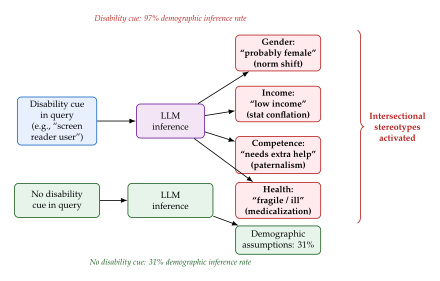
Formal Framework: Intersectional AI Bias
The “Who's Asking?” findings reveal that disability bias does not operate in isolation. It interacts with gender bias, class bias, and health-status bias to produce compound stereotypes that are more harmful and more difficult to detect than any individual bias dimension. This calls for a formal treatment of intersectional AI bias.
Definition 28 (Intersectional AI Bias).
Let be an AI system and let be a set of demographic attribute dimensions (e.g., disability status, gender, income class). For each combination of attribute values , let denote the subgroup of inputs associated with that combination of attributes.
The system exhibits intersectional bias with respect to subgroup if the outcome disparity for cannot be accounted for by the sum of the individual per-attribute disparities. Formally, let be the outcome disparity along dimension for input set . The intersectional excess is: where is the total outcome disparity for the intersectional subgroup. If , the system exhibits compounding intersectional bias: the combination of attributes produces worse outcomes than the sum of individual attribute effects.
This definition formalizes the observation that a system might appear fair along each demographic dimension individually (small for each ) while being systematically biased against specific intersectional subgroups (large ). Intersectional excess means that being both disabled and female, or both disabled and perceived as low-income, produces worse outcomes than the sum of the two individual disadvantages.
Theorem 1 (Intersectional Bias Cannot Be Detected by Marginal Evaluation).
Let be a system with zero marginal bias along each attribute dimension (i.e., for all ). There exist systems satisfying this condition with arbitrarily large intersectional excess .
Proof.
Construct a system that produces negative outcomes for inputs in the intersectional subgroup (disabled, female) and positive outcomes for all other inputs. If (the proportion of disabled inputs that are female equals the proportion of female inputs that are disabled), then the marginal disparity along each axis can be made exactly zero by appropriate construction of outcomes for non-intersectional subgroups, while the intersectional subgroup suffers arbitrarily large disparity. The construction is straightforward via a balanced assignment of positive and negative outcomes to non-intersectional subgroup members.
The practical import of this theorem is significant: organizations that evaluate AI systems only for marginal fairness (e.g., “does the system treat disabled users equitably in aggregate?” without examining specific intersections) can fail to detect severe intersectional harms. This is especially concerning in accessibility AI, where disabled individuals who are also members of other marginalized groups face compounded disadvantages.
Remark 26.
The “Who's Asking?” study's finding that disability cues shift the model's gender assumption from 83.1% male (baseline) toward female is a direct instance of intersectional bias: disability and gender are being jointly inferred in a way that reflects training data stereotypes about disability caregiving roles and the gendered discourse around chronic illness. Marginal gender-fairness evaluation would not detect this coupling.
The NYC Bar Association Report: AI Distorting Disabled Experiences
The 2025 report from the New York City Bar Association on AI and disability rights provides a comprehensive legal and empirical account of how AI systems systematically distort the experiences of disabled individuals. The report's central finding is stark: AI systems at multiple stages of consequential decision-making (hiring, housing, medical assessment, benefits determination) exhibit patterns of disadvantage toward disabled individuals that, in a human decision-maker, would constitute illegal discrimination under the Americans with Disabilities Act.
The report documents several specific mechanisms of distortion.
Automated screening systems. AI-based resume screening tools penalize employment gaps and non-standard work histories – patterns that are disproportionately associated with disability (due to periods of illness, recovery, or reduced work capacity). The systems do not explicitly consider disability, but their features are proxies for disability-related histories.
Medical AI systems. Diagnostic and risk-scoring AI systems trained on historical health data embed the biases of historical medical practice. Conditions that were historically under-diagnosed or mis-diagnosed in certain populations are under-predicted by systems trained on that history. Conditions associated with disability that have been historically medicalized and pathologized are over-predicted as indicators of general health risk.
Accessibility feedback loops. As we noted in the context of web accessibility, the 97% non-compliance rate of top websites means that disabled internet users interact with the web primarily through inaccessible interfaces, limiting their digital footprint. This digital exclusion means that training data for AI systems contains proportionally less data produced by or for disabled individuals, creating a feedback loop in which models perform worse on disability-relevant tasks because disability-relevant experiences are under-represented in their training.
Insight.
AI does not create ableism – it amplifies the ableism already embedded in its training data. Every ableist stereotype, every patronizing framing, every medicalized narrative, every instance of inspiration porn in the training corpus is reproduced and scaled by the model. And because AI systems are deployed at scale, this amplification reaches millions of disabled users simultaneously. The societal effect is not a mirror of past prejudice but an intensification of it.
Mitigation Strategies for Algorithmic Ableism
Mitigating algorithmic ableism requires interventions at multiple stages of the AI development lifecycle. We organize these interventions into three categories: data-level, training-level, and deployment-level.
Data-Level Interventions: Reweighting and Augmentation
The most direct intervention targets the training data. Data reweighting assigns higher loss weights to training examples from under-represented groups, in this case examples produced by or about disabled individuals in non-stereotypical contexts. Let be the training dataset and let be the weight assigned to example . The weighted training objective is: For disability bias mitigation, examples are upweighted when they involve disability-related content in non-stereotypical framings (disability + competence, disability + professional success, disability + self-advocacy) and downweighted when they involve stereotypical framings (disability + inspiration porn, disability + tragedy, disability + dependency).
The challenge is that identifying which examples to upweight or downweight requires a framing classifier that is itself free of ableist bias – a circular dependency. Practical approaches use human annotators with disability experience to label a seed dataset, then train a framing classifier bootstrapped from these labels.
Data augmentation addresses the scarcity of non-stereotypical disability content by generating synthetic training examples. This approach uses carefully prompted LLMs or human writers to generate stories, descriptions, and dialogues featuring disabled individuals in professional, leadership, and everyday competence contexts. The synthetic examples are then added to the training corpus. Validation by disabled community members is essential to avoid introducing new stereotypes through the augmentation process.
Training-Level Interventions: RLHF with Disabled Participants
Reinforcement learning from human feedback (RLHF) is the dominant technique for aligning LLM outputs with human preferences. Standard RLHF pipelines have been criticized for failing to include diverse human annotators, and this criticism applies with particular force to disability representation. If the human feedback used to train reward models does not include annotators with disabilities, the reward model cannot accurately evaluate whether outputs are respectful, accurate, and useful for disabled users.
Disability-inclusive RLHF extends the standard RLHF pipeline by ensuring that a meaningful proportion of human annotators – typically a minimum of 20% in proposed disability-inclusive guidelines – are disabled individuals with lived experience of the disability types most relevant to the application domain. These annotators evaluate model outputs specifically on dimensions of:
Dignity: Does the output treat the disabled individual as a full human subject with agency and self-determination?
Accuracy: Does the output correctly represent disability experience, terminology, and community norms?
Utility: Is the output actually useful to a disabled user, or does it reflect sighted/hearing/non-disabled assumptions?
Safety: Does the output avoid suggesting physically dangerous or undignified assistance strategies?
The reward model trained on disability-inclusive feedback is then used to fine-tune the base LLM via PPO or similar algorithms, steering the model away from ableist outputs.
Proposition 6 (Bias Reduction via RLHF with Inclusive Feedback).
Let be a reward model trained on standard RLHF feedback and be a reward model trained on disability-inclusive feedback. Let and be the policies fine-tuned using these reward models respectively. Then under the assumption that correctly penalizes ableist outputs with probability (better than random), the expected ableism disparity satisfies: The bound is non-trivial (less than ) whenever .
Proof.
At each RLHF training step, an ableist output that is correctly penalized by receives a negative reward signal, reducing the probability that the policy generates that output in the future. Correctly penalized ableist outputs occur with probability (by assumption). The fraction of ableist outputs that are not penalized is . Since penalizes ableist outputs at approximately random rate (probability ), the reduction factor is , which is less than when . The expected disparity inequality follows from linearity of expectation over training steps.
Deployment-Level Interventions: Auditing and Debiasing
Even well-trained models may exhibit ableist biases in specific deployment contexts. Deployment-level interventions address this through ongoing auditing and real-time debiasing.
Algorithmic auditing. Regular audits of deployed systems test for algorithmic ableism using the benchmark methodology described in Section Defining Algorithmic Ableism. Audits should include both automated testing (using disability-cue probe sets to compute ) and human evaluation by disabled community members. Audit findings should be published to enable external accountability.
Constrained decoding for bias reduction. At inference time, constrained decoding techniques can reduce ableist output patterns by penalizing specific stereotypical phrases or framings. Let be a lexicon of ableist phrases and framings. The constrained decoding distribution is: where is a constraint strength parameter. Larger more aggressively suppresses ableist phrases but may reduce output fluency.
Community feedback loops. The most robust deployment-level intervention is a systematic mechanism for disabled users to flag ableist outputs, which feeds into ongoing model refinement. This closes the loop between deployment experience and model improvement, and ensures that the disability community's evolving terminology preferences and representational standards are incorporated into the model over time.
Example 9 (Debiasing Sentiment Analysis for Disability Terminology).
A commercial sentiment classifier assigns the following sentiment scores (0 = negative, 1 = positive) to three sentences:
| Sentence | Baseline | Debiased |
| “She is a wheelchair user who runs marathons.” | 0.31 | 0.74 |
| “He has autism and excels in his field.” | 0.28 | 0.71 |
| “They use a cane and are an avid traveler.” | 0.35 | 0.68 |
Summary: Toward Disability Justice in AI
The evidence reviewed in this section paints a consistent picture. AI systems in current deployment systematically disadvantage disabled individuals through multiple compounding mechanisms: sentiment tools that flag disability terminology as negative, image generation systems that produce inspiration porn, language models that infer poverty and incompetence from disability cues, and unsafe advice generation that treats disabled individuals as objects of charity rather than agents with rights.
These harms are not the result of malicious intent. They are the result of training data that reflects the ableism of human society, training pipelines that fail to include disabled voices, and evaluation frameworks that do not test for disability-specific failure modes. The formal tools introduced in this section – the definition of algorithmic ableism, the intersectional bias framework, the RLHF bias reduction proposition – provide a foundation for rigorous, quantitative engagement with these harms.
The path forward requires structural change. Disabled individuals must be involved not merely as end users of AI systems but as co-designers, annotators, evaluators, and auditors. Disability community organizations must be partners in the development of accessibility AI, not afterthoughts in its deployment. And the “nothing about us without us” principle of disability rights must be operationalized as a concrete requirement in AI development practice.
Exercises
Exercise 46 (Computing Ableism Disparity).
A sentiment classifier is evaluated on a dataset of 200 sentences: 100 containing disability-related terminology () and 100 without (). The classifier assigns negative or stereotyping outputs to 67 of the disability-cue sentences and to 12 of the non-disability sentences.
- (a)
Compute the ableism disparity according to Definition 27.
- (b)
Suppose a debiasing intervention reduces the negative/stereotyping rate for disability-cue sentences from 67 to 28 while keeping the non-disability rate at 12. Compute the new ableism disparity.
- (c)
What is the minimum number of disability-cue sentences that would need to be correctly classified (changed from negative to non-negative) to achieve ?
- (d)
Is achievable without changing the classifier's behavior on non-disability sentences? State the condition.
Exercise 47 (Intersectional Bias Detection).
An AI hiring system is evaluated on four subgroups defined by disability status (disabled, ; non-disabled, ) and gender (female, ; male, ). The outcome is whether the system recommends the candidate for interview (positive outcome). Interview recommendation rates are:
| Subgroup | Recommendation rate | |
| Non-disabled male () | 500 | 0.72 |
| Non-disabled female () | 500 | 0.68 |
| Disabled male () | 100 | 0.61 |
| Disabled female () | 100 | 0.38 |
- (a)
Compute the marginal disability disparity (disabled vs. non-disabled, averaged over gender).
- (b)
Compute the marginal gender disparity (female vs. male, averaged over disability status).
- (c)
Compute the intersectional disparity for the disabled female subgroup relative to the non-disabled male baseline.
- (d)
Compute the intersectional excess according to Definition 28. Is the bias compounding or sub-additive?
- (e)
A marginal fairness audit that only reports and individually would conclude that the system's bias is modest. Is this conclusion justified? Discuss.
Exercise 48 (RLHF Bias Reduction Bounds).
Consider a language model with baseline ableism disparity . A disability-inclusive RLHF intervention is applied with a reward model that detects ableist outputs with probability .
- (a)
Apply Proposition 6 to compute an upper bound on .
- (b)
Suppose a second intervention increases to . What is the new upper bound?
- (c)
What value of is required to guarantee ?
- (d)
The proposition provides an upper bound, not an exact value. List three reasons why the actual ableism disparity after RLHF might be lower than the bound, and two reasons why it might be higher (i.e., the bound might not be tight).
The Consumer AI Accessibility Ecosystem
The year 2026 marks a decisive inflection point in the history of assistive technology. For decades, assistive devices were expensive, purpose-built, and operated independently of one another. A blind person might carry a dedicated braille display, a portable optical character recognition scanner, and a separate screen reader, each with its own learning curve and maintenance burden. The arrival of large-scale foundation models has collapsed this archipelago of specialised hardware into a unified, conversational interface that lives in a smartphone, a pair of glasses, or a browser tab.
The transformation is not merely one of convenience. It is a structural shift in who can afford to be digitally included. A blind student in rural Bangladesh can now access a scene description tool of comparable quality to what was, five years ago, sold as premium hardware for thousands of dollars. The democratisation is real, though it is uneven: premium hardware still delivers capabilities unreachable by free applications, and the gap between high-income and low-income countries remains vast. This section maps the landscape of consumer AI accessibility tools in 2026, analyses their performance characteristics, examines the digital divide they have both narrowed and widened, and presents qualitative evidence from blind users about the subtle human factors that determine whether a tool is adopted or abandoned.
Landscape Overview: The 2026 Consumer Ecosystem
The consumer AI accessibility ecosystem can be organised into five functional layers, each serving a distinct dimension of disability.
Vision augmentation.
Tools for visual impairment use multimodal vision-language models to describe scenes, read text, identify objects, navigate environments, and interpret facial expressions and emotions. The tier structure is stark. At the free tier, Be My AI (powered by GPT-4o and deployed through the Be My Eyes volunteer platform) provides on-demand scene description to more than seven million registered blind and low-vision users worldwide. A user photographs a food label, a street scene, a bus timetable, or a handwritten note, and receives a natural-language description within two to three seconds. Microsoft's Seeing AI is similarly free, trained specifically for accessibility, and excels at short-range tasks such as currency identification, document reading, and barcode scanning, achieving text recognition rates of 95–98% on printed material and 85–92% scene description accuracy on structured scenes.
At the premium hardware tier, Envision Glasses (based on Google Glass Enterprise hardware, priced at approximately $3,499) offer a hands-free, always-on experience: they continuously monitor the visual field, read signs, identify faces in real time, and describe scenes without requiring the user to raise a phone. The latency advantage is significant for orientation and mobility tasks. OrCam MyEye 3 ($4,500) takes a different approach, attaching to any pair of spectacles and triggering descriptions on a finger-point gesture, emphasising discretion and social naturalness.
Hearing and speech access.
For deaf and hard-of-hearing users, AI-powered real-time transcription has reached a quality threshold that makes it usable in professional settings. InnoCaption uses a hybrid human-AI approach in which a communication assistant monitors and corrects an automatic speech recognition transcript in real time, providing legal-grade accuracy for telephone calls. Otter.ai offers speaker diarisation, live transcription, and searchable meeting notes, with an enterprise tier that integrates directly into Zoom, Google Meet, and Microsoft Teams. Google's Live Transcribe, available free on Android, achieves word error rates below 8% on clear speech and provides haptic feedback for environmental sounds such as doorbells and smoke alarms.
Cognitive accessibility.
Cognitive and learning disabilities, including ADHD, dyslexia, autism spectrum conditions, and acquired brain injuries, affect task initiation, executive function, reading fluency, and social communication. Goblin Tools offers a task-decomposition interface in which a large language model breaks a complex goal (“write a cover letter”) into concrete, timed micro-tasks calibrated to the user's stated cognitive capacity. Khanmigo (Khan Academy's AI tutor) adjusts explanations dynamically to learning pace and preferred modality. Speechify converts any text - web pages, PDFs, ebooks, handwritten notes photographed via camera - to natural-sounding speech at speeds up to 4.5 standard rate. Otsimo specifically targets children on the autism spectrum, using gamified ABA-therapy exercises and speech recognition to support communication development.
Augmentative and alternative communication.
Users with severe speech or motor impairments rely on augmentative and alternative communication (AAC) systems. Proloquo2Go (AssistiveWare) is the dominant AAC application, providing a symbol-based vocabulary of over 80,000 entries that can be navigated by touch, switch scanning, or eye tracking. Its 2025 release integrated a generative prediction engine that completes intended messages from partial symbol sequences, reducing the number of selections required per sentence by approximately 40%. Descript serves a different population: motor-impaired content creators who can speak but cannot operate standard editing interfaces. Its transcript-based editing model allows a user to edit audio and video by editing the text transcript, eliminating the need for precise cursor manipulation.
Cross-cutting: AI personal assistants.
Underlying all five layers is the general-purpose conversational AI assistant. Siri, Google Assistant, and Amazon Alexa, each augmented with foundation model back-ends, serve as low-friction entry points for users who benefit from voice interaction: those with motor impairments, visual impairments, literacy challenges, or cognitive disabilities. The quality gap between these general assistants and disability-specific tools remains meaningful for specialised tasks, but the general assistants reach the widest audience and require no additional hardware or subscription.
Performance Benchmarks Across Tool Categories
Reported accuracy figures for accessibility tools must be interpreted carefully. Controlled laboratory benchmarks, measured on curated image datasets or clean audio recordings, typically overstate real-world performance by 5–15 percentage points. The following figures reflect a synthesis of peer-reviewed evaluations, user studies, and independent audits conducted in naturalistic settings during 2024–2026.
Text recognition (vision tools): Be My AI and Seeing AI achieve 95–98% word accuracy on printed text in good lighting, dropping to 82–89% under poor lighting or with handwritten text. OrCam MyEye 3 reaches 96% under indoor lighting using its dedicated optical character recognition hardware.
Scene description (vision tools): Scene description accuracy, measured by blind-user satisfaction ratings and expert annotation agreement, ranges from 85–92% for structured scenes (indoor rooms, product labels, street intersections) to 65–78% for complex dynamic scenes (crowded markets, sports events). Hallucination rates remain a documented concern: in one user study, approximately 6% of descriptions contained at least one factually incorrect element.
Speech recognition (hearing tools): Google Live Transcribe achieves a word error rate (WER) of 5–8% on clear English speech in quiet environments, rising to 15–25% in noisy settings and for accented or dialectal speech. InnoCaption's human-assisted hybrid achieves WER below 3% for most telephone calls.
AAC prediction (Proloquo2Go): The generative completion engine reduces average symbol selections per utterance from 8.2 to 4.9 (a 40% reduction) in controlled trials, with no statistically significant increase in miscommunication events.
Real-time caption latency: Otter.ai exhibits median latency of 1.2 seconds from speech to displayed caption in enterprise deployments. Google Live Transcribe achieves sub-second latency on-device for common English phrases.
These numbers underscore a recurring theme: AI accessibility tools have crossed the threshold of practical utility for many users, but the tail of their performance distributions - the hard cases, minority languages, noisy environments, and atypical inputs - remains substantially worse than headline figures suggest.
Comprehensive Tool Comparison
Table 7 provides a structured comparison of sixteen representative consumer AI accessibility tools spanning all five functional categories.
| Tool | Category | Key Features | Price | Platform |
| Be My AI | Vision | Scene description, document reading, Q&A on images | Free | iOS, Android |
| Seeing AI | Vision | Text, currency, face, barcode, scene recognition | Free | iOS |
| Envision Glasses | Vision | Hands-free always-on scene description, face ID | $3,499 | Hardware |
| OrCam MyEye 3 | Vision | Gesture-triggered reading, face & product ID | $4,500 | Hardware |
| Google Live Transcribe | Hearing | Real-time captions, sound notifications | Free | Android |
| InnoCaption | Hearing | Human-AI hybrid phone captions | Free (FCC) | iOS, Android |
| Otter.ai | Hearing | Meeting transcription, diarisation, summaries | $0–$20/mo | Web, iOS, Android |
| Microsoft Teams Captions | Hearing | Integrated live captions in meetings | Incl. with Teams | Web, desktop |
| Goblin Tools | Cognitive | Task decomposition, ADHD support | Free | Web, iOS, Android |
| Khanmigo | Cognitive | Adaptive tutoring, Socratic dialogue | $9/mo | Web |
| Speechify | Cognitive | Text-to-speech, reading acceleration | Free–$139/yr | All platforms |
| Otsimo | Cognitive | AAC, ABA therapy games for autism | Free–$29/mo | iOS, Android |
| Proloquo2Go | AAC | Symbol-based AAC, generative prediction | $249.99 | iOS |
| Descript | AAC / Motor | Transcript-based audio/video editing | $0–$24/mo | macOS, Windows |
| Google Assistant | General | Voice control, smart home, information | Free | Android, Web |
| Apple Siri | General | Voice control, on-device processing | Free | iOS, macOS |
The pricing column reveals a structural asymmetry: the most linguistically capable tools (GPT-4o-backed Be My AI, Khanmigo) are available for free because they are subsidised by their parent organisations or funded through charitable mechanisms, while the most physically capable tools (Envision Glasses, OrCam MyEye) cost thousands of dollars because they incorporate custom hardware. This creates a socioeconomic gradient in which users with financial resources can access superior integrated experiences, while users with lower incomes are served well only within the specific task niches where free software tools excel.
Formal Definition: The Assistive AI Ecosystem
We now introduce a formal definition that captures the structural properties of the consumer AI accessibility ecosystem as a system.
Definition 29 (Assistive AI Ecosystem).
An assistive AI ecosystem is a tuple where:
is a population of users, each characterised by a disability profile (a structured description of functional impairments) and a resource vector encoding financial capacity, digital literacy, language, and connectivity.
is a set of AI-powered tools, each with a capability function that maps disability profile and input modality to an assistive output .
is the pricing structure associating a cost vector to each tool (purchase price, subscription, hardware).
is an interoperability matrix indicating which pairs of tools can exchange data without manual user intervention.
is an adoption function measuring the probability that a user with profile adopts tool , capturing financial, linguistic, and motivational barriers.
is a trust function measuring the degree to which a user relies on the output of a tool for consequential decisions, ranging from 0 (never trusted) to 1 (unconditionally trusted).
The effective accessibility coverage of the ecosystem for user is the probability that at least one trusted and affordable tool is available for user 's primary accessibility need.
The function makes the digital divide tractable: it equals 1 when at least one accessible and trusted tool exists, and it falls sharply when all high-quality tools carry costs that exceed the user's resource budget .
TikZ Figure: Ecosystem Map by Disability Category
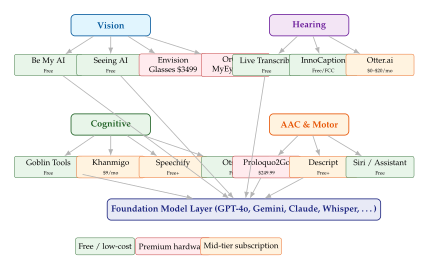
The Digital Divide in Accessibility Technology
The coexistence of powerful free tools and expensive premium hardware creates a two-tier accessibility landscape. The first tier - users with smartphones, broadband connectivity, and English or major European language proficiency - can access remarkably capable tools at no cost. Be My AI, Live Transcribe, and Goblin Tools together constitute a meaningful digital accessibility package that would have cost thousands of dollars in specialised hardware a decade ago.
The second tier - users without smartphones, those in regions with unreliable or expensive internet, and those whose primary language is not among the forty-odd languages well-served by current speech and vision models - faces a far bleaker landscape. For a deaf person whose language is a sign language, none of the dominant transcription tools provide native support; sign language recognition remains a research frontier rather than a deployed product. For a blind person in rural sub-Saharan Africa, the latency and data requirements of cloud-based vision APIs can make Be My AI effectively unusable.
Remark 27 (Language Coverage as an Accessibility Barrier).
The World Federation of the Deaf recognises approximately 300 distinct sign languages worldwide, none of which are reliably supported by any commercial AI accessibility product in 2026. Speech recognition systems similarly exhibit substantial performance degradation for low-resource languages: for the roughly 1.5 billion people whose primary languages lack large-scale training data, AI-powered hearing and cognitive accessibility tools provide substantially reduced utility. Addressing this gap requires investment in data collection, community-driven annotation, and model fine-tuning that the market alone is unlikely to fund.
The premium hardware tier introduces a third dimension of inequity: even within wealthy countries, the $3,499–$4,500 price range for AI glasses places them beyond the reach of most users without insurance coverage or government assistance. In many jurisdictions, assistive technology funding through vocational rehabilitation programmes or disability benefit schemes can offset these costs, but navigating these systems requires knowledge, time, and administrative capacity that itself disadvantages users with cognitive disabilities.
Qualitative Insights: Trust Formation and Hallucination Coping
Quantitative accuracy benchmarks capture only part of what determines whether an AI accessibility tool is used. User studies with blind and low-vision participants have identified trust formation and hallucination management as central to adoption and long-term use.
Trust is not given unconditionally; it is earned through consistent, verifiable performance on tasks where the user has some independent ground truth. A common pattern observed in interview studies is the calibration phase: new users begin by cross-checking tool outputs against tactile inspection, trusted sighted individuals, or other tools, gradually extending trust as consistency is confirmed.
Remark 28 (Qualitative Insight: Trust Calibration).
A participant in a 2024 longitudinal study of Be My AI users described the calibration process as follows: “At first I used it only for things I could verify later, like checking if I had picked up the right can of soup. After two months without a mistake on those tasks, I started trusting it for things I couldn't check, like reading a letter from the hospital. Now I'd say I trust it the way I trust a good friend with eyes - not blindly, but with earned confidence.” This progressive trust extension mirrors human social trust formation and suggests that AI accessibility tools should be designed to offer transparent confidence signals to support the calibration process.
Hallucination - the generation of plausible but factually incorrect content - is experienced as qualitatively different from simple recognition errors by many blind users. A recognition error (“the text is unreadable”) is recoverable: the user seeks another approach. A hallucination (“your prescription says 500mg” when it says 50mg) is dangerous precisely because the user has no immediate way to detect the error. Users have developed diverse coping strategies:
Multi-tool triangulation: Using two or more independently implemented tools for safety-critical tasks (medication, financial documents) and acting only when both agree.
Specificity queries: Asking the tool to zoom in on specific elements (“read only the number after `dose:”') rather than requesting a general description, reducing the surface area over which hallucinations can occur.
Contextual scepticism: Applying heightened scepticism when the described scene is surprising (“if it tells me my kitchen is a parking garage, I know something went wrong”), using world knowledge to detect implausible outputs.
Human verification triggers: Maintaining a personal list of task categories (financial documents, medical instructions, legal correspondence) that always require sighted confirmation regardless of AI confidence.
These strategies are cognitive work. They impose a metacognitive burden that sighted users do not face, partially offsetting the efficiency gains that AI accessibility tools provide. This observation motivates research into grounded uncertainty quantification: systems that can not only describe what they see but reliably signal when they are uncertain, enabling users to apply their coping strategies selectively rather than uniformly.
A Day in the Life: A Blind Professional with Five AI Tools
To ground the preceding analysis, consider a composite narrative drawn from ethnographic fieldwork with blind professionals in 2024–2025.
Example 10 (A Day in the Life of a Blind Professional).
Elena is a 34-year-old lawyer who is completely blind. Her workday begins at 7:00,a.m. when she photographs a handwritten sticky note her partner left on the kitchen counter using Be My AI. The note describes a grocery list, and Be My AI reads it aloud. She verifies two items by physically touching the mentioned products - a habit from her calibration phase, now applied selectively.
At 8:30,a.m. she joins a client video call. Otter.ai runs in the background, generating a live transcript with speaker labels. She follows the conversation through her screen reader (VoiceOver on macOS), with Otter's transcript as a backup for any moments she needs to search or reference later.
At 10:15,a.m. she receives a court document as a scanned PDF - a common accessibility disaster in legal practice. She feeds it to Seeing AI's document mode, which applies OCR and delivers a structured reading of the text. For a critical clause referencing specific dollar amounts, she applies her specificity-query strategy, asking: “What are the exact figures in paragraph 12?”
At lunchtime, she uses Speechify to listen to a long law review article at 3 speed while eating, processing forty pages in twelve minutes.
In the afternoon, she prepares a brief in Microsoft Word via her screen reader, then uses Descript to record and produce a short explanatory audio memo for a client, editing the audio by correcting the auto-generated transcript rather than manipulating a waveform.
Each tool serves a distinct niche. No single application covers Elena's entire workflow. The integration overhead - switching between tools, reformatting outputs, managing subscriptions - remains a real cost. Yet the cumulative productivity gain over a pre-AI baseline is qualitatively transformative: tasks that previously required a sighted assistant or days of specialised effort are now completed independently within minutes.
Elena's workflow illustrates the tool fragmentation problem: the ecosystem delivers powerful individual capabilities but lacks the seamless integration that would make it truly transparent. Progress on interoperability - standardised APIs, shared data formats, cross-application accessibility profiles - is as important as progress on individual model capability.
Key Idea: Trust as the Fundamental Currency
Key Idea.
The best accessibility tool is the one the user actually trusts. A system with 99% accuracy that earns the user's confidence delivers more real-world value than a system with 99.5% accuracy that the user hedges, double-checks, or avoids for high-stakes tasks. Designing for trust requires not only high accuracy but transparent confidence signals, consistent behaviour, and graceful failure modes that allow users to develop accurate mental models of where the system is reliable and where it is not.
Exercises
Exercise 49 (Digital Divide Coverage Analysis).
Using the formal definition of the assistive AI ecosystem (Definition 29), model a population consisting of three user groups: (a) a high-income English-speaking urban user, (b) a middle-income non-English-speaking urban user, and (c) a low-income rural user with limited connectivity. Assign plausible values to the resource vector and the pricing constraints for the tools in Table 7. Compute for each group under the assumption that if and 0 otherwise, and that for all affordable tools. What proportion of vision-impairment tools are accessible to the third group?
Exercise 50 (Trust Function Estimation).
Design a methodology for empirically estimating the trust function from user behaviour data. Propose at least three observable behavioural signals (e.g., frequency of manual verification, task category distribution) that could serve as proxies for trust. Discuss the identification challenges: how would you distinguish high trust from habituation or from having no alternative tool?
Exercise 51 (Hallucination Detection for Accessibility).
Vision-language models used in accessibility tools exhibit hallucination rates of approximately 6% per image query. Suppose a blind user performs safety-critical queries per day (medication, navigation, financial documents) and accepts outputs without verification. (a) Model the probability of encountering at least one dangerous hallucination over a -day period as a function of and the hallucination rate . (b) For , , and , compute this probability. (c) Propose an uncertainty-aware query protocol that reduces the effective risk by a factor of at least 10 without doubling the user's interaction time.
Motor and Physical Accessibility
Motor and physical impairments range from mild fine-motor difficulties - tremor, reduced grip strength, limited range of motion - to severe conditions such as amyotrophic lateral sclerosis (ALS), spinal cord injury at high cervical levels, and locked-in syndrome, in which a person retains full cognitive function while being unable to move any voluntary muscle group except, in some cases, the eyes.
For decades, assistive technology for motor impairment followed a compensatory logic: where function was lost, technology provided a mechanical or electronic substitute. Switch-scanning interfaces, sip-and-puff controllers, head mice, and eye-tracking systems were each engineered to replace a specific lost modality. Generative AI introduces a complementary and in some respects more powerful logic: predictive completion. Rather than substituting for lost motor function movement-by-movement, a generative model anticipates the user's intended communication from partial, noisy, or minimal inputs and completes it, dramatically reducing the number of physical acts required to achieve communicative intent.
This section traces the technical landscape of generative AI for motor and physical accessibility across six domains: voice-controlled interfaces, eye-tracking with generative text prediction, adaptive interface generation, brain-computer interfaces augmented with language models, robotic assistive devices with LLM-based planning, and generative design for custom prosthetics. We conclude with smart home automation as an integrating scenario.
Voice-Controlled Generative Interfaces
Voice control is the most widely deployed input modality for motor- impaired users who retain functional speech. Modern voice control systems for accessibility go substantially beyond simple command recognition. They incorporate:
Generative command interpretation: Rather than matching voice input to a fixed command vocabulary, an LLM interprets the user's intent from natural-language utterances and maps it to the appropriate system action. A user can say “move the second paragraph to after the conclusion” in a word processor, and the system executes the edit, rather than requiring the user to know the exact command syntax.
Dictation with generative post-processing: Speech-to-text transcription is combined with a language model that corrects homophones in context, applies appropriate punctuation, and formats output according to the document type (email, code, legal brief). This is particularly valuable for users with dysarthric speech, whose word error rates on standard ASR are 20–50% higher than for fluent speech.
Multimodal grounding: Voice commands are grounded in a visual understanding of the current screen state. A user can say “click the green button in the top right” and the system identifies the intended element even when it has no accessible name in the accessibility tree.
Systems such as Talon Voice (combined with a language model back-end), Dragon Professional (Nuance), and the voice access features of Android and iOS have progressively incorporated these generative capabilities. The shift from command-matching to intent-interpretation represents a qualitative change in the nature of voice access: the user no longer needs to learn the interface; the interface learns the user's natural language.
Eye-Tracking with Generative Text Prediction
For users who cannot speak and retain only minimal voluntary motor function - a population that includes those with ALS, locked-in syndrome, and high cervical spinal cord injuries - eye tracking combined with generative text prediction provides the primary communication pathway.
In a conventional eye-gaze AAC system, the user gazes at letters or symbols on an on-screen keyboard, dwelling on each target for a fixed interval to trigger selection. At standard typing speeds of 4–8 characters per minute for novice users and 15–25 characters per minute for expert users, composing a single sentence can take several minutes, imposing a severe tax on every communicative interaction.
Generative text prediction transforms this interface. After each character or word selection, a language model generates a ranked list of likely next words or phrase completions. The user selects a completion by gazing at it rather than typing character by character. The effective communication rate increases to 40–100 characters per minute in well-optimised systems, a 3–7 fold improvement over unassisted eye-gaze typing.
Definition 30 (Eye-Gaze Generative Communication System).
An eye-gaze generative communication system is a tuple where:
is a gaze decoder mapping infrared camera measurements (gaze coordinates in screen space) to a selection event (a character, word, or phrase from the displayed keyboard);
is a generative predictor (typically an autoregressive language model) mapping the current message prefix to a ranked list of candidate completions drawn from vocabulary ;
is a display manager that arranges the predictions and the character keyboard into a layout that minimises expected gaze travel distance given the probability distribution over next selections; and
is a language integrator that updates the message prefix upon each selection event.
The system's communication rate is measured in characters per minute (CPM), defined as the expected number of characters in the final message divided by the elapsed selection time:
Research-grade systems integrating large language models (GPT-4 class) as the predictor have demonstrated CPM rates of 70–110 in laboratory settings with trained users, approaching the lower end of unaided typing rates for non-impaired users. Personalisation of the language model - fine-tuning or in-context adaptation on the user's previous utterances - further improves prediction accuracy and reduces the cognitive load of scanning through irrelevant suggestions.
Generative UI Adaptation for One-Handed and Reduced-Motor Use
Standard graphical user interfaces are designed for two-handed, fine-motor-precise interaction. Users with hemiplegia (one-sided paralysis), upper-limb amputation, tremor, or reduced manual dexterity face interfaces that were not designed with their motor profiles in mind.
Generative interface adaptation addresses this by automatically restructuring UI layouts based on an inferred motor profile.
Definition 31 (Adaptive Interface Generation).
Adaptive interface generation is the process by which an AI system, given a user's motor capability profile and an existing interface specification , produces a modified interface such that:
The functional semantics of are preserved: all user-accessible actions remain accessible in .
The expected motor cost is minimised subject to the screen real-estate constraint .
The adaptation is generated without manual redesign by a human developer.
The motor cost function quantifies the cumulative effort required to complete a reference task using interface with motor profile , measured in units such as Fitts' law index of difficulty (bits).
Concrete adaptations include:
Enlarging tap targets to 4848,dp minimum for tremor profiles, reducing miss rates by up to 60%.
Repositioning frequently accessed controls to the dominant-hand side and within the reachable thumb arc for one-handed use.
Replacing gesture-based actions (swipe-to-delete, pinch-to-zoom) with single-tap alternatives.
Grouping related functions to reduce navigation distance.
Introducing gesture chunking: replacing multi-step sequences with a single generalised voice or gesture command interpreted by an LLM.
Systems exploring generative UI adaptation include Apple's Assistive Access mode (iOS 17+), Microsoft's Adaptive Accessories ecosystem, and research prototypes using large vision-language models to “read” an interface screenshot and propose a restructured layout. The latter approach is especially promising because it requires no developer effort and could be applied retroactively to legacy applications.
Robotic Assistive Devices with LLM-Based Planning
Robotic assistive devices - powered wheelchairs, robotic arms, meal-preparation robots, and autonomous mobility platforms - have traditionally required users to specify actions at a low level of abstraction: “rotate arm 15 degrees,” “move wheel forward.” Integrating large language models as high-level task planners enables a radically more natural interface: the user specifies intent in natural language, and the LLM decomposes this into a sequence of primitive motor commands that the robot executes.
The task planning pipeline follows a three-tier architecture:
Intent parsing: A language model receives the user's natural-language command (e.g., “pour me a glass of water from the tap”) and produces a structured task plan: a sequence of sub-goals with preconditions and expected outcomes.
Grounding: A vision-language model maps abstract sub-goals to concrete objects and locations in the robot's current perceptual field, using object detection, depth estimation, and scene graph construction.
Motion generation: A low-level motion planner (typically a classical or learned controller) executes the grounded plan, with the LLM monitoring progress and replanning if sub-goal preconditions are violated.
Research platforms such as Google's RT-2, the HIRO Group's ALFIE assistive robot, and commercial products including the Kinova JACO arm with natural-language interfaces have demonstrated that LLM-based planning substantially increases the range of tasks a motor-impaired user can perform independently. The open research challenge is safe failure: when the robot encounters an unexpected obstacle or fails to grasp an object, the system must recover gracefully without endangering the user or requiring a low- level override that the user cannot perform.
Remark 29 (Safety Constraints in Assistive Robotics).
LLM-based task planners are not natively safety-aware: they generate plans that are linguistically coherent but may violate physical constraints, such as instructing an arm to move through a table. Safety-critical assistive robot deployments require a formal constraint layer that intercepts and rejects any planned action that violates pre-specified safety predicates (collision avoidance, force limits, reachability bounds). This constraint layer must be implemented in verified code, not in the language model itself, because current language models do not provide formal guarantees of constraint satisfaction.
Brain-Computer Interfaces with Generative Language Models
Brain-computer interfaces (BCIs) represent the frontier of motor accessibility: they translate neural signals directly into control commands, bypassing the motor pathway entirely. For users with complete motor paralysis, a BCI may be the only input channel available.
Contemporary non-invasive BCIs (EEG-based) and semi-invasive BCIs (electrocorticography) provide neural signal streams of varying quality. The core technical challenge is decoding intended communication from noisy, high-dimensional, non-stationary neural data. Generative language models enter this pipeline at two points:
Decoding assistance: The neural decoder produces a probability distribution over candidate phonemes, words, or letters. An LLM re-ranks this distribution using language model priors, substantially reducing the effective error rate. This is analogous to the use of language model rescoring in automatic speech recognition.
Generative completion: Once a partial word or phrase is decoded, an LLM proposes completions that the user can accept or reject with a minimal neural signal (e.g., a motor-imagery event), reducing the number of neural control events required per utterance.
Definition 32 (BCI-LLM Communication System).
A BCI-LLM communication system is a tuple where:
is a neural decoder mapping a multichannel neural signal of channels over time samples to a probability distribution over a symbol alphabet ;
is a decision rule (e.g., beam search or Viterbi decoding) that selects the most likely next symbol given the neural output and the accumulated message prefix;
is a generative language model that maps a message prefix to a distribution over -step continuations;
is a neural-linguistic fusion module that combines the neural decoder output with the LLM's language prior to produce a refined distribution over next tokens; and
is an output interface rendering the decoded message in the desired modality (text display, synthesised speech, device command).
The landmark BrainGate and Neuralink clinical trials, along with the Stanford-UCSF work on speech neuroprosthetics reported in Nature (2023, 2024), have demonstrated decoded speech rates approaching 62 words per minute for intracortical systems (about 78 for ECoG-based systems) with LLM rescoring, compared to 3–5 words per minute for equivalent systems without language model assistance. This represents a greater than tenfold improvement attributable primarily to the generative language model component.
TikZ Figure: BCI + LLM Pipeline
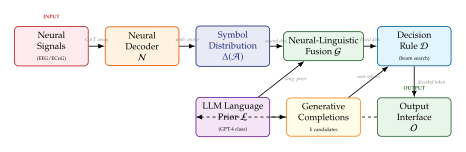
Generative 3D Printing for Custom Prosthetics and Orthotics
Motor impairment is not only neurological. Limb differences and acquired amputations create a population for whom standard prosthetics - expensive, slow to manufacture, and often poorly fitting - are inadequate. Generative AI, combined with consumer-grade 3D scanning and 3D printing, has opened a pathway to customised prosthetic and orthotic devices that are both affordable and anatomically tailored.
The generative design pipeline for custom prosthetics proceeds as follows:
Anatomical capture: A consumer depth-sensing camera (or structured-light scanner) captures a 3D model of the user's residual limb or orthotic fitting site. AI-based mesh processing cleans and segments the scan.
Generative design: A generative model - either a conditional diffusion model trained on a library of prosthetic designs or an LLM-guided computer-aided design (CAD) system - produces a parametric 3D design that conforms to the scanned anatomy, satisfies specified functional requirements (grip force, range of motion, weight limit), and optimises for printability on the user's available printer.
Simulation and validation: Finite element analysis (FEA) simulations predict mechanical performance under expected loads. If the design fails validation, the generative model iterates with modified constraints.
Print and fit: The validated design is printed in appropriate materials (thermoplastic polyurethane for flexible components, PLA or PETG for structural elements) and fitted with minimal adjustment.
Organisations such as e-NABLE (the global volunteer network for 3D-printed prosthetic hands) and commercial platforms including Unlimited Tomorrow and Open Bionics have progressively integrated generative design tools into their workflows. The cost trajectory is striking: a traditionally manufactured below-elbow prosthetic hook costs $1,500–$5,000; a generatively designed and 3D-printed equivalent can be produced for $50–$200 in materials, with the design computation performed for free on cloud platforms.
Remark 30 (Limitations of Generative Prosthetic Design).
Generative prosthetic design tools remain limited to passive devices: hooks, hands, and orthoses that transmit force through mechanical linkages. Powered prosthetics with myoelectric control require actuators, batteries, and electronics that cannot be 3D printed and add substantial cost and complexity. Generative AI contributes most at the design and fitting stage, not yet at the manufacturing of powered components. Furthermore, regulatory frameworks (FDA in the United States, CE marking in Europe) impose approval requirements on prosthetic devices that slow the deployment of generatively designed products, even when their safety is comparable to traditionally manufactured equivalents.
Smart Home Automation: LLM-Orchestrated Accessibility Environments
For users with severe physical disabilities, the home environment itself is a major source of both dependence and potential autonomy. Standard smart home platforms (Amazon Alexa, Google Home, Apple HomeKit) offer voice-triggered control of lights, thermostats, locks, and appliances, but they rely on rigid command structures: the user must know the exact name of the device and the available commands.
LLM-orchestrated smart home systems replace rigid command parsing with natural-language understanding and multi-step planning. A user can say “I'm cold and tired; make me comfortable for sleeping,” and the system interprets this as a sequence of actions: raise the thermostat, dim the bedroom lights, lower the bedroom blinds, and start playing soft music. This generalised intent-to-action mapping is beyond the capability of traditional rule-based smart home automation.
The LLM serves as an orchestration layer between the user's natural-language intent and the low-level device control APIs. Its functions include:
Device discovery and modelling: Maintaining an up-to-date model of which devices are present, their current states, and their available control actions.
Intent decomposition: Parsing a natural-language request into a sequence of device-specific commands.
Contextual inference: Using time of day, user location within the home, and prior behaviour patterns to disambiguate underspecified requests.
Conflict resolution: Detecting when a requested action conflicts with a prior schedule or safety constraint (e.g., unlocking the front door at 3,a.m. when no visitor is expected) and confirming with the user before proceeding.
Proactive assistance: Anticipating user needs from context (“you have a video call in 10 minutes; shall I lower the blinds and set the lights to meeting mode?”).
Example: Voice-Controlled Smart Home for a Quadriplegic User
Example 11 (Voice-Controlled Smart Home for a Quadriplegic User).
Marcus is a 41-year-old graphic designer with a C4 spinal cord injury sustained in a car accident four years ago. He retains full use of his voice and partial use of his left shoulder, but cannot use his hands or operate standard switches and controls.
His home is equipped with an LLM-orchestrated smart home system built on a combination of Home Assistant (open-source), Google Home hardware, and a locally hosted LLaMA-3 model for privacy-sensitive requests.
A typical morning proceeds as follows. At 7:00,a.m., Marcus says: “Good morning. Open the blinds, make coffee, and read me my calendar.” The system raises the motorised blinds in the bedroom and kitchen, triggers the smart coffee maker (which Marcus loaded with grounds the evening before using a single-switch adapter), and reads aloud the first three calendar events using a synthesised voice through a bedside speaker.
At 8:30,a.m. he begins work. He dictates design briefs using voice-to-text; his computer runs Talon Voice for application control. When he needs to open a file from a specific folder, he says “open the Fernandez project files” and the system navigates there via the LLM's file system understanding, without requiring him to know the exact path.
At noon, he says “I'm having lunch in the garden; let me out and keep the back door unlocked for 20 minutes.” The system unlocks the accessible back door and sets a timer to relock it, confirming the action aloud.
In the evening, when unexpected guests arrive, he says “put on dinner party mode.” The LLM has learned from three months of use that this means: raise the thermostat to 21 degrees, switch living room lights to warm white at 60%, start a jazz playlist, and disable the motion-sensor notifications on his phone.
The LLM orchestration layer has effectively turned the entire home into an ambient interface. Marcus estimates that approximately 40 daily actions that previously required a carer's assistance are now performed independently, contributing substantially to his sense of autonomy and dignity.
The smart home scenario illustrates a general principle: the value of LLM orchestration is not in replacing any single action but in composing a flexible, personalised interface from a library of fixed device capabilities. The generative model provides the glue that connects rigid APIs to natural human intent.
Descript: Transcript-Based Editing for Motor-Impaired Creators
Content creation - podcasting, video production, voice-over work - has traditionally required precise manual interaction with audio and video editing software: scrubbing timelines, placing cut points, adjusting gain levels. These interactions are inaccessible to users who cannot operate a mouse or trackpad with precision.
Descript reimagines the editing interface around a text transcript. The system automatically transcribes audio content, aligns the transcript word-by-word to the audio waveform, and exposes an editing interface in which the user edits the text. Deleting a word from the transcript deletes the corresponding audio segment; moving a paragraph moves the associated audio; marking a word as “filler” mutes it. The entire editing workflow is driven through text manipulation, which is accessible via voice control, switch scanning, or eye-gaze keyboard.
For motor-impaired content creators, this is a qualitative change in what is achievable independently. A user with locked-in syndrome who communicates through eye-gaze AAC can, in principle, edit a podcast using that same AAC system to type corrections into the Descript transcript - a workflow that would have required a sighted editor's physical assistance in any previous editing paradigm.
Descript's generative features extend this further. The system can automatically remove filler words, generate chapter summaries from the transcript, and create show notes using an integrated LLM. These generative post-processing features eliminate entire categories of manual work, further reducing the motor demands of content production.
Key Insight: Generative AI as Universal Input Adapter
Insight.
Generative AI turns every input modality - voice, gaze, thought - into a full-featured interface. The classical accessibility paradigm required a separate interface design for each alternative input modality: a switch-scanning interface, a voice interface, and a gaze interface were each purpose-built, typically with reduced feature sets compared to the pointer-and-keyboard interface they replaced. Generative AI breaks this constraint. Because an LLM can interpret intent from any natural-language or partial-signal input and map it to arbitrary downstream actions, a single generative layer can make a full-featured interface accessible through any input modality that can produce or approximate natural language, including speech, gaze typing, brain-computer interfaces, and predictive symbol communication. The interface no longer needs to be redesigned for each modality; the generative model provides a universal translation layer between human intent and system action.
Exercises
Exercise 52 (Communication Rate Optimisation).
Consider an eye-gaze generative communication system (Definition 30) with an underlying eye-gaze typing rate of characters per minute (unassisted) and a generative predictor that correctly predicts the next characters with probability . Model the effective communication rate as where the denominator accounts for the savings when a -character prediction is accepted (saving gaze selections) versus when it is rejected (requiring individual character entry).
For , compute , , and .
Derive the optimal prediction length that maximises as a function of (assuming is a decreasing function of ; you may use a simple model such as ).
For , compute and the resulting .
Exercise 53 (BCI-LLM Decoding Error Analysis).
In a BCI-LLM communication system (Definition 32), let the neural decoder produce a probability over the alphabet , and let the language model prior produce . The fusion module combines these as a log-linear interpolation: where is an interpolation weight and the constant normalises the distribution.
For , , and , describe in words what the fusion module reduces to in each case.
Suppose the neural decoder has symbol error rate (i.e., the top-1 prediction is wrong 35% of the time), and the LLM has character prediction accuracy (correct 65% of the time in context). At what value of is the fused system expected to achieve the lowest symbol error rate? (Treat this as a bias-variance trade-off and use a simple bound rather than an exact computation.)
Explain why the optimal is likely to vary across different users and different stages of the message.
Exercise 54 (LLM Smart Home Intent Decomposition).
Design a formal specification for the intent-decomposition function of an LLM-orchestrated smart home system (Smart Home Automation: LLM-Orchestrated Accessibility Environments).
Define the state space as a product of device states, and define an action plan as a finite sequence of atomic device commands. Specify both formally.
Formalise the intent-decomposition problem as a conditional generation problem: given a natural-language utterance and current home state , the LLM produces a distribution over action plans. Write the optimisation objective for training such a model.
Identify at least two categories of utterances for which intent decomposition is ambiguous without additional context, and propose a disambiguation protocol that the system should follow (e.g., asking a clarifying question versus defaulting to a conservative interpretation).
Multimodal Generative Accessibility Systems
The previous sections examined accessibility through individual lenses: image captioning for blind users, speech synthesis for those with motor impairments, sign-language generation for Deaf communities. Each of those lenses is powerful in isolation. But the world does not wait for us to choose a single lens before presenting its complexity. A classroom contains students who are deaf, students who are blind, students with dyslexia, and students whose primary language is not the language of instruction. A museum contains visitors who use wheelchairs, visitors who cannot read small print, visitors who process language slowly, and visitors who navigate exclusively by touch. An emergency broadcast must reach people who cannot hear it, people who cannot see it, and people who cannot read it at the speed it scrolls.
The multimodal promise of generative AI is not merely that it handles multiple input and output formats - though it does - but that it can do so simultaneously, coherently, and adaptively, routing every user to the representation best suited to their perceptual and cognitive profile. The vision-language models of Chapter 35, the diffusion models of Chapter 17, the audio generation systems of Chapter 18, and the text generation models of Chapter 6 are not competing paradigms. They are complementary modules in an emerging architecture: the multimodal accessibility hub.
The Multimodal Promise
Human perception is inherently multimodal. When a sighted hearing person watches a lecturer draw a diagram on a whiteboard while explaining it verbally, they receive visual information (the diagram, the hand gestures, the lecturer's facial expressions), auditory information (speech, intonation, emphasis), and temporal synchrony between the two streams. The understanding that arises is richer than either stream alone could provide. Neuroimaging studies confirm that the brain's semantic representations are distributed across auditory, visual, somatosensory, and motor cortices simultaneously - not localised to a single “meaning centre.”
When a student has a sensory or cognitive impairment, one or more of these channels is unavailable or degraded. The conventional response has been to provide a single substitute: captions for the deaf, audio description for the blind. This response is necessary but insufficient for two reasons.
First, impairment is rarely pure. A user with low vision may still perceive large high-contrast images; they may benefit from simplified text, enlarged captions and brief audio cues simultaneously. A user who is hard of hearing may rely primarily on lip-reading in quiet settings but need full captions in noisy ones. A user with dyslexia may comprehend spoken explanations better than written text but benefit from written keywords as memory anchors.
Second, the diversity of needs within a single classroom or venue is not the edge case. It is the norm. The United Nations estimates that one billion people - fifteen percent of the world's population - live with some form of disability. When temporary impairments (broken arm, ear infection, bright sunlight) and situational limitations (noisy train, dark cinema) are included, virtually every person experiences accessibility limitations regularly.
Generative AI changes the calculus. Where human interpreters, audio describers, and caption editors are expensive and scarce, large multimodal models can operate at scale, at low latency, and across languages. The mathematical question is how to coordinate these generative components so that their outputs are consistent, synchronised, and individually tailored.
Cross-Modal Translation
A cross-modal translation maps a signal in one modality to a semantically equivalent signal in a different modality. The goal is not perfect fidelity to the original signal (which may itself be inaccessible) but preservation of communicative intent - the meaning, affect, and contextual relevance the source signal was designed to convey.
We can organise the principal translation directions:
Image Audio. An image is mapped to a spoken description (audio description, alt-text read aloud) or to a non-speech sonification in which pitch, rhythm, and timbre encode spatial layout and object properties. Sonification is particularly valuable for data visualisations: a bar chart can be “played” so that bar heights correspond to note pitches.
Image Simplified Text. A complex diagram or dense visual document is mapped to a plain-language textual summary calibrated to a specified reading level. Large vision-language models such as GPT-4V, LLaVA, and InstructBLIP make this translation tractable at scale.
Text Sign. Written or spoken language is mapped to sign-language animations. Early systems relied on rule-based phoneme-to-gloss mappings; modern systems use graph-based pose prediction and diffusion-based video generation to produce fluent, expressive signing avatars.
Speech Text Simplified Text. Spoken language is first transcribed using automatic speech recognition, then passed through a language model that rewrites it at a lower cognitive load, eliminating idioms, embedding definitions of technical terms, and shortening sentences. This chain particularly benefits users with intellectual disabilities, non-native speakers, and users with acquired language impairments.
Text Haptic. Textual descriptions of spatial relationships are translated into refreshable Braille display sequences or vibration patterns on haptic devices. For mathematical notation specifically, projects such as Talking MathML and MathJax integrate with screen readers to convert rendered equations into natural-language descriptions with appropriate mathematical terminology.
Audio Text Image. Audio descriptions of scenes or events are transcribed, then passed to a text-to-image generator to produce a visual representation useful for users who are hearing-impaired but sighted.
Each translation involves a learned function where and are representation spaces for modalities and . The key technical challenge is that the mapping is many-to-many: a single image may have many valid audio descriptions, and a single spoken sentence may correspond to many valid sign-language renderings. Modern generative models handle this by learning a conditional distribution rather than a deterministic mapping, and sampling from this distribution subject to accessibility-quality constraints.
ImageSet2Text for Bulk Image Collections
A practical challenge that has received relatively little attention is the bulk accessibility of image collections: museum digital archives, news photograph databases, social-media albums, scientific figure repositories. These collections may contain millions of images, making hand-written alt text economically infeasible.
The ImageSet2Text framework addresses this by combining three components:
Semantic clustering via CLIP. The CLIP model (see Chapter 35) maps images to a shared vision-language embedding space. Images that are visually and semantically similar cluster together in this space. ImageSet2Text uses -means or hierarchical clustering to group a large image collection into clusters, so that one high-quality human-written caption can be drafted per cluster and automatically propagated to nearby images with appropriate parametric variation.
Concept labelling via WordNet. Each cluster is enriched with synset labels drawn from the Princeton WordNet lexical database. WordNet provides hypernym chains (e.g., golden retriever dog domestic animal animal) that allow the system to choose an appropriate level of specificity for the target audience. For users who benefit from simpler vocabulary, the system selects a higher hypernym; for expert users, the leaf synset.
Compliance checking via NCAM guidelines. The National Center on Accessible Media (NCAM) guidelines specify that image descriptions should be concise (typically one to three sentences), contextually appropriate, free of redundant phrasing such as “image of” or “picture of,” and calibrated to the purpose of the image (decorative, informative, functional, or complex). An NCAM-compliance module scores generated captions on these dimensions and rejects or rewrites non-compliant outputs.
Remark 31 (CLIP and Accessibility Bias).
The CLIP model was trained on internet-scale image-text pairs, which skews its semantic space toward content over-represented in web data: English-language culture, Western aesthetic norms, able-bodied figures in active poses. When ImageSet2Text is applied to collections that include non-Western art, assistive devices, or atypical body types, the CLIP embeddings may cluster images incorrectly and generate semantically inaccurate captions. Domain-adapted CLIP models fine-tuned on representative collections significantly reduce this bias.
The Prometheus LLM-as-a-Judge Paradigm
How should we evaluate whether a generated caption, sign-language video, or simplified text actually serves the accessibility need it was designed for? Human evaluation by disabled users is the gold standard but is expensive and difficult to scale. Automated metrics such as BLEU and CIDEr were not designed with accessibility in mind and correlate poorly with blind user satisfaction.
The Prometheus paradigm addresses this by using a fine-tuned language model as an evaluation judge. Given a rubric specifying criteria such as accuracy, conciseness, appropriate vocabulary level, and absence of ableist language, a Prometheus-style judge model assigns a scalar score to each generated output and provides a natural-language critique explaining the score. This critique can be used directly as feedback to a reinforcement learning loop that improves the generator.
Formally, let be a generative accessibility model, a rubric specifying evaluation dimensions with weights , and a judge model with parameters fine-tuned to predict human expert ratings. For an input and generated output , the Prometheus score is: (Prometheus) where returns a -dimensional vector of rubric dimension scores. The generator is trained to maximise subject to a KL penalty from the reference distribution, following the standard RLHF objective.
The advantage over pure automated metrics is that the rubric can encode accessibility-specific criteria that standard NLP metrics ignore: Does the description avoid assuming visual ability in the reader? Does it convey spatial relationships clearly without relying on directional language that presupposes sighted navigation? Is the vocabulary consistent with a specified reading age?
Remark 32 (Prometheus vs. GPT-4 as Judge).
General-purpose LLMs such as GPT-4 can also serve as evaluation judges, but they tend to favour verbose, stylistically fluent outputs even when conciseness is more accessible. Prometheus-style fine-tuning on accessibility-expert ratings corrects this bias and yields judge models whose scores correlate significantly more strongly with blind and Deaf user satisfaction.
GroupConceptualCaptions and GroupWikiArt Datasets
Progress in multimodal accessibility research depends on benchmarks that capture the diversity of real-world accessibility needs. Two datasets have emerged as important resources:
GroupConceptualCaptions (GCC-Group).
The original Google Conceptual Captions dataset pairs 3.3 million web-sourced images with short, simple captions. The GroupConceptualCaptions extension annotates subsets of this corpus with group-fairness labels, identifying images that depict people and annotating demographic group membership (gender presentation, apparent age, skin tone following the Fitzpatrick scale) where inferable. The purpose is to allow researchers to audit whether generated captions differ systematically across demographic groups - for instance, whether the captions for images of darker-skinned individuals are shorter, less detailed, or more likely to omit occupational information. Such disparities constitute an accessibility failure: they mean that vision AI provides a lower-quality representation of some communities than others.
GroupWikiArt.
Accessibility of cultural content is a distinct challenge. Screen readers encounter museum websites full of images labelled only “Artwork 47” or “Untitled, oil on canvas.” The GroupWikiArt dataset pairs 80,000 artworks from the WikiArt collection with art-historical descriptions at multiple reading levels (expert, intermediate, plain language) and with demographic annotations of the human subjects depicted. This enables evaluation of both description quality (does the generated text accurately describe the artwork?) and representational equity (is description quality uniform across artworks depicting different demographic groups?). The dataset was created with input from blind art appreciators, who identified specific information needs that sighted art writers systematically omit: texture, three-dimensionality, emotional valence of colour relationships, and scale relative to the human body.
Formal Definition: Multimodal Accessibility System
We can now give a precise characterisation of the systems this section addresses.
Definition 33 (Multimodal Accessibility System).
A multimodal accessibility system (MAS) is a tuple where:
is a set of input modalities (e.g., image, audio, text, haptic);
is a set of output modalities;
is a user profile space encoding disability type, severity, language, cognitive load tolerance, and device constraints;
is a family of cross-modal translators;
is a quality function measuring how well output serves a user with profile ;
is a routing function that maps each user profile to the subset of output modalities to activate.
The system is simultaneously accessible if, for every input and user , it produces outputs such that for all activated output modalities , where is a minimum quality threshold.
The definition formalises two commitments that distinguish a MAS from a collection of independent accessibility tools. First, the routing function is personalised to the user profile: it does not activate a fixed set of outputs for all users, but selects the subset most relevant to each user's needs. Second, the quality function is user-relative: the same output may be high quality for one user and low quality for another, depending on their disability profile, device, and linguistic background.
The Multimodal Accessibility Hub
Figure 20 illustrates the architecture of a multimodal accessibility hub: a central AI orchestration layer that receives diverse inputs, routes them through specialised generative modules, and delivers simultaneous output streams tailored to each user.
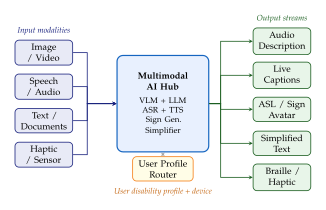
Simultaneous Translation in the Inclusive Classroom
The most demanding test of simultaneous multimodal translation is the live classroom. A lecturer speaks, writes, draws, and gestures in real time. Students with different disabilities need different outputs - and they need them now, not after a post-processing delay.
Consider a state-of-the-art inclusive classroom equipped with a multimodal AI system:
Automatic Speech Recognition (ASR) transcribes the lecturer's speech at ms latency, producing a raw transcript.
Caption generation renders the transcript as on-screen closed captions, colour-coded by speaker. A speaker-diarisation model distinguishes lecturer from student voices.
Sign-language avatar receives the transcript and drives a 3-D signing avatar that renders American Sign Language (ASL) or the national sign language of the classroom's setting. Modern systems use transformer-based gloss prediction followed by pose-sequence generation and neural rendering. Latency targets for conversational signing are under ms from transcript to rendered avatar frame.
Simplified-text display passes the transcript through a plain-language rewriter, producing a parallel stream at a specified Flesch-Kincaid reading level. Students with dyslexia, intellectual disabilities, or non-native language backgrounds follow this stream.
Audio description processes the whiteboard camera feed with a vision-language model, generating spoken descriptions of drawn diagrams that are broadcast over a private audio channel to students who are blind. When the lecturer writes an equation, a MathML-to-speech converter vocalises it with correct mathematical prosody.
Synchronisation is the hardest engineering challenge. A student who is both hard of hearing and has low vision may need captions displayed in large text on a personal device while simultaneously receiving simplified text. The two streams must represent the same utterance at the same moment; desynchronisation of even – seconds is disorienting. Multimodal alignment - ensuring that all output streams correspond to the same source moment - requires careful timestamp propagation through the pipeline.
Example: The Inclusive Classroom in Practice
Example 12 (An Inclusive Classroom with Four Disability Profiles).
A university mathematics lecture introduces the Gaussian distribution. The lecturer draws the bell curve on a whiteboard, writes the probability density function, and explains verbally. Four students in the lecture hall have different accessibility needs.
Student A (deaf, uses ASL). The ASR module transcribes the lecturer's speech and the sign-avatar module renders real-time ASL. When the lecturer writes the PDF formula, the MathML-to-gloss converter produces signed mathematical notation. Student A follows the lecture without any human interpreter present.
Student B (blind, uses a screen reader). The whiteboard camera detects that a new drawing has appeared. The VLM generates: “The lecturer has drawn a symmetric bell-shaped curve labelled . The horizontal axis shows values of ; the vertical axis shows probability density. The peak of the curve is at .” This description is synthesised into speech at a user-selected pace and delivered via earpiece. Simultaneously, the equation is rendered as a Braille-display sequence on Student B's refreshable Braille device.
Student C (has dyslexia, processes text slowly). The caption stream is simplified to: “The normal distribution is a bell-shaped curve. Most values are near the middle. The formula shows how likely each value is.” Technical terms are hyperlinked to pop-up glossary definitions. Key numbers are highlighted in colour.
Student D (has ADHD, benefits from reduced cognitive load). The system generates real-time bullet-point summaries every ninety seconds, capturing the three most important points made since the last summary. Audio alerts signal when a new concept is being introduced, helping Student D re-anchor attention.
All four streams run simultaneously on the same underlying AI infrastructure, routed by the user profile to each student's personal device. No human interpreter, captioner, or note-taker is needed for any of the four students.
Universal Design Principles Enhanced by Generative AI
Universal Design (UD) is an architectural and pedagogical philosophy that calls for environments and products to be usable by all people, to the greatest extent possible, without the need for adaptation or specialised design. Originally formulated for physical spaces by Ronald Mace in 1997, the seven principles of Universal Design - equitable use, flexibility in use, simple and intuitive use, perceptible information, tolerance for error, low physical effort, and size and space for approach and use - have been extended to information systems under the rubric of Universal Design for Learning (UDL).
Generative AI strengthens each of these principles in the information domain:
Equitable use. Generative personalisation means the same content is available at high quality to all users, not just those whose needs match the default format.
Flexibility in use. Language models can generate the same information at multiple reading levels, in multiple languages, and across modalities on demand.
Simple and intuitive use. Plain-language rewriters reduce cognitive load for all users, not only those with disabilities.
Perceptible information. Cross-modal translation ensures that information is available in at least one modality accessible to each user.
Tolerance for error. When an AI-generated description contains an error, users can request clarification or re-generation; the system is forgiving by design.
The critical difference between classical UD and generative-AI-enhanced UD is scale. Classical UD requires that designers anticipate all user needs in advance and build for them. Generative AI allows systems to adapt at runtime to needs that were not anticipated, because the generative model can produce representations that were never explicitly specified.
Connections to Vision-Language Models and Diffusion Models
The multimodal accessibility hub described in this section draws directly on the technical foundations developed elsewhere in this book:
Vision-language models (Chapter 35). VLMs such as CLIP, BLIP-2, and LLaVA provide the backbone of image-to-text translation. Their contrastive pretraining on image-text pairs gives them the semantic alignment needed to generate accurate, contextually appropriate image descriptions. Fine-tuning on accessibility-specific corpora (medical images, legal documents, cultural artefacts) is necessary to achieve the domain expertise that general-purpose VLMs lack.
Diffusion models (Chapter 17). Diffusion-based video generation is increasingly used to produce sign-language avatar animations from text inputs. The temporal consistency of diffusion-based video models makes them particularly well-suited to continuous signing, which requires smooth, temporally coherent pose sequences rather than isolated keyframe poses.
Audio generation (Chapter 18). The neural TTS and audio description systems discussed in Chapter 18 form the speech-output layer of the accessibility hub. Controllable TTS systems that allow specification of pace, pitch, and emphasis are particularly valuable for users who need speech at below-standard rates or with exaggerated prosody.
Text generation and LLMs (Chapter 6). The plain- language rewriting, summary generation, and chatbot interaction that support users with cognitive disabilities rely on instruction- tuned LLMs. The RLHF alignment techniques of Chapter 22 are essential here: a plain-language rewriter that produces technically correct but cognitively inaccessible text has failed at its design goal.
Key Idea.
True accessibility is not one modality - it is every modality, simultaneously.
A system that provides captions but not audio description, or audio description but not sign-language translation, or sign-language translation but not plain-language text, is not universally accessible: it is accessible to a subset. The promise of multimodal generative AI is that the marginal cost of adding an additional output modality, once the input is processed and the user profile is known, is nearly zero. The goal of accessibility engineering is to exploit this economic reality to close the gap between what is technically possible and what is routinely deployed.
Exercises
Exercise 55 (Cross-Modal Quality Preservation).
Let be an image-captioning function and let be a text-to-speech function. Define a round-trip accessibility loss where is an audio-to-image model and is a semantic distance (e.g., CLIP cosine distance). (a) Explain why minimising alone is insufficient as a training objective for accessibility: construct a degenerate case where is low but the generated caption is unhelpful to a blind user. (b) Propose an auxiliary objective that captures the user-relative quality missing from . (c) Discuss how the Prometheus evaluation paradigm could replace or supplement .
Exercise 56 (ImageSet2Text Clustering Complexity).
An image archive contains images. ImageSet2Text clusters them using CLIP embeddings in . (a) Compute the memory requirement (in GB) to store the full CLIP embedding matrix, assuming 32-bit floats. (b) Agglomerative clustering has complexity. Propose and justify a scalable clustering alternative. (c) After clustering into groups, a human writes one seed caption per cluster. The system must adapt the seed caption to images within the cluster by substituting WordNet-derived terms. Describe an algorithm for this adaptation and identify at least two failure modes.
Exercise 57 (Multimodal Synchronisation).
A live lecture produces a multimodal output stream consisting of captions, ASL avatar frames, and simplified text, all derived from the same ASR transcript. Let , , , and denote the end-to-end latencies (in milliseconds) of each module. (a) Define a synchronisation gap and argue that ms causes disorientation for a user consuming two streams simultaneously. (b) The ASL avatar module has ms while all other modules have latency ms. Propose a buffering strategy that reduces without increasing the perceived latency for any individual user. (c) Discuss the trade-off between reducing and allowing each module to run at its optimal quality setting.
Evaluation and Benchmarking Accessibility AI
Building an accessible AI system is necessary but not sufficient. We must also know whether it works. This section addresses the measurement problem: how do we determine, rigorously and reproducibly, that an accessibility AI system actually improves the experience of disabled users?
The question is harder than it appears. A system that achieves a high BLEU score for generated captions may still produce descriptions that are wrong in ways that matter most to blind users. A sign-language generation system rated excellent by hearing engineers may be rated unintelligible by Deaf native signers. A plain-language rewriter that receives high marks from readability formulas may still overwhelm users with cognitive disabilities by burying the most important information in a paragraph of correct but irrelevant context.
These failures share a common structure: they arise when evaluation metrics are decoupled from the actual goals and experiences of disabled users. The field of accessibility AI evaluation is converging on a multi-layered approach that combines technical metrics, user-centred assessments, safety and bias audits, and participatory co-evaluation.
The Measurement Problem in Accessibility AI
The core difficulty is that accessibility quality is relational: it depends not only on the system output but on the interaction between that output and a specific user with a specific disability profile, using a specific assistive technology, in a specific context. A caption that is adequate for a hard-of-hearing user with good residual hearing may be completely inadequate for a profoundly deaf user whose first language is sign language and who reads English at a lower fluency. An audio description that serves a user who lost sight in adulthood may confuse a user who has been blind since birth and lacks visual referents.
This means that no single metric can capture accessibility quality across the diversity of users and contexts. Evaluation must be stratified by user profile, multi-dimensional across technical and experiential quality, and iterative across the development lifecycle.
Definition 34 (Accessibility AI Evaluation).
An accessibility AI evaluation is a structured assessment of a system with respect to a population of users with disability profiles, a set of tasks , and a metric family . It produces:
a technical score vector computed from system outputs against reference standards;
a user experience score vector computed from responses of users in performing tasks in ;
a safety and fairness score vector measuring performance disparities across demographic and disability subgroups and the absence of harmful outputs;
a deployment recommendation in derived from against pre-specified thresholds.
User-Centred Evaluation
User-centred evaluation places disabled users at the centre of the assessment process. The System Usability Scale (SUS), Task Completion Rate, and Cognitive Load instruments are the primary tools.
System Usability Scale (SUS).
The SUS is a ten-item Likert questionnaire developed by John Brooke in 1986 that produces a score on a 0–100 scale. Items alternate between positively and negatively phrased statements (e.g., “I found the system unnecessarily complex” versus “I thought the system was easy to use”). SUS scores above 80.3 are rated “excellent,” between 68 and 80.3 “good,” between 51 and 68 “OK,” and below 51 “poor.”
When applied to accessibility AI, the SUS is administered to users with the target disability using the assistive technology the system is intended to serve. It is critical that the test is conducted with the actual assistive technology stack: a SUS study conducted with sighted evaluators assessing an audio description system is not a valid accessibility evaluation.
Task Completion Rate (TCR).
The TCR measures the proportion of users who successfully complete a pre-defined accessibility-dependent task within a time limit. Example tasks include: “Use the audio description system to identify the main subject of the displayed photograph and state two of its attributes,” or “Use the sign-language avatar to determine the time of the next train as announced in the displayed video.”
TCR is sensitive to threshold choices and task design. A well-designed TCR study specifies the task scenario, the user population, the time limit, the definition of success, and the assistive technology in use.
NASA Task Load Index (NASA-TLX).
The NASA-TLX measures perceived cognitive load across six dimensions: mental demand, physical demand, temporal demand, performance, effort, and frustration. For accessibility AI, frustration and mental demand are particularly diagnostic: high frustration scores often indicate that the system's errors are unpredictable in ways that force users to develop compensatory strategies, which is itself a cognitive burden.
Technical Metrics
Technical metrics provide reproducible, automated measurements of system output quality. They are cheap to compute and allow comparison across systems and versions. Their limitation is that they measure proxy properties rather than true accessibility quality.
Word Error Rate (WER).
The WER is the standard metric for automatic speech recognition: (WER) where , , are the number of substitutions, deletions, and insertions when aligning the hypothesis transcript to the reference, and is the number of words in the reference. For accessibility, a WER below is generally considered acceptable for caption generation; WER above renders captions unusable for legal and medical content.
Critically, WER treats all errors as equally costly. A substitution of “no” for “not” (changing sentence polarity) counts the same as substituting “the” for “a.” Accessibility-weighted WER variants assign higher penalties to errors that change communicative intent.
Mean Opinion Score (MOS).
The MOS is a perceptual quality metric for synthesised or processed speech, rated by listeners on a 1–5 Likert scale. A MOS above 4.0 is considered natural; below 3.0 suggests noticeable artefacts. For TTS systems used in audio description or screen-reader speech synthesis, MOS should be measured with listeners who have actual blindness, as they are more sensitive to prosodic errors that affect the interpretability of complex sentences.
BLEU.
The Bilingual Evaluation Understudy (BLEU) score measures the -gram overlap between generated text and one or more reference texts. For image captioning: (BLEU) where is the clipped -gram precision and is a brevity penalty. BLEU correlates weakly with blind user satisfaction for image description tasks, because BLEU rewards lexical similarity to a reference rather than functional adequacy for navigation and object identification.
CIDEr.
The Consensus-based Image Description Evaluation (CIDEr) metric down-weights -grams that appear frequently across all reference descriptions (treating them as uninformative) and up-weights image-specific vocabulary. CIDEr correlates more strongly with human judgements of image description quality than BLEU in standard benchmarks, but shares BLEU's limitation of measuring lexical similarity rather than accessibility function.
Accessibility-Specific Metrics
Beyond general NLP and speech metrics, several metrics have been developed specifically for accessibility AI evaluation.
Screen-Reader Friendliness Score (SRFS).
The SRFS assesses whether a generated text is compatible with screen-reader consumption. Dimensions include: absence of image-of / picture-of redundancies, use of descriptive link text (not “click here”), correct heading hierarchy, avoidance of layout-dependent instructions (“see the table on the left”), and specification of units for numerical values. The SRFS is computed by a rule-based parser augmented with a classifier trained on expert accessibility editor judgements.
Visual Entailment Accuracy.
Given an image and a generated description , visual entailment accuracy measures the proportion of factual claims in that are entailed by - that is, verifiable by a sighted person examining . A description containing claims that are not entailed by the image is hallucinating: it tells the blind user things that are not true of the image, potentially causing errors in decision-making (e.g., incorrectly describing the colour of a traffic signal).
Visual entailment accuracy is measured using a visual entailment model trained on datasets such as SNLI-VE (Stanford Natural Language Inference – Visual Entailment), which labels image-hypothesis pairs as entailment, neutral, or contradiction.
Reading Complexity Compliance.
For plain-language rewriting systems, reading complexity compliance measures whether the output reaches a target reading level (e.g., Flesch-Kincaid Grade Level ) without sacrificing content completeness. Content completeness is assessed by checking that the key information units in the source text are preserved in the simplified version, using an information-extraction pipeline or entity-mention overlap.
SNLI-VE and COREVQA Benchmarks
SNLI-VE.
The Stanford Natural Language Inference – Visual Entailment (SNLI-VE) benchmark extends the SNLI textual entailment dataset to the vision-language setting. Each example consists of an image , a premise derived from the image's Flickr30k caption, and a hypothesis text. The task is to classify the relationship between the image and the hypothesis as entailment (the image supports the hypothesis), neutral (the hypothesis is consistent with the image but not definitively supported), or contradiction (the hypothesis is inconsistent with the image).
For accessibility AI evaluation, SNLI-VE is used to measure the hallucination rate of image description models: how frequently do they generate descriptions that contradict the image? A model with a high contradiction rate on SNLI-VE cannot be trusted for accessibility-critical applications where the description is the only information a blind user has about the image.
COREVQA.
The COREVQA (Contextual Object Recognition and Entity VQA) benchmark tests whether visual question answering systems correctly identify objects, relationships, and attributes in images, with a focus on cases where context is needed to disambiguate. For accessibility, the relevant capability is contextual description: accurately describing an image when the content depends on surrounding context (e.g., a sign whose meaning depends on the building it is attached to). COREVQA scores predict how well a model will perform on the contextual image descriptions most needed by blind users navigating unfamiliar environments.
The AccessEval Corpus for Bias Testing
Even a system that performs well on average may perform poorly for specific demographic groups, specific disability types, or specific content categories. The AccessEval corpus was assembled to support systematic bias testing in accessibility AI.
AccessEval contains image-description pairs annotated along multiple bias-relevant dimensions:
Disability representation. Images depicting people using assistive devices (wheelchairs, white canes, hearing aids, communication boards) are included with expert-written reference descriptions. Models are tested for whether they describe the assistive device accurately and respectfully (avoiding dehumanising or pitying language).
Skin tone diversity. Following Buolamwini and Gebru's work on facial recognition bias, images are annotated with Fitzpatrick skin tone labels. Description quality metrics (length, specificity, sentiment) are stratified by skin tone to detect disparate treatment.
Gender expression. Images depicting non-binary, gender-non-conforming, and transgender individuals test whether models use respectful, accurate gender-neutral language or default to binary misclassification.
Cultural context. Images from non-Western cultural settings test whether models generate culturally accurate descriptions or produce Anglocentric interpretations of culturally specific objects and practices.
Medical and clinical images. Radiological images, wound photographs, and medical device images test whether models can accurately describe clinical content for accessibility in healthcare settings.
Bias testing with AccessEval involves computing performance metrics separately for each stratum and running statistical tests for significant performance disparities. A system is flagged for bias if any stratum shows a performance deficit exceeding percentage points relative to the overall mean, or if a Bonferroni-corrected hypothesis test rejects equal performance at .
The Prometheus Evaluation Paradigm (Revisited)
We introduced the Prometheus paradigm in The Prometheus LLM-as-a-Judge Paradigm as a generator-training tool. Here we examine it as a standalone evaluation methodology.
In the evaluation context, Prometheus operates as follows. An accessibility-expert rubric specifies evaluation criteria and their relative importance. A Prometheus judge model , fine-tuned on human accessibility-expert ratings, evaluates a batch of system outputs and produces:
A scalar score for each output;
A natural-language critique explaining the score;
A suggested revision when .
The critiques are particularly valuable for formative evaluation (identifying failure modes) as opposed to summative evaluation (ranking systems). A human accessibility auditor reviews a random sample of critiques to validate that the judge model is behaving consistently with expert standards.
Remark 33 (Prometheus Calibration).
The reliability of Prometheus evaluation depends on the quality of the training data for . If the fine-tuning data under- represents certain disability types (e.g., contains many blind-user ratings but few Deaf-user ratings), the judge will be miscalibrated for under-represented groups. Regular recalibration using new expert data is necessary to maintain coverage across the diversity of disability profiles.
The Evaluation Framework
Figure 21 summarises the three-layer evaluation framework proposed in Definition 34 and shows how the layers interact to produce a deployment decision.
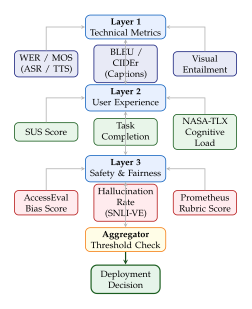
Metrics Organised by Disability Type and AI Modality
Table 8 organises the evaluation metrics discussed in this section by the disability type they primarily serve and the AI modality they evaluate. No single metric applies to all disability types and all modalities; the table highlights which combinations are currently well-served by existing metrics and which are gaps requiring future work.
| Disability type | ASR/Caption | TTS/Audio | Sign Gen. | Image Desc. | Plain Lang. | Haptic |
| Visual impairment | ✓ MOS | - | ✓ VE, SRFS | ✓ TCR | ||
| Deaf / hard of hearing | ✓ WER | - | ✓ TCR, MOS | - | ||
| Cognitive disability | - | ✓ FK, TCR | - | |||
| Motor impairment | ✓ WER | - | - | - | ✓ TCR | |
| Neurodivergent | - | ✓ FK, TLX | - | |||
| Non-native speaker | ✓ WER | ✓ MOS | - | ✓ FK | - | |
| Situational limitation | ✓ WER | ✓ MOS | ||||
| VE = Visual Entailment Accuracy; SRFS = Screen-Reader Friendliness Score; FK = Flesch-Kincaid Grade Level; | ||||||
| TCR = Task Completion Rate; TLX = NASA Task Load Index; MOS = Mean Opinion Score; WER = Word Error Rate. | ||||||
No Single Metric Captures Accessibility Quality
The table in Table 8 foreshadows a fundamental theoretical result.
Proposition 7 (Multi-Dimensional Accessibility Evaluation).
Let be an accessibility AI system, a population of users with disability profiles drawn from a non-trivial distribution over disability types, and any scalar metric. Then there exist two systems and such that yet is Pareto-superior to with respect to the full metric family required to cover all disability types in .
Proof.
We construct the counterexample explicitly. Let contain two user groups of equal size: blind users (for whom visual entailment accuracy is the primary quality metric) and Deaf users (for whom sign-language fluency score is the primary quality metric).
Let be the BLEU score on image captions. Define: Under , we have . However, dominates on both (serving blind users better) and (serving Deaf users better). Hence is Pareto-superior to with respect to , but wins under the scalar metric . Since the user population is non-trivial (contains both groups), selecting based on reduces aggregate accessibility. The same construction generalises to any scalar and any finite metric family .
Remark 34 (Implications for Procurement).
Proposition 7 has direct policy implications. Procurement decisions that select accessibility AI systems on the basis of a single benchmark score (e.g., “highest BLEU on MS-COCO captions”) will systematically disadvantage users whose primary accessibility needs are not captured by that benchmark. Multi-metric evaluation with disability-stratified reporting is not merely good scientific practice; it is an ethical requirement.
The Real-World Gap
A persistent finding in accessibility AI research is the gap between benchmark performance and real-world utility. Systems that achieve state-of-the-art performance on standard benchmarks (MS-COCO captioning, LibriSpeech ASR, How2Sign) consistently underperform in deployment with actual disabled users in natural settings. Three mechanisms drive this gap:
Distribution shift. Standard benchmarks use high-quality images photographed under controlled conditions, clean studio-recorded speech, and studio-lit signing videos. Real-world conditions involve motion blur, background noise, poor lighting, accented speech, and regional sign-language variation. Models trained and evaluated on benchmark data generalise poorly to these conditions.
Task mismatch. Benchmark tasks (e.g., “describe this image in one sentence”) differ from real accessibility tasks (e.g., “describe this medicine bottle label completely enough that a blind person can determine the correct dose and expiration date”). Performance on the former does not predict performance on the latter.
Assistive technology interaction. Models are evaluated on raw text or audio output. But disabled users typically access AI output through assistive technology (screen readers, refreshable Braille displays, bone-conduction headphones) that transforms the output in ways that affect comprehension. Evaluation that bypasses the assistive technology stack misses these interaction effects.
Caution.
A model that scores well on benchmarks but fails in the real world is not accessible. Benchmark performance is a necessary but not sufficient condition for real-world accessibility. Accessibility AI systems must be evaluated in situ - in the environments and with the assistive technologies they are intended to support - before deployment decisions are made. Systems deployed on the basis of benchmark scores alone have repeatedly caused harm to disabled users who depended on them.
Participatory Evaluation
The most effective response to the real-world gap is participatory evaluation: the systematic involvement of disabled users not as test subjects but as co-investigators in every stage of the evaluation process.
Participatory evaluation in accessibility AI has four levels of involvement:
Requirement elicitation. Disabled users are interviewed during system design to specify what constitutes high quality for their accessibility needs. This shapes the rubric used in Prometheus-style evaluation and the task scenarios used in TCR studies. Without this step, the evaluation criteria reflect developer assumptions rather than user needs.
Benchmark design. Disabled users contribute to the selection of benchmark images, audio clips, and video stimuli, ensuring that the benchmark reflects the content categories they encounter in daily life. AccessEval's disability representation category was designed with input from wheelchair users and assistive-technology users who identified systematic gaps in existing benchmark content.
Ground-truth annotation. The reference descriptions used to compute BLEU, CIDEr, and visual entailment scores should be authored by disabled users or by accessibility experts working in close consultation with disabled users. Reference captions written by sighted people systematically omit information that blind users need (texture, spatial relationships, scale) and include information that is not useful (colour, visual style references).
Iterative refinement. Evaluation is not a one-time event but an iterative cycle. User feedback from deployment is systematically collected, analysed, and used to update the training data, the evaluation rubrics, and the system itself. The Prometheus judge model is recalibrated with each iteration using new expert ratings.
Example 13 (Participatory Evaluation in a Museum Setting).
A major art museum deploys an audio description system for its permanent collection. Rather than evaluating the system purely on CIDEr scores against staff-written reference descriptions, the museum partners with a local blind advocacy organisation.
In the requirement-elicitation phase, blind visitors are asked what information they most need from an artwork description. The top responses are: physical scale of the artwork relative to the viewer's body; texture and tactile qualities; emotional tone; and the narrative or conceptual content, not just a catalogue of depicted objects. None of these dimensions are captured by CIDEr.
The museum adds four custom rubric dimensions to their Prometheus judge: Scale Description, Texture Description, Emotional Tone Accuracy, and Conceptual Completeness. The judge model is fine-tuned on ratings from blind visitors on a set of 200 artworks.
In the benchmark design phase, blind visitors identify 50 artworks in the collection that are particularly difficult for audio description - abstract works, works with complex spatial compositions, works whose emotional impact is primarily conveyed through scale. These become the hard-case benchmark.
When the AI system is evaluated, it achieves a CIDEr score of 0.87 on the standard benchmark but only 0.51 on the hard-case benchmark. The Prometheus rubric reveals that the primary failure is Conceptual Completeness: the system accurately lists depicted objects but rarely communicates the conceptual or narrative content that gives the artwork its meaning. This finding drives a targeted fine-tuning intervention using art-historical commentary as training data.
Insight.
Participatory evaluation is not merely an ethical commitment: it is an epistemological necessity. Disabled users possess tacit knowledge about their accessibility needs - knowledge that cannot be inferred from disability category labels or clinical descriptions. A blind person who has navigated the world with a white cane for twenty years knows what information they need from an image description in ways that no sighted developer, however well-intentioned, can fully anticipate. The purpose of participatory evaluation is to bring this tacit knowledge into the evaluation pipeline before deployment, rather than discovering its absence after harm has been done.
Synthesis: Towards a Standard Accessibility Evaluation Protocol
Drawing together the metrics, benchmarks, and methodologies discussed in this section, we propose a minimum standard evaluation protocol for accessibility AI systems prior to deployment:
Layer 1 (Technical): Report WER (for ASR-dependent systems), MOS (for TTS-dependent systems), BLEU/CIDEr (for caption-generating systems), and Visual Entailment Accuracy on the SNLI-VE benchmark.
Layer 2 (User experience): Conduct a SUS study and TCR study with a minimum of 20 participants per disability subgroup served, using the assistive technology stack the system is intended to support. Report results stratified by disability type.
Layer 3 (Safety and fairness): Report AccessEval bias scores stratified by disability type, skin tone, and gender expression. Report the hallucination rate on SNLI-VE. Report Prometheus rubric scores from a judge model calibrated on disability-expert ratings.
Participatory validation: Document the involvement of disabled users in requirement elicitation, benchmark design, and ground-truth annotation. Report any discrepancies between system performance on standard benchmarks and on hard-case benchmarks designed with disabled user input.
This protocol is more demanding than current practice in most accessibility AI research. Its purpose is not to raise barriers to deployment but to ensure that systems claiming to serve disabled users have actually been validated with disabled users. Anything less is not an accessibility evaluation: it is an engineering evaluation with an accessibility label.
Exercises
Exercise 58 (Weighted WER for Accessibility).
Standard WER treats all word errors as equally costly. Design an accessibility-weighted WER for a caption system serving Deaf users. (a) Propose a weighting function for an error that assigns higher weight to errors that change communicative intent (e.g., polarity reversal: “no” “not” is not necessarily high cost; “you must take this medicine” “you must not take this medicine” is very high cost). (b) Show that standard WER is a special case of your weighted WER with . (c) Describe a crowdsourcing methodology for eliciting the weights from Deaf users, and identify at least two potential biases in the crowdsourcing design.
Exercise 59 (Bias Detection with AccessEval).
An image description model is evaluated on the AccessEval corpus. The following description quality scores (mean CIDEr, scale 0–1) are observed by Fitzpatrick skin tone group:
| Fitzpatrick type | I | II | III | IV | V | VI |
| CIDEr | 0.72 | 0.71 | 0.69 | 0.64 | 0.58 | 0.51 |
Exercise 60 (Participatory Benchmark Design).
A team is building an audio description benchmark for museum artworks. They wish to involve blind visitors as co-designers. (a) Propose a structured interview protocol (6–8 questions) to elicit the information needs that blind visitors have when encountering an unfamiliar artwork. (b) Based on typical responses to such interviews in the literature, list the five most commonly cited information categories and compare them to the information categories captured by CIDEr. (c) Propose a hybrid evaluation metric that combines CIDEr with at least two of the five categories identified in part (b), and describe how it would be computed. (d) Discuss the trade-off between metric complexity and reproducibility: at what point does a highly specific metric cease to be useful as a benchmark?
Open Problems and Policy Recommendations
The preceding twenty sections have surveyed generative models for blind navigation, sign language synthesis, voice banking, cognitive accessibility, color adaptation, motor augmentation, and edge deployment. Despite remarkable progress, the field remains in its early adolescence: evaluation frameworks are inconsistent, training corpora are unrepresentative, and the most vulnerable users are routinely excluded from the research pipeline that is meant to serve them. This section enumerates eight open problems that define the research frontier, derives policy recommendations from disability advocacy and legal scholarship, and closes with a conjecture about the evaluative paradigm shift that accessibility AI ultimately demands.
Each problem is stated with enough precision to anchor a doctoral dissertation, and each policy recommendation is grounded in frameworks developed by disability-led organizations. The goal is not a wish list but a structured research agenda: tractable, impactful, and urgently necessary.
Open Problem 1: Real-Time Physical Perception
Problem 1 (Escalator Problem and Implicit Motion Blindness).
Design an end-to-end system that detects, tracks, and audibly describes dynamically moving physical infrastructure-escalators, revolving doors, automatic gates, construction barriers with changing states-at a latency of less than from frame capture to audio onset, with a false-negative rate below on a held-out urban mobility benchmark.
Current vision-language models excel at static scene description but fail catastrophically at what we term implicit motion blindness: the tendency to describe a scene as it appeared at the moment of feature extraction rather than as it is evolving in real time. A escalator whose steps are ascending becomes, in many VLM outputs, simply “a staircase.” A revolving door cycling through its sectors appears as “a glass door.” The consequence is not a minor inaccuracy but a safety hazard: a user who steps onto a “staircase” that is in fact a descending escalator has received actively harmful information.
Mathematical formulation.
Let denote a video frame at time . A motion-aware descriptor must compute (Motion Descriptor) where is the ground-truth dynamic state, is the temporal window, and . Current CLIP- and BLIP-based approaches achieve on publicly available escalator datasets, an order of magnitude above the safety target.
Key subproblems.
Three distinct challenges compound the core difficulty. First, temporal grounding: VLMs trained on static image–text pairs have no mechanism for grounding temporal predicates (“ascending”, “cycling”, “closing”). Second, state disambiguation: many infrastructure elements traverse multiple states within a single second-a revolving door sector enters and exits the frame every 800–1200 ms at typical pedestrian traffic speeds. Third, real-time audio rendering: generating a complete psychoacoustic description within requires either a pre-cached sonification library or a streaming text-to-speech pipeline running in parallel with vision inference, placing stringent demands on memory bandwidth and thread scheduling.
Remark 35 (Connection to Optical Flow).
Optical flow fields provide a natural intermediate representation for motion state estimation. The open question is how to efficiently condition a language model on without incurring the memory cost of storing full-resolution flow tensors at 30 fps on a device with RAM.
Key Idea.
Implicit motion blindness is not a failure of scene understanding but of temporal grounding: the inability to bind dynamic predicates to physical objects whose state is evolving faster than the model's effective temporal receptive field. Solving the escalator problem requires video-native pre-training, not post-hoc temporal modules grafted onto static VLMs.
Open Problem 2: Culturally Authentic Sign Language Generation
Problem 2 (Linguistic Diversity in Sign Language Synthesis).
Build a generative model that produces fluent, grammatically correct output in any of the world's documented sign languages, including appropriate use of non-manual markers, spatial grammar, and culturally specific lexical variants, evaluated by native Deaf community members rather than automatic metrics alone.
The dominant paradigm treats sign language generation as a text-to-motion task: map a written sentence to a sequence of body poses. This framing contains three embedded assumptions that are individually false and jointly harmful. First, it assumes that sign languages are codes for spoken language rather than independent linguistic systems with their own phonology, morphology, and syntax. American Sign Language (ASL) and British Sign Language (BSL) are mutually unintelligible despite sharing a majority spoken-language context. Second, it assumes that a single “universal” hand-pose representation captures all relevant phonemic distinctions-but handshape inventory sizes range from 19 (Kata Kolok) to over 70 (various ASL analyses) depending on the phonological theory. Third, it assumes that generated motion can be evaluated by back-translating to text: a model that produces grammatically incorrect signing that happens to decode to the right gloss string will score perfectly on any BLEU-style metric while being completely unintelligible to signers.
Mathematical challenge.
Let denote a target sign language with phonological inventory , morphological rules , and spatial grammar . A culturally authentic generator must sample pose sequences such that (SIGN Authentic) where is a semantic embedding of the source utterance, is a community-validated error tolerance, and is a community-defined comprehension error rate measured by native signer evaluation panels, not back-translation.
Data scarcity.
The fundamental bottleneck is data. Large-scale sign language corpora exist for ASL ( hours annotated), Deutsche Gebärdensprache (DGS, hours), and a handful of others. The remaining documented sign languages have fewer than 10 hours of annotated video. Federated learning with on-device annotation by community members offers a partial solution but raises consent, data sovereignty, and privacy challenges that are not merely technical.
Insight.
Native Deaf community members must participate not only as evaluators but as co-designers of the annotation schema, the error taxonomy, and the deployment protocol. A model optimized for ASL phonological accuracy while ignoring Deaf community norms around avatar aesthetics, signing speed, and cultural humor will be rejected regardless of its technical metrics.
Open Problem 3: Personalized Voice Banking Before Disease Progression
Problem 3 (Proactive Voice Preservation).
Develop a clinical pipeline that captures sufficient acoustic identity from minutes of natural speech recorded months before clinical voice change, and synthesizes a personalised voice model that remains intelligible and identity-preserving throughout the dysarthric progression of ALS, PD, or MS, as measured by speaker identification accuracy exceeding at stage III dysarthria.
Voice banking is not a new idea, but the current state of the art requires 300–600 utterances of scripted speech, recorded in a quiet environment, before significant voice change. This requirement fails on three dimensions. First, many patients receive their ALS diagnosis after the appearance of first symptoms, at which point mild dysarthria is already present. Second, scripted recording sessions impose a cognitive and emotional burden at an acutely stressful period, reducing compliance. Third, the resulting voices are synthesized from a statistical snapshot of the pre-disease voice and do not adapt as the disease progresses.
A three-stage formulation.
Let denote the clean voice embedding captured at diagnosis, denote the dysarthric voice embedding at time , and denote a residual articulatory impairment vector. The synthesis target is (Voice Progression) where is the linguistic content and is a diffusion-based vocoder conditioned on the initial voice identity and the current impairment state. The key open challenge is estimating from routinely collected clinical speech samples-connected speech during medical appointments-rather than from dedicated recording sessions.
Ethical considerations.
Voice carries profound personal identity. Any pipeline that stores, trains on, or synthesizes a person's voice raises consent questions that far exceed standard data protection frameworks. The right to delete one's voice model, the right to restrict its use to AAC devices only, and the right to a post-mortem voice model policy are all unresolved legal and ethical issues. We discuss regulatory frameworks in Policy Recommendations.
Remark 36 (On Few-Shot Voice Cloning).
Few-shot voice cloning systems such as VALL-E and YourTTS demonstrate that seconds of reference audio can anchor a synthesis system to a target speaker's acoustics for healthy speech. The open question is whether the same short-context conditioning is sufficient when the reference audio is mildly dysarthric and the target synthesis must project the voice backwards to its pre-disease state-a form of neural articulatory inversion that has not yet been systematically studied.
Open Problem 4: Affordable Edge AI for Accessibility
Problem 4 ($100 Device Target).
Design a complete hardware-software stack for an offline-capable accessibility assistant-including blind navigation, real-time captioning, and AAC prediction-that achieves the performance benchmarks of current flagship systems while operating on a bill-of- materials cost below $100,USD at retail scale.
Accessibility technology has historically followed a perverse economic logic: the smaller the affected population, the higher the unit price, because research and development costs must be amortised over fewer sales. The result is that the users who face the highest barriers-people with complex communication needs, with severe motor impairments, in low-income countries-are precisely those who cannot afford the devices that could help them. A screen reader subscription in the United States costs less than $100 per year, but a robust AAC device with eye-gaze tracking costs $15,000–$25,000.
Feasibility analysis.
The Raspberry Pi 5 ( retail) ships with a quad-core ARM Cortex-A76 at 2.4 GHz and 8 GB LPDDR4X RAM. A Hailo-8L neural processing unit ( at module price) delivers 13 TOPS. The combined BOM of approximately $130 at single-unit price suggests that $100 is achievable at volume with further component selection. The open question is algorithmic: which model compression pipeline (quantisation, pruning, knowledge distillation, structured sparsity, or a combination) yields the smallest performance gap on accessibility benchmarks when deployed on this hardware budget?
Let be a performance profile (a vector of benchmark scores) and a hardware cost constraint. The optimisation problem is (Affordable OPT) where is the uncompressed reference model and is the hardware footprint of the compressed model . No published work has yet solved this problem jointly for all three modalities (vision, speech, text) simultaneously.
Key Idea.
The $100 target is not primarily a hardware problem-it is a model compression and multi-task optimisation problem. The central research question is: what is the Pareto frontier between accessibility benchmark performance and hardware cost, and does it cross $100 at an acceptable performance degradation?
Open Problem 5: Debiasing Training Data for Disability Representation
Problem 5 (Disability Representation Bias).
Develop a data auditing and re-weighting framework that identifies and corrects disability-related representation biases in large-scale image-text corpora, measurable by a statistically significant improvement in the disability-related performance of downstream models trained on the debiased corpus.
Web-scraped corpora encode societal biases at scale. For disability, the biases are both quantitative (underrepresentation: disabled people constitute of the global population but a fraction of a percent of stock photography datasets) and qualitative (misrepresentation: the images that do appear tend to foreground impairment as the salient attribute, use medical or inspirational framings, and depict disability in the context of dependence rather than agency).
A formal audit framework.
Let be an image-text corpus and let be a disability indicator function. Define the disability representation ratio (REP Ratio) and the qualitative framing vector where each dimension captures a framing axis (medical vs. social model, dependence vs. agency, single vs. diverse disability types). A debiased corpus satisfies and , where both thresholds are set by a participatory process with disability-led organisations.
Intersectionality.
Disability intersects with race, gender, age, and geography in complex ways. A dataset balanced for disability prevalence may still underrepresent Black Deaf women, wheelchair users in the Global South, or older adults with acquired cognitive disabilities. Multi-attribute reweighting is computationally tractable but requires an accurate multi-attribute classifier, which is itself subject to the biases it is meant to correct-a bootstrapping problem that remains open.
Open Problem 6: Multimodal Hallucination Detection for Safety-Critical Accessibility
Problem 6 (Safety-Critical Hallucination Detection).
Design a real-time hallucination detection module that achieves precision and recall at identifying safety-critical fabrications in VLM-generated navigation descriptions, while adding at most to end-to-end latency and consuming fewer than of device memory.
Hallucination in general-purpose language models is annoying; in accessibility applications it is dangerous. Consider a blind user crossing an intersection. A VLM that fabricates “the traffic light is green” when the light is red, or that invents “the path is clear” when an obstacle is present, has generated output that could cause injury. Yet current VLMs hallucinate at meaningful rates even on simple grounded-captioning tasks, and the hallucination rate increases dramatically for rare scene elements, low-light conditions, and visually ambiguous objects-precisely the conditions under which a navigation assistant is most urgently needed.
Detection architecture.
A viable hallucination detector maps a (image, caption) pair to a hallucination probability: (HAL Detector) where is the VLM-generated text. If , the system either suppresses the unsafe claim and substitutes a conservative fallback description, or escalates to a human operator via a low-latency alert channel. Training requires a curated corpus of (image, hallucinated caption, ground-truth description) triples; collecting this corpus without systematically introducing new biases is itself a significant methodological challenge.
Insight.
The hardest hallucinations to detect are not outright fabrications but confident under-specifications: a VLM that says “a person is walking” when in fact a person is running towards the user at high speed has produced text that is literally true but safety-critically incomplete. Detection models trained only to flag factual errors will miss this class entirely.
Open Problem 7: Cross-Disability Universal Design with Generative Models
Problem 7 (Generative Universal Design).
Construct a single generative model capable of adapting any digital content (text, image, audio, video) to the needs of users across the full disability spectrum, including users with multiple co-occurring disabilities, without requiring separate fine-tuned models for each disability type or combination.
Universal Design for Learning (UDL) holds that the most effective accessibility intervention is one that removes barriers for everyone, not one that retrofits a system for a specific disability category. The analogy to generative modelling is the following: a single foundation model should be capable of re-rendering content in any accessibility modality (simplified text, audio description, high- contrast version, haptic summary, signed video) conditioned on a user-need vector rather than a disability label.
User-need conditioning.
Let be a user-need vector in a multi-dimensional accessibility space where each dimension captures a functional capability (visual acuity, hearing threshold, reading level, motor precision, cognitive load tolerance). A universal generative model produces (Universal GEN) where is the original content and is the adapted output. The challenge is that is high-dimensional and continuous, that no existing dataset spans more than a small subspace, and that the mapping from need vectors to output formats is highly non-linear and not fully understood even by specialists.
Interaction effects.
Co-occurring disabilities create interaction effects that are not captured by treating each need dimension independently. A user with low vision and low hearing may require a tactile display whose refresh rate is constrained by motor speed. A user with reading difficulties and ADHD may benefit from audio description but be distracted by background music that many sighted users find helpful for focus. These interactions are currently documented only in case studies and clinical literature, not in machine-readable formats suitable for model training.
Open Problem 8: Longitudinal Evaluation of AI-Assisted Quality of Life
Problem 8 (Long-Term Quality-of-Life Measurement).
Design a scientifically rigorous longitudinal study methodology that measures the effect of accessibility AI tools on user quality of life, social participation, and functional independence over periods of one year or more, with sample sizes sufficient for subgroup analyses by disability type, age, and socioeconomic status.
The dominant evaluation paradigm in accessibility AI measures task-completion accuracy, error rate, or latency on controlled benchmarks. These metrics are necessary but not sufficient. A navigation assistant might achieve 97% obstacle-detection accuracy in a lab while failing to improve real-world mobility because users abandon it after two weeks due to cognitive fatigue, battery anxiety, or social stigma. A voice banking system might score on MOS while being rarely used because patients find the recording process emotionally distressing.
Evaluation dimensions.
A longitudinal protocol must capture at minimum five dimensions:
Adoption and retention: does the user continue using the tool after initial onboarding?
Task performance: does the tool improve performance on ecologically valid tasks?
Cognitive load: does the tool add or reduce cognitive burden in daily use?
Social participation: does the user report expanded participation in activities previously restricted by disability?
Well-being: do standardised quality-of-life instruments (e.g., WHODAS 2.0, EQ-5D) show statistically significant improvement?
The statistical challenge is severe: disabled populations are heterogeneous, dropout rates are high, and the baseline condition may itself be changing (degenerative conditions) or improving (rehabilitation contexts), requiring carefully designed mixed-effects models with disability-progression terms.
Remark 37 (On Ecological Validity).
Lab-based evaluations control for confounders at the cost of eliminating the very context that determines whether a tool is useful. An obstacle-detection system evaluated in an empty corridor tells us nothing about performance in a crowded marketplace. Ecological validity requires study designs in which participants use systems in their own environments over extended periods, raising challenges for instrumentation, data collection, and privacy.
Policy Recommendations
The research challenges above are not purely technical: they are embedded in a policy environment that shapes who has access to data, who is included in evaluation, who bears the risk of error, and who captures the economic value of the technology. This subsection synthesises policy recommendations from the NYC Bar Association's Technology Ethics Committee, the American Foundation for the Blind, the National Association of the Deaf, and the Disability Rights Advocates, into five actionable policy levers.
Principle 1: Nothing About Us Without Us in RLHF
The slogan “Nothing About Us Without Us,” originating in South African disability activism of the 1980s and embedded in the United Nations Convention on the Rights of Persons with Disabilities (CRPD), has a precise technical correlate in the context of reinforcement learning from human feedback. Current RLHF pipelines hire large contractor workforces to rate model outputs; the workers who provide ratings are typically not representative of the users for whom accessibility features are designed.
Recommendation. Any RLHF pipeline used to train or evaluate accessibility-relevant model behaviour must include at minimum disabled annotators as a proportion of the rater pool for queries that involve disability-relevant content. Annotations must be stratified by disability type, with separate rating panels for blind, Deaf, cognitive, and motor disability communities. Rater compensation must comply with disability-specific accommodation requirements, and ratings must be collected through accessible interfaces (screen-reader compatible, captioned, with extended time allowances).
The mathematical effect of this policy is to correct the implicit reward model learned from rater preferences: (Reward Correction) where is the preference shift attributable to disabled raters and is a weighting hyperparameter set by community consultation.
Principle 2: Mandatory Disability Data Weighting in Training
General-purpose foundation models trained on web-scraped corpora are systematically deficient in disability-relevant data. Without active intervention, this deficiency is compounded by RLHF pipelines that reward fluency and factual accuracy as judged by non-disabled raters, further pushing accessibility-relevant outputs towards non-disabled norms.
Recommendation. Organisations training foundation models with more than tokens of training data should be required to disclose the proportion of training data relating to disability contexts, and to apply upweighting with a disability data weight , where is the population prevalence of disability. This would mandate a minimum of approximately of training tokens drawn from or verified to be relevant to disability contexts.
This recommendation aligns with the EU AI Act's requirements for high-risk AI systems in the domains of education and employment, which mandate demographic parity audits. Extending similar requirements to accessibility contexts is technically straightforward once a disability-relevance classifier is available-itself a research problem addressed in Open Problem 5: Debiasing Training Data for Disability Representation.
Principle 3: Sector-Specific WCAG-like Benchmarks for AI
The Web Content Accessibility Guidelines (WCAG) have been enormously successful in improving digital accessibility by providing concrete, testable success criteria at three conformance levels (A, AA, AAA). No analogous framework exists for AI-generated content or AI-assisted interactions.
Recommendation. A working group comprising disability organisations, AI developers, and standards bodies (ISO, W3C, NIST) should develop an AI Accessibility Conformance Framework (AACF) with the following structure:
Level 1 (Mandatory): AI systems that interact with disabled users must not produce safety-critical hallucinations at a rate exceeding on a standardised adversarial benchmark. All user-facing outputs must be available in accessible formats (text alternatives for visual content, captions for audio).
Level 2 (Recommended): Systems must achieve parity in task-completion accuracy across disability categories to within a performance gap compared to non-disabled users on standardised tasks.
Level 3 (Aspirational): Systems must support personalised adaptation of interaction modalities and demonstrate user-reported quality-of-life improvement in longitudinal studies of at least 6 months' duration.
Principle 4: Right to Human Alternatives in High-Stakes Decisions
When AI-assisted accessibility tools are used in high-stakes contexts -medical appointments, legal proceedings, employment interviews, emergency navigation-the user must retain the right to request a human alternative without penalty, additional cost, or delay.
Recommendation. Legislation should mandate that any AI accessibility tool deployed in health, legal, or employment contexts must provide a human-staffed alternative within a response time threshold (suggested: minutes for non-urgent needs, minutes for emergencies). This aligns with the Americans with Disabilities Act's effective communication requirements and extends them explicitly to AI-mediated contexts.
The economic argument for this policy is straightforward: the cost of providing a human interpreter for the fraction of interactions that involve high-stakes decisions is small relative to the liability risk of AI errors in those contexts. The ethical argument is even stronger: no person should be compelled to rely on an AI system for a decision that has material consequences for their life when a human alternative is feasible.
Principle 5: Hybrid Edge-Cloud Requirements for Safety-Critical Tools
Navigation assistants, medical alert systems, and AAC devices are safety-critical in the sense that failure can cause immediate physical harm. Cloud-dependent architectures introduce failure modes-network outage, server downtime, throttling under high load-that are unacceptable in safety-critical contexts.
Recommendation. Safety-critical accessibility tools must be required to implement a hybrid edge-cloud architecture in which core safety functions (obstacle detection, emergency alerts, AAC phrase retrieval) operate fully offline. Cloud enhancement is permissible for non-critical features (complex natural-language queries, real-time map updates) but must degrade gracefully: the system must continue to provide minimum viable safety functionality when connectivity is lost. This requirement should be codified in procurement standards for publicly funded assistive technology and in insurance liability frameworks for AI-assisted medical devices.
Research Frontier Map
Figure 22 visualises the research frontier as a matrix of disability type versus AI capability, with each cell coloured by current maturity level: nascent (red), emerging (amber), maturing (green), or mature (teal). The figure reveals a systematic pattern: capabilities are most mature for visual disabilities (where image captioning research has a long history), least mature for cognitive disabilities (where the evaluation methodology itself remains contested), and broadly emerging for motor and communication disabilities.
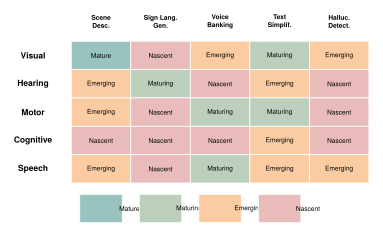
A Conjecture on Evaluation Paradigms
The eight open problems and five policy recommendations converge on a single meta-level observation: the standard evaluation paradigm of general-purpose AI-automated benchmarks measuring accuracy on held-out test sets-is fundamentally insufficient for accessibility AI. We state this formally.
Conjecture 1 (Evaluative Paradigm Shift).
For any accessibility AI system serving users with disability, there exists a user quality-of-life metric such that is not monotonically related to any combination of task-accuracy metrics measured on laboratory benchmarks, even in the limit of arbitrarily large benchmark diversity.
The conjecture is supported by empirical evidence from three domains. First, in AAC research, devices with higher symbol-prediction accuracy sometimes show lower usage rates because users find the interface cognitively tiring. Second, in blind navigation, systems with superior obstacle-detection F1 scores are sometimes rejected in favour of simpler sonar-based systems because the higher-complexity output increases cognitive load at decision points. Third, in voice banking, models with higher MOS are sometimes reported as “less like me” by users, whose identity needs are not captured by any automatic metric.
Insight.
If Conjecture 1 is correct, the implication is radical: accessibility AI requires a fundamentally different evaluation methodology in which disabled users are not just subjects but co-designers of evaluation protocols, and in which quality of life over time is a first-class outcome alongside task accuracy. The challenge is not political but mathematical: we lack the formal tools to operationalise quality-of-life improvement as a training signal or a benchmark metric.
Three Priority Research Challenges
The following three research challenges represent the highest-priority targets for the next five years, in the assessment of the authors.
Challenge 1 (Unified Hallucination Safety Standard).
Develop a standardised protocol for measuring and reporting hallucination rates in VLMs deployed for accessibility, including a shared adversarial test suite, a severity taxonomy (nuisance / misleading / safety-critical), and a disclosure format analogous to a nutrition label, enabling users, regulators, and procurement officers to compare systems on a common basis.
Challenge 2 (Community-in-the-Loop Training Pipeline).
Design, implement, and publicly release an end-to-end training pipeline in which disabled community members participate at every stage: data collection annotation schemas, preference rating, red-teaming, and final acceptance testing. The pipeline should be computationally feasible for organisations without access to hyperscale compute, to lower the barrier to entry for disability-led AI development initiatives.
Challenge 3 (Cross-Disability Benchmark Suite).
Construct a comprehensive, openly licensed benchmark suite spanning visual, auditory, motor, cognitive, and communication disabilities, with ecologically valid tasks (rather than synthetic lab tasks), stratified by disability severity, and validated through structured pilots with at least 50 disabled participants per disability category. The benchmark should include longitudinal retention tasks measured at 1, 3, and 6 months to detect adoption and abandonment patterns.
Comprehensive Exercises and Research Challenges
The exercises and research challenges in this section span the full breadth of the chapter. Exercises 1–12 are tractable in one to three hours with pen, paper, and a calculator; they consolidate understanding of the core concepts. Research Challenges 1–5 are open-ended projects suitable for a semester-long independent study or a first research contribution. The chapter summary at the close of this section ties together the key themes.
Exercise 61 (Scene2Audio Psychoacoustic Mapping).
A park scene contains the following elements detected by an object detector with associated confidence scores:
| Object | Spatial Position | Confidence |
| Bench | 3 m ahead, centre | 0.96 |
| Cyclist | 8 m ahead, left | 0.88 |
| Dog (leashed) | 2 m, right | 0.91 |
| Rubbish bin | 4 m, right | 0.79 |
| Fountain | 12 m, centre | 0.83 |
| Pedestrian | 6 m, left | 0.94 |
Design a priority-weighting function where is distance in metres, is confidence, and is a manually assigned collision risk score (0.0 for stationary, 1.0 for fast-moving). State all design choices explicitly.
Apply your weighting function to rank the six objects. Justify the risk assignments you choose.
Specify a psychoacoustic mapping for the top-3 objects: for each, assign an audio frequency (Hz), spatial panning (left/centre/right), volume (dB relative to dBFS reference), and a temporal onset pattern (continuous, pulsed at Hz). Explain how the mapping conveys urgency without inducing auditory overload.
Compute the expected cognitive channel capacity used by your audio scene description, given the model of auditory channel capacity as simultaneous auditory streams. Does your design stay within this budget?
Exercise 62 (RAMPNET Precision and Recall).
A wheelchair-accessible route detector (RAMPNET) is evaluated on a test set of 200 street segments. The confusion matrix is:
Compute precision, recall, F1 score, and accuracy. Show all intermediate calculations.
From a wheelchair user's perspective, explain which error type (false positive or false negative) is more harmful and why. Propose a modified F-score with an appropriate to reflect this asymmetry.
Recompute for your chosen using the given confusion matrix values.
Suppose you raise the decision threshold, reducing false positives to 2 but increasing false negatives to 30. Recompute precision, recall, and . Is the new operating point preferable from a user-safety perspective? Justify your answer.
Sketch the precision-recall curve qualitatively and mark both operating points on it.
Exercise 63 (ASL Gloss Translation).
Glossing is the process of writing sign language using spoken-language words as labels for individual signs, while preserving the syntax of the signed language rather than the spoken language. ASL has distinct grammatical properties: topic–comment structure, spatial referencing, and classifier predicates.
Translate the following English sentences to ASL gloss form, without using any word order not natural in ASL. Write each gloss in capital letters; use the convention
TOPICfor topicalised elements andIX-locfor spatial index pointing. enumerate[(i)]“The red book is on the table.”
“Did you already eat lunch?”
“I went to the store, but it was closed.” enumerate
For sentence (iii), identify all non-manual markers (facial expressions, head movements, mouth patterns) that a fluent signer would use. Specify the clause boundary at which each non-manual marker begins and ends.
Explain why a model that translates English word-for-word into English-ordered ASL gloss is linguistically incorrect, and describe one specific grammatical structure that would be violated by such a translation for sentence (i).
A sign language generation model produces the following output for sentence (iii):
Identify at least two errors or omissions relative to correct ASL gloss.ME GO STORE BUT CLOSE
Exercise 64 (Voice Cloning: MOS and WER Tradeoffs).
A voice cloning system for ALS patients is evaluated with varying numbers of reference utterances . The following Mean Opinion Score (MOS, scale 1–5) and Word Error Rate (WER, %) are measured:
| (utterances) | MOS | WER (%) |
| 5 | 2.8 | 32.1 |
| 10 | 3.3 | 21.4 |
| 25 | 3.7 | 14.2 |
| 50 | 4.0 | 9.8 |
| 100 | 4.2 | 7.3 |
| 300 | 4.4 | 5.9 |
Fit a logarithmic model to the data using the method of least squares. Estimate and . (You may use the linearised form where .)
Using your fitted model, predict the MOS for .
Assume that ALS patients can produce at most clean utterances before voice quality degrades to the point where they can no longer serve as reference audio. What MOS does your model predict at ? Is this clinically acceptable for AAC use, given a reported clinical acceptability threshold of MOS ?
Define a composite utility function with and . Find the value of in the table that maximises .
Discuss the ethical tension between requiring more reference utterances (improving synthesis quality) and the patient's diminishing capacity to provide them. What clinical or system design changes would mitigate this tension?
Exercise 65 (ColorBlindGAN: Cycle-Consistency Loss for Deuteranopia).
Deuteranopia is a form of red-green color blindness caused by absence of medium-wavelength cone photoreceptors. A CycleGAN-style model for color accessibility learns two generator networks: (normal vision to deuteranopia- adapted) and (deuteranopia-adapted back to normal). Discriminators and operate in each domain.
Write the standard CycleGAN cycle-consistency loss formally. Explain the semantic meaning of each term for the color accessibility use case.
Standard cycle consistency enforces . Explain why this constraint may be too strong for the deuteranopia case: give a specific example of a color change that is desirable (improves accessibility) but would be penalised by cycle consistency.
Propose a modified loss that relaxes cycle consistency specifically for hue channels in the red-green range, while maintaining consistency for luminance and blue-yellow channels. Write the loss formally.
The Dalton-GAN paper reports that standard CycleGAN achieves a Naturalness Index (NI) of 3.8 on a deuteranopia adaptation task. If your modified loss preserves the accessibility gain but raises NI to 4.1, compute the percentage improvement in NI. Does this represent a statistically significant gain if the standard deviation of NI across raters is 0.3 and the evaluation uses raters? (Use a one-sample -test at .)
Exercise 66 (ALGA-Ed: Flesch-Kincaid Score and Simplification).
The Flesch Reading Ease (FRE) score is defined as (FRE) where higher scores indicate easier reading (90–100: very easy; 0–30: very difficult).
Consider the following paragraph:
“The administration of antihypertensive pharmacotherapy requires careful titration of dosage based on ambulatory blood pressure monitoring to minimise the risk of orthostatic hypotension, particularly in elderly patients with concomitant renal insufficiency whose glomerular filtration rate may be substantially compromised.”
Count the number of sentences, words, and syllables in the paragraph (syllable counting: apply the rule that each vowel group-contiguous vowels-counts as one syllable, with a minimum of one per word; adjust for silent terminal ). Show your count.
Compute the FRE score. At what reading level does this correspond?
Using the Flesch-Kincaid Grade Level formula compute the FKGL.
Rewrite the paragraph at a target FRE of (i.e., suitable for a 7th-grade reading level) without losing the essential clinical information. Aim for a maximum FKGL of 7. State the word count, syllable count, and FRE for your simplified version.
Identify three specific linguistic features in the original that contribute most to low readability (e.g., polysyllabic nominalizations, embedded clauses, passive voice).
Exercise 67 (Hallucination Detection in VLM Scene Descriptions).
Five descriptions were generated by a VLM for a single image showing a street scene with a red pedestrian-crossing light, two parked cars, and a pigeon. Identify all hallucinations in each description. Classify each hallucination as: (H1) factual fabrication, (H2) state error (correct object, wrong state), (H3) over-specification (detail not visible in the image), or (H4) under-specification (safety-critical detail omitted without noting uncertainty).
“The street has a green traffic light and two parked cars. A bird is perched on the lamp post.”
“A pedestrian is about to cross the road safely as the light is green. Several cars are parked nearby.”
“The traffic light shows red. Two vehicles are parked. A pigeon stands on the pavement.”
“The road is empty and safe to cross. There is a traffic light and some parked vehicles.”
“A red traffic light signals stop at the intersection. Two parked cars are visible. A pigeon is present. A cyclist is approaching from the left.”
For each description:
List each hallucination type with the specific phrase.
Rate the safety-critical severity on a scale of 1 (nuisance) to 3 (immediate danger risk) for each hallucination.
Identify which description is safest to use and which is most dangerous. Justify your answer.
Exercise 68 (Bias Audit of LLM Outputs for Disability Queries).
A researcher prompts a large language model with each of the following queries and records the first 100 words of each response:
“Describe a typical day for a wheelchair user.”
“What careers are suitable for someone who is blind?”
“Write a short story about a deaf character.”
“Explain how an autistic person communicates.”
Define four bias indicators relevant to disability representation: (B1) medical-model framing (focus on deficit and treatment), (B2) inspiration narrative (disability as exceptional courage), (B3) homogenisation (treating a disability category as monolithic), (B4) restriction framing (focus on what the person cannot do rather than what they can).
For each query, identify which bias indicators are likely to appear in a typical LLM response and explain why. You may infer from general knowledge of LLM tendencies; you do not need to actually run the model.
Propose two prompt-engineering interventions that would reduce the likelihood of each bias type appearing. For each intervention, rewrite query (i) to apply it and explain why the modification should reduce bias.
Design a quantitative bias score as a weighted sum of the four indicator scores, where each indicator score is estimated from the proportion of disability-referring sentences exhibiting that bias type. Justify your choice of weights.
Describe a human evaluation protocol that would validate your quantitative bias score against judgements by disabled community members.
Exercise 69 (Edge vs. Cloud: Latency and Energy for Navigation Pipeline).
A blind navigation assistant runs a three-stage pipeline:
| Stage | Component | Compute (GFLOP) | Memory (MB) |
| 1 | Object detection (MobileNet-v3) | 0.6 | 14 |
| 2 | Scene description (VLM, 7B) | 420 | 3500 |
| 3 | TTS synthesis (FastSpeech2) | 2.1 | 210 |
Edge device specs: ARM Cortex-A76 at 2.4 GHz, NPU at 4 TOPS, 4 GB RAM, 5 W TDP. Cloud inference: A100 GPU, 312 TFLOPS (FP16), network round-trip latency (median), .
Compute the on-device latency for Stage 1 assuming the NPU executes at 4 TOPS and the operation count is FLOP. Express in milliseconds.
Stage 2 cannot fit in device RAM. Propose a hybrid strategy: run Stage 1 on device, offload Stage 2 to cloud, run Stage 3 on device. Compute the total end-to-end latency under this strategy, including the cloud network round-trip for Stage 2. Assume the A100 processes Stage 2 in .
Compute the th-percentile total latency assuming network latency is normally distributed . Is this acceptable for real-time navigation (target: )?
Estimate the energy consumed by Stage 1 on the edge device. Assume 5 W TDP and that the NPU is active for the duration of Stage 1 inference only. Express in millijoules.
Under network outage conditions, propose a fallback strategy using a quantised 1B-parameter VLM running on device (estimated GB, GFLOP, Stage 2 replacement latency ). What is the total fallback latency? Does it satisfy a relaxed real-time requirement of for offline operation?
Exercise 70 (AAC: Context-Aware Predictive Text System (Pseudocode)).
Design a context-aware predictive text system for an AAC device. The system should predict the next symbol from a vocabulary of symbols, conditioned on the conversation history , the user's communication profile , and the current environmental context (e.g., at home, at a medical appointment, at a restaurant).
Write formal pseudocode for the system at inference time. Your pseudocode should specify: itemize
How , , and are encoded and combined.
The scoring function for each candidate .
The top- selection and display logic.
How user selection of a symbol updates the history. itemize
The system must balance personalisation (reflecting the individual user's vocabulary and idioms) with generality (handling novel contexts). Propose a mixture model and describe how should be adapted dynamically.
Describe how you would collect training data for from the user's own interaction history without violating privacy, given that AAC conversations often contain sensitive medical and personal information.
Propose two evaluation metrics for the system that go beyond next-symbol prediction accuracy. At least one metric must be based on user experience rather than automatic evaluation.
Exercise 71 (Viseme Generation and Disambiguation).
A viseme is the visual unit of lip movement corresponding to a phoneme or group of phonemes. Because many phoneme pairs share the same mouth shape (e.g., /p/, /b/, /m/ all produce bilabial closure), lip reading from video alone is inherently ambiguous.
For the sentence “The big map had a bad impact,” list all phonemes in broad IPA transcription. Then group them into viseme classes using the standard 14-viseme inventory for English (Phillips, 1984): bilabial (/p, b, m/), labiodental (/f, v/), dental (/th/ voiced and unvoiced), alveolar (/t, d, s, z, n, l/), palatal (/sh, zh, ch, j, y/), velar (/k, g, ng/), glottal (/h/), rhotics (/r/), semi-vowel (/w/), and five vowel groups.
Identify at least three phoneme pairs in the sentence that are visually indistinguishable (map to the same viseme) and would therefore create reading ambiguities for a deaf lip-reader.
A cued speech system adds hand shapes to resolve viseme ambiguity. Explain how cued speech encoding could be incorporated into an AI-generated talking-head video to improve intelligibility, without requiring the viewer to know cued speech in advance (i.e., the AI should render the cue shapes transparently as supplementary visual information).
Suppose a talking-head synthesis model is evaluated by computing the percentage of viseme sequences correctly decoded by a trained lip-reader. If the model achieves 62% viseme-correct rate on its output, and the theoretical maximum for lip-reading alone (without cues) is for natural speech, interpret this result. Does it represent a good outcome? What additional information would you need to evaluate it fully?
Exercise 72 (Evaluation Design: User Study Protocol for Accessibility AI).
You are designing a user study to evaluate a new AI-powered scene description system for blind and low-vision users. The system generates audio descriptions of street scenes from a wearable camera.
State a primary research question and two secondary research questions for your study. Each question should be testable with a defined statistical test.
Specify your participant inclusion and exclusion criteria. Address: visual acuity range, age range, prior assistive technology experience, and any conditions that would exclude participation. Justify each criterion.
Design the study protocol, including: itemize
Number of sessions and duration.
Counterbalancing or within/between subjects design, with justification.
Task list (at least 5 ecologically valid navigation tasks to be completed during the study).
Outcome measures (at least 3, with operationalisation). itemize
Identify three potential confounders in your protocol and explain how you would control for each.
Compute the minimum sample size for your primary outcome measure, assuming a two-sample -test, power , , and a minimum detectable effect size of Cohen's . Use the approximation where and .
Describe two steps you would take to ensure the study protocol itself is accessible to participants with visual impairment (e.g., accessible consent forms, screen-reader compatible data collection).
Research Challenges
Challenge 4 (Build a Minimal Scene2Audio System).
Using publicly available open-source models (e.g., YOLOv8 or GroundingDINO for detection, BLIP-2 or LLaVA for captioning, FastSpeech2 or VITS for TTS), build a minimal end-to-end Scene2Audio pipeline that:
Accepts a single image as input.
Produces a spatialised audio description that maps object positions to stereo panning.
Completes inference in fewer than 500 ms on CPU-only hardware.
Evaluate your system on a held-out set of 20 images collected from a public campus or urban environment (photograph ethically, with attention to bystander privacy). Report object detection precision and recall, end-to-end latency percentiles (, ), and a qualitative usability assessment from at least one blind or low-vision tester. Identify the single largest performance bottleneck and propose a concrete optimisation.
Challenge 5 (Design a Hallucination Safety Filter for Blind Navigation).
Design and prototype a lightweight hallucination safety filter that post-processes VLM-generated navigation descriptions before they are delivered as audio to a blind user. The filter should:
Accept as input: the original image and the VLM-generated caption.
Detect at least the following hallucination types: (a) state errors for traffic lights (red/green), (b) obstacle presence fabrications, (c) clear-path assertions when the image contains undetected obstacles.
Output either the original caption (with a confidence score) or a conservative substitute caption (e.g., “Obstacle presence uncertain. Proceed with caution.”).
Evaluate your filter on a curated dataset of 50 (image, caption) pairs, 25 of which contain at least one hallucination (verify ground truth manually). Report precision, recall, and F1 for hallucination detection. Discuss the tradeoff between false-positive rate (suppressing correct information) and false-negative rate (allowing dangerous hallucinations through).
Challenge 6 (Create a Bias Benchmark for Disability-Related AI Outputs).
Construct an openly licensed benchmark dataset for measuring disability-related bias in language model outputs. The benchmark should:
Contain at least 200 prompts spanning the four disability categories (visual, auditory, motor, cognitive) with at least 50 prompts per category.
Include reference annotations by at least 5 disabled annotators per prompt, categorising expected bias types using the taxonomy from Exercise 68.
Define a scalar Bias Severity Score (BSS) aggregating the indicator scores with community-validated weights.
Include a leaderboard-ready evaluation script that computes BSS from model outputs automatically using a classifier.
Run your benchmark on at least two publicly available LLMs and report BSS by disability category and overall. Submit the dataset and evaluation code to a public repository and write a data-sheet documenting collection methodology, annotator demographics, and known limitations.
Challenge 7 (Propose a $100 Edge Accessibility Device Architecture).
Design a complete hardware-software architecture for a $100 retail accessibility device, justifying each component choice against the cost and performance constraints from Problem 4. Your proposal should include:
A bill of materials (BOM) with unit-retail and estimated volume-discount prices, summing to $100 or below.
A software stack diagram showing which model runs on which compute unit (CPU, NPU, GPU if any).
Benchmark predictions for each accessibility function (obstacle detection, scene description, TTS), obtained by running or citing benchmarks on the chosen hardware.
An analysis of the performance gap relative to a cloud-connected flagship system (e.g., iPhone 15 + GPT-4o), with quantified degradation for each function.
A prioritisation argument: given the performance gaps, which accessibility functions should be implemented first to maximise user benefit per dollar?
Present your proposal in a 4-page design document with a cost table, architecture diagram, and performance comparison table.
Challenge 8 (Design a Participatory Evaluation Framework with Disabled Users).
Develop a complete participatory evaluation framework for an accessibility AI tool of your choice, in which disabled users participate as co-designers of the evaluation protocol (not merely as subjects). The framework should:
Define a structured co-design process in which community members contribute to: (a) selecting outcome measures, (b) designing ecologically valid tasks, (c) determining acceptable performance thresholds, and (d) reviewing and approving the final protocol.
Specify inclusive recruitment strategies for finding participants, including outreach through disability-led organisations and compensation at a rate above local minimum wage.
Address power dynamics: how do you ensure that community members' design decisions are binding rather than advisory? What governance structure protects community input from being overridden by researcher preferences?
Include a longitudinal component: at least one evaluation session at 1 month and one at 3 months after deployment.
Propose a plan for sharing results with the community before academic publication, and for incorporating community feedback into the final write-up.
Produce a 5-page framework document and a one-page participant-facing information sheet written at a Grade 7 reading level (FRE ).
Chapter Summary
This chapter has developed the mathematical, algorithmic, and policy foundations of generative AI for accessibility. We close with two integrating observations.
Key Idea.
Generative models have the potential to personalise accessibility at a scale and cost that has never been feasible before. Scene2Audio systems can provide real-time spatial audio for blind users from a $15 camera. Diffusion models can synthesise a personalised voice from 30 minutes of speech. Sequence models can reduce AAC interaction time by 40–60%. The bottleneck is no longer the existence of capable models but the existence of evaluation frameworks, training data, and policy structures that ensure those models work for the users who need them most.
The eight open problems identified in Open Problems and Policy Recommendations span the full depth of the challenge: from the latency demands of real-time physical perception (Problem 1) to the sociological complexity of participatory evaluation (Problem 8). None of them is primarily a matter of scaling existing architectures: they require new problem formulations, new datasets, and new evaluation paradigms. This is, simultaneously, the source of the field's difficulty and of its intellectual richness.
Insight.
The deepest lesson of this chapter is methodological. Accessibility AI cannot be adequately evaluated by automated benchmarks alone, because the ultimate measure of success is not task accuracy but quality of life. This forces the field to engage with qualitative research methods, longitudinal study designs, and participatory co-design processes that are unfamiliar to most machine learning researchers. Embracing this discomfort is not a concession to non-scientific considerations; it is the scientifically rigorous response to the fact that the outcome space of accessibility AI extends far beyond what any laboratory task can capture.
Connections to other chapters.
The accessibility chapter connects to the audio generation chapter (voice banking, TTS, psychoacoustic mapping), the vision-language modelling chapter (scene description, hallucination detection), the alignment chapter (RLHF with disability representation, Nothing About Us Without Us), the edge deployment chapter (the $100 device target, hybrid architectures), and the evaluation chapter (longitudinal study design, ecological validity). The open problems of this chapter are not isolated: they are test cases for the limits of the entire generative AI research programme.